

(Shiloh Musings) Yes, the Arabs attacked Israel again. The Gazan Arabs launched rockets, missiles, weapons, qassams at Israel. They landed in Ashkelon. The day before the Arabs had also attacked Israel; the missiles landed in the Eshkol Region.
Ashkelon and the Eshkol Region are easy targets for the Arab terrorists in Gaza. It's one of the reasons that Israel must prevent more weapons and terrorists from reaching Gaza.
The Israel Government, like all governments in the world, has an obligation to do anything and everything to protect its citizens.
I have no doubt that the Arab terrorists who are attacking Israel are connected to Bin Laden's terrorist organization. MEMRI.
Those Arab terrorists who want to destroy Israel endanger the entire world!
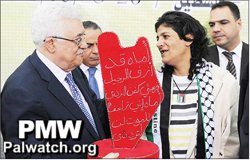
In this picture, Abbas is seen with released prisoner Amal Jum'a. Jum'a was arrested with explosives in May 2004, the day before her planned suicide bombing in a Tel Aviv market. Abbas is holding a representation of the PA map of "Palestine" that includes Israel and the PA areas. A poem glorifying Martyrdom death is written on the map:"Mother, death has come. Prepare the death shroud. Mother, to my death I march. I do not hesitate."
Since the release of Palestinian prisoners in exchange for the Israeli hostage Gilad Shalit, Palestinian Authority Chairman Mahmoud Abbas has repeatedly honored and glorified the released prisoners.
On the day of their release, Abbas greeted each one at a general ceremony in Ramallah and has since then publicly praised and honored them. (more on Palestine Media Watch PMW)


 the IDF has no plans to fund multiple Iron Dome batteries. Ha’aretz
estimates that each intercept missile could cost approximately $40,000
and each Iron Dome battery $500,000, while
the IDF has no plans to fund multiple Iron Dome batteries. Ha’aretz
estimates that each intercept missile could cost approximately $40,000
and each Iron Dome battery $500,000, while 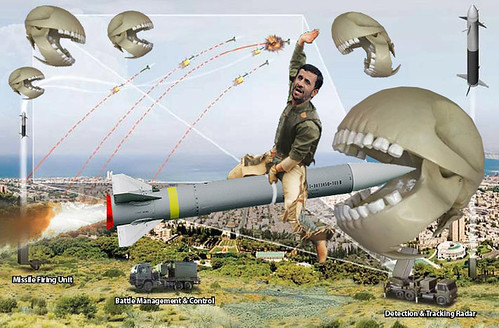






Palestinian Hamas border policemen inspect a destroyed Hamas compound after an Israeli strike in Gaza City Photo: AFP/GETTY
Palestinian militants in Gaza fired more than 50 rockets into Israel on
Saturday, the heaviest barrage in two years, Israeli officials said.
Saturday, the heaviest barrage in two years, Israeli officials said.
A Hamas official was killed and four civilians were wounded when Israel hit
back with tank fire and air strikes, said Gaza Health Ministry spokesman
Adham Abu Salmia.
back with tank fire and air strikes, said Gaza Health Ministry spokesman
Adham Abu Salmia.
Israeli Foreign Minister Avigdor Lieberman said he will file a complaint at
the U.N. after Saturday's unusually large barrage of rockets. In a
statement, Lieberman said the Palestinians "primary goal is destroying
Israel."
the U.N. after Saturday's unusually large barrage of rockets. In a
statement, Lieberman said the Palestinians "primary goal is destroying
Israel."
The violence comes amid increasing calls for reconciliation between
Western-backed Palestinian President Mahmoud Abbas and his bitter rivals,
the Islamic militant group Hamas. Abbas is seeking U.N. recognition for a
Palestinian state by the fall and is currently lobbying for votes worldwide.
Hamas used force to disperse a reconciliation rally in Gaza. Some reporters
were later beaten up, threatened and briefly detained.
Western-backed Palestinian President Mahmoud Abbas and his bitter rivals,
the Islamic militant group Hamas. Abbas is seeking U.N. recognition for a
Palestinian state by the fall and is currently lobbying for votes worldwide.
Hamas used force to disperse a reconciliation rally in Gaza. Some reporters
were later beaten up, threatened and briefly detained.
Israeli police spokesman Tamir Avtabi said Gaza militants fired 54 mortar
shells at Israeli border communities within 15 minutes. He said two Israeli
civilians were lightly wounded by shrapnel and residents were advised to
stay at home or in bomb shelters.
shells at Israeli border communities within 15 minutes. He said two Israeli
civilians were lightly wounded by shrapnel and residents were advised to
stay at home or in bomb shelters.
Hayim Yellin, head of the Eshkol region where the mortars exploded, said they
were of the same type as those intercepted on a cargo ship last week loaded
with weapons Israel said were sent by Iran to Palestinian militants in the
Gaza Strip.
Hamas acknowledged it launched some of the mortars — an unusual move as the
Islamic militant group does not usually take responsibility for such
attacks. Hamas fears triggering another Israeli invasion similar to a
three-week operation aimed at stopping daily Palestinian shelling two years
ago that killed about 1,400 Palestinians.
Israeli police said the mortar barrage Saturday was the heaviest since that
round of fighting.
Israel holds Hamas responsible for all violence originating in Gaza, though
Hamas usually blames smaller groups for rocket fire.
Hamas spokesman Ismail Radwan said the shelling was in reaction to recent
Israeli airstrikes that killed militants. He warned Israel "not to test
Hamas' response."
Hamas ousted Fatah from Gaza in bloody street battles in 2007. Since then,
Hamas controls Gaza and the Western backed secular Fatah rules the West Bank.
Repeated efforts to reconcile the two rival governments have failed.
Palestinians have held rallies in Gaza and the West Bank in recent days
calling for the two sides to resolve their differences.
The internal Palestinian rift makes their vision of statehood harder to
achieve and hinders their ability to reach a peace agreement with Israel.
Peace talks between Israel and the Palestinians collapsed last year over
disputes about Israeli construction in the West bank, areas Palestinians
want as parts of their future state.
were of the same type as those intercepted on a cargo ship last week loaded
with weapons Israel said were sent by Iran to Palestinian militants in the
Gaza Strip.
Hamas acknowledged it launched some of the mortars — an unusual move as the
Islamic militant group does not usually take responsibility for such
attacks. Hamas fears triggering another Israeli invasion similar to a
three-week operation aimed at stopping daily Palestinian shelling two years
ago that killed about 1,400 Palestinians.
Israeli police said the mortar barrage Saturday was the heaviest since that
round of fighting.
Israel holds Hamas responsible for all violence originating in Gaza, though
Hamas usually blames smaller groups for rocket fire.
Hamas spokesman Ismail Radwan said the shelling was in reaction to recent
Israeli airstrikes that killed militants. He warned Israel "not to test
Hamas' response."
Hamas ousted Fatah from Gaza in bloody street battles in 2007. Since then,
Hamas controls Gaza and the Western backed secular Fatah rules the West Bank.
Repeated efforts to reconcile the two rival governments have failed.
Palestinians have held rallies in Gaza and the West Bank in recent days
calling for the two sides to resolve their differences.
The internal Palestinian rift makes their vision of statehood harder to
achieve and hinders their ability to reach a peace agreement with Israel.
Peace talks between Israel and the Palestinians collapsed last year over
disputes about Israeli construction in the West bank, areas Palestinians
want as parts of their future state.


