| Iran announced last month it would shift its production of higher-grade uranium to an underground bunker and triple output capacity in a defiant move that further fueled Western unease about Tehran's intentions. |
|
Showing posts with label UN Nuclear Non-Poliferation Treaty. Show all posts
Showing posts with label UN Nuclear Non-Poliferation Treaty. Show all posts
IAEA worried over Iran plans to triple uranium production. UN nuclear chief Amano to meet Iranian FM Salehi, says "further cooperation is needed to restore confidence of int'l community."

 Labels:
Ali Akbar Salehi»
IAEA»
Nuclear»
Nuclear Proliferation»
UN Nuclear Non-Poliferation Treaty»
Yukiya Amano
Labels:
Ali Akbar Salehi»
IAEA»
Nuclear»
Nuclear Proliferation»
UN Nuclear Non-Poliferation Treaty»
Yukiya Amano

North Korea named head of UN nuclear disarmament body
Labels:
North Korea»
Nuclear»
Nuclear Proliferation»
Obama's nuclear disarmament conference»
U.S. Nuclear Regulatory Commission»
UN Nuclear Non-Poliferation Treaty»
United Nations
...it makes perfect sense within the scheme of the U.N.. Why is anyone surprised?North Korea has been named to head the U.N.'s nuclear disarmament body?

........ ...... ..... ........ ...... ..... ........ ...... ..... ........ ...... ..... via israelmatzav.blogspot.com
Iran close to finalizing uranium deal with Zimbabwe
Labels:
Bomb Iran»
Iran»
Nuclear»
Nuclear Proliferation»
Robert Mugabe»
Tehran»
UN Nuclear Non-Poliferation Treaty»
Zimbabwe
 you can't buy lunch with a Zimbabwe dollar, the people are starving because they chased the white farmers out of the country... but the government can still sell things that go boom! If you want to see a warning of what happens with the left in power then just look to Mugabe. The people have no work and they can't afford to buy their children food, but they still have hate... hate of the Jews... hate of the first world that they will use to project the troubles that their own government made with it's leftist plans. And Iran is the vehicle of their hate. When your people are starving... why try Capitalism that creates jobs for the future when you can bomb Israel.
Iran has had a shortage of a critical component for its nuclear weapons for a long time: Uranium. Now, Iran is on the verge of signing a natural resources agreement with Robert Mugabe's Zimbabwe that would give it preferential access to Zimbabwe's 455,000 tons of uranium over the next five years. Given that Iran currently has access to mostly depleted uranium from South Africa from the 1970's, that's a huge deal.
Ilan Berman argues that it's also a deal that has been largely ignored by western sanctions. It's time to change that.
Over the past three years, Western chancelleries have marshaled considerable diplomatic efforts to dissuade potential uranium suppliers such as Kazakhstan, Uzbekistan and Brazil from providing Tehran the raw material needed for its nuclear program. For all of their concern, however, Washington policy makers have not yet given serious thought to penalizing countries for their uranium sales to Iran, or crafted a legislative framework that makes it possible to do so.Hmmm.
They should. By identifying and then punishing Tehran's current suppliers of uranium ore, the U.S. and its allies can slow its acquisition of the raw material necessary to realize its nuclear ambitions-and send a clear signal to potential future sources of uranium for Iran's atomic effort, like Zimbabwe, that their involvement with the Islamic Republic's nuclear program will come at a steep economic and political cost.
In its ongoing bid to derail Iran's nuclear drive, Capitol Hill is now said to be contemplating new sanctions aimed at further tightening the international noose around Tehran. Iran's flirtation with Zimbabwe strongly suggests that lawmakers would do well to focus less on trying to stop Iran's centrifuges from spinning and more on making sure that Iran's nuclear machinery is running on empty.
Crack leaks radioactive water into sea off Japan
Labels:
EPA»
Japan»
Nuclear»
UN Nuclear Non-Poliferation Treaty
 | ||
that's_offensive!.
|

 |
| "Hell In A Bottle" 1986 Japan via doppelganger |
The contaminated water will quickly dissipate into the sea and is not expected to cause any health hazard. Nevertheless, the disturbing discovery points at the unexpected problems that can crop up and continue to hamper technicians trying to control the crisis.Increases in radiation from sources that are likely from troubled nuclear energy reactors in Japan.

 |
| All this talk about Asia makes me hungry |
I guess this is their response to the bombing of Hiroshima and Nagasaki
Quality District offices on
March 16, 2011 in San Francisco.
In the wake of the nuclear
disaster in Japan,
the Environmental Protection
Agency is deploying additional radiation
detectors in areas on the
West Coast to compliment
the existing RadNet system,
which measures radition levels in air.
RadNet is a nationwide network
of monitoring stations in each state
that collect samples of air, rain,
drinking water, and milk
for analysis of radioactivity.
via sacbee.com

Exposure from x-rays or gamma rays is measured in units of roentgens. For example:
* Total body exposure of 100 roentgens (or 1 Gy) causes radiation sickness.
* Total body exposure of 400 roentgens (or 4 Gy) causes radiation sickness and death in half the individuals. Without medical treatment, nearly everyone who receives more than this amount of radiation will die within 30 days.
* 100,000 rads causes almost immediate unconsciousness and death within an hour
Enjoy the weather! via jammiewearingfool.blogspot.com
 |
| looting in Japan |
A monitor in Sacramento maintained by the U.S. Environmental Protection Agency today showed slight increases in radiation from sources that are likely from troubled nuclear energy reactors in Japan.
The "beta" category picks up strontium, while the "gamma" category picks up cesium and iodine. All three are constituents typically associated with nuclear energy production.
The recent increases remain within normal background levels, the EPA said, which vary according to atmospheric conditions.
The numbers are recorded in "counts per minute," which is a way of measuring radiation levels over time and cannot be easily compared to dose levels, such as those experienced by medical patients undergoing X-ray examination.
Another monitor in Sacramento, maintained by the U.S. Department of Energy as part of the Comprehensive Nuclear Test Ban Treaty Organization, also picked up elevated radiation levels. This monitor, which is far more sensitive, detected "miniscule quantities" of the radioactive isotope xenon-133, the agency stated.
The origin was determined to be consistent with a release from the Fukushima reactors in northern Japan. The levels detected were at 0.1 disintegrations per second per cubic meter of air, which results in a dose rate about one-millionth of the dose rate a person normally receives from rocks, bricks, the sun and other natural background sources. This coincides with a similar reading March 16 through 17 in Washington state.
Xenon-133 is a radioactive noble gas produced during nuclear fission that poses no concern at the detected level, according to the Department of Energy. via sacbee.com
THE NEW YORK TIMES: Japanese Scramble to Avert Meltdowns as Nuclear Crisis Deepens After Quake: TOKYO — Japanese officials struggled on Sunday to contain a widening nuclear crisis in the aftermath of a devastating earthquake and tsunami, saying they presumed that partial meltdowns had occurred at two crippled reactors and that they were bracing for a second explosion, even as they faced serious cooling problems at four more reactors. >>> Hiroko Tabuchi and Matthew L. Wald | Sunday, March 13, 2011
via librabunda.blogspot.com image via fuckyeahbubblebutts.tumblr.com and image via blogs.indiewire.com Justin Sullivan / Getty Images
image via scoutingreality.com
Argentina & Saudi Arabia Seek Nuclear Partnership
Labels:
Argentina»
Kirchner»
Nuclear»
nuclear meltdown»
Nuclear Proliferation»
Saudis»
UN Nuclear Non-Poliferation Treaty

not sure this is a good thing. Argentina is very close to going to war over the Falklands againThe Saudi government has tasked the head of the King Abdullah City for Atomic and Renewable Energy with drawing up a cooperation agreement with Argentina regarding the use of nuclear energy for peaceful purposes.
Source: 'Okaz, Saudi Arabia, March 29, 2011
No joke. Obama admin just "reminded" Iran it's not allowed to smuggle weapons
Labels:
Barack Obama»
Bomb Iran»
Gaza»
Hamas»
Iran»
Iran's Sanctions»
Iranian»
Nuclear»
Nuclear Proliferation»
Palestinians»
U.S. Nuclear Regulatory Commission»
UN Nuclear Non-Poliferation Treaty

 Allegedly Carrying Nuclear Weapons, Iranian Plane Forced to Land in Turkey: Excerpts from the Turkish Press

TURKEY INTERVENES IN IRAN'S AND SAUDI ARABIA'S FIGHT OVER BAHRAIN
State Department spokesman Mark Toner said in a statement late Wednesday that the U.S. condemns illicit smuggling of arms and ammunition. He said U.N. resolutions prohibit Iran, in particular, from exporting weapons and that "any activity to the contrary is another example of Iran's destabilizing activities in the region."
Israel said the ship intercepted Tuesday in international waters in the Mediterranean Sea had roughly 2,500 mortar shells, nearly 75,000 bullets and six anti-ship missiles. It said the weapons were sent by Iran by way of Syria, and that the advanced anti-ship missiles could have challenged Israeli enforcement of a naval blockade of the Hamas-controlled Gaza Strip. via foxnews.com
h/t @Mere_Rhetoric
Allegedly Carrying Nuclear Weapons, Iranian Plane Forced to Land in Turkey: Excerpts from the Turkish Press
Labels:
Bahrain»
Bomb Iran»
Davutoğlu»
Erdogan»
Iran»
Mahmoud Ahmadinejad»
Nuclear»
Nuclear Proliferation»
Saudi Arabia»
Saudi King Abdullah»
Saudis»
Turkey»
UN Nuclear Non-Poliferation Treaty
Fearing further trouble in the volatile region, Turkey has warned Saudi Arabia and Iran, at odds over the Saudi intervention in Bahrain, to act with restraint and avoid actions that would undermine peace and stability.
Turkish Foreign Minister Ahmet Davutoğlu warned his Saudi and Iranian counterparts against creating problems in the Middle East, calling on both sides to act with restraint following their spat over Bahrain, the Hürriyet Daily News & Economic Review has learned.
In phone conversations with the two countries' foreign ministers, Davutoğlu said peace and stability are a dire need for the turbulent region and should not be undermined.
Davutoğlu spoke twice on the phone with his Iranian counterpart, Ali Akbar Salehi, first in Ankara before departing for Russia and then in Moscow late Tuesday, diplomatic sources told the Daily News. The Turkish foreign minister also held a telephone conversation with the foreign minister of Saudi Arabia, who expressed willingness to visit Turkey soon.
Prime Minister Recep Tayyip Erdoğan may also hold bilateral talks with Saudi Arabian officials on the sidelines of the Jeddah Economic Forum from Saturday to Tuesday.
Iran has criticized Saudi Arabia's decision to send more than 1,000 troops to Bahrain at the request of the country's Sunni rulers. The United Arab Emirates has sent 500 policemen to Bahrain and Qatar has said it would also send police.
"The presence of foreign troops and meddling in Bahrain's internal affairs will only further complicate the issue," Iranian Foreign Ministry spokesman Ramin Mehmanparast was quoted as saying by Iranian news agencies. Iran, which sits across the Gulf from Bahrain, has summoned the Saudi Arabian ambassador to discuss the situation.
A Bahraini foreign ministry official called Iran's remarks "blatant interference in Bahrain's internal affairs," the state news agency BNA said, adding that Bahrain had recalled its ambassador to Iran for consultations.
Bahrain has been gripped by its worst unrest since the 1990s after protesters took to the streets last month, inspired by uprisings that toppled the leaders of Egypt and Tunisia.
The latest crisis between the country's Shiite majority and its dominant Sunni minority has also, with the arrival of Saudi troops, revealed the regional hostilities between Sunni Arab countries and non-Arab Shiite Iran.
More than 60 percent of Bahrainis are Shiites, many of whom complain of discrimination by the ruling Sunni royal family.
Diplomatic sources said Davutoğlu also spoke on the phone with his counterparts from Bahrain and the United Arab Emirates to discuss the developments in the Middle East and North Africa, including Libya.
http://www.hurriyetdailynews.com/n.php?n=turkey-mediates-to-soothe-tension-between-iran-saudi-arabia-2011-03-16
EU RAPPORTEUR FIRES BACK AT TURKEY'S PM
The European Parliament's rapporteur for Turkey, Ria-Oomen Ruijten, sent a letter to Prime Minister Erdogan, who had said Ruijten's report was unbalanced.
Ruijten said: "The report indicates three clauses well appreciated, 19 developments received gladly, 5 clauses received sadly and 3 developments received deeply sad. This is not a math calculation, but it shows that our goal is not to criticize but to advise and remember certain issues."
http://www.hurriyet.com.tr/dunya/17291928.asp?gid=373
PRIME MINISTER SAYS TURKEY WILL CONTINUE WITH NUCLEAR PLANS
Turkey will press on with its plans to build its first nuclear power plant, despite being situated in an earthquake fault line and despite Japan's nuclear accident, the country's prime minister said.
"We are now counting the months, even weeks, before we start our project with Russia for the nuclear plant at Akkuyu," on Turkey's Mediterranean coast, Prime Minister Recep Tayyip Erdogan said late Tuesday during a visit to Moscow
Erdogan told a forum of Russian and Turkish business leaders that "everything is ready" for construction to begin on the plant. "We are going to commit to a nuclear program an investment of $20 billion," the Anatolia news agency quoted him as saying.
Before leaving Ankara for the visit, the prime minister said the government would not go back on its decision to build three nuclear plants within the next five years, despite the crisis in Japan.
"There is no investment without risk," Erdogan said.
Ankara and Moscow signed a deal in May last year to build the first nuclear reactor, sparking protests from environmentalists who warned of the dangers of locating it in a region known for seismic activity.
Energy Minister Taner Yildiz said Turkey had demanded that extra security measures be taken in building the plant, given its location.
Turkey suffered a massive earthquake in 1998 that killed 140 people in Adana, its fifth largest city, close to Mersin, the province where the nuclear power plant is to be built.
http://www.afp.com/afpcom/fr/taglibrary/thematic/politic
TURKISH PREMIER ATTENDS TURKEY-RUSSIA BUSINESS FORUM
Turkish Prime Minister Recep Tayyip Erdogan said that economic, political, military and cultural relations had been further improving between Turkey and Russia.
Prime Minister Erdogan attended the Turkey-Russia Business Forum as part of his official visit to Moscow. He recalled that they decided to establish a high-level cooperation council during Russian President Dmitriy Medvedev's visit to Turkey in May 2010, adding, "today, we are in Moscow to attend the second meeting of the council. Economic, political, military and cultural relations have been further improving between our countries. The council has added a new dimension to our multi-dimensional relations with Russia."
"Turkey-Russia Joint Economic Committee held its 11th meeting in Kazan on March 2 and 4, 2011. During the meeting, many important decisions were made about energy, agriculture, trade and transportation. We agreed to develop our cooperation in automotive industry, chemistry, shipbuilding, the health industry and the aviation industry. Another decision made at the meeting was to establish a working group to develop cooperation in banking and finance," he said.
Referring to economic and commercial relations, Prime Minister Erdogan said: "Our trade volume exceeded $26 billion in 2010. We want to increase our trade volume to $100 billion in the next five years. Turkish construction firms have already undertaken nearly 1,200 projects in Russia worth of $32 billion."
"Despite the global financial crisis, Turkey hosted three million Russian tourists in 2008, 2.7 million in 2009 and 3.1 million in 2010. I believe the number of Russian tourists visiting Turkey will increase in 2011. We invite Russian people to benefit from Turkey's tourism opportunities," he said.
"Energy is the most important dimension of our economic and commercial relations. In the next twenty years, energy investments worth of $100 billion will be made in Turkey. I think that such an environment will create new cooperation opportunities between our countries. As you know, we are about to begin construction of a nuclear power plant in cooperation with Russia. It will cost about $20 billion. We also attach great importance to establish a large Turkish logistic center in southern Russia," he added.
http://www.aa.com.tr/tr/rusya-ile-vizesiz-donem.html
ALLEGEDLY CARRYING NUCLEAR WEAPONS, IRANIAN PLANE FORCED TO LAND IN TURKEY
The Turkish Foreign Ministry said Wednesday that a cargo plane from Iran had been required to land in Southeast Turkey.
"The security checks are continuing at Diyarbakır airport," a Foreign Ministry official told the Hürriyet Daily News & Economic Review. The official declined to elaborate further and only said the checks would target both the plane's documents and its cargo. The plane belongs to YAS, an Iranian transportation company.
An Iranian Embassy official in Ankara told the Daily News that the plane landed in Diyarbakır for refueling.
"The plane is now about to take off. There is no problem at all," the official said, speaking on condition of anonymity.
The Doğan news agency (DHA), reported that Turkish fighter jets forced the plane to land Tuesday night at Diyarbakır airport so it could be searched for an alleged cargo of weapons being shipped from Iran to Syria.
The Turkish ministry official said it is a routine procedure for some foreign cargo planes to request permission to fly over Turkey and sometimes be required to make unscheduled landings to be searched.
"This Iranian cargo plane received permission but, even in this situation, we can ask some planes to make an unscheduled landing for technical reasons," the official said. "We have done this with other planes in the past."
The Anatolia news agency said the plane was heading from Tehran to Aleppo.
DHA said the plane was asked to make an unscheduled landing based on tip-offs that it was carrying nuclear weapons. The ministry did not provide any information about the plane's cargo.
http://www.hurriyet.com.tr/gundem/17291944.asp?gid=373
RUSSIA WITHOUT A VISA
The visa procedure between Turkey and Russia officially ended during Prime Minister Recep Tayyip Erdogan's visit to Moscow. Turks who go to Russia after April 17 will not need a visa for entry and will be able to stay in that country for up to 30 days.
Erdogan underlined the importance of lifting visa procedures, and said he was expecting a significant rise in the number of Russian tourists this year.
http://www.milliyet.com.tr/2011/03/17/gundem/
PEACE & DEMOCRACY PARTY NOT TO REMAIN BELOW ELECTORAL THRESHOLD
Four million votes are needed to cross the 10 percent electoral threshold in Turkey. The Peace & Democracy Party (BDP) can get enough votes if it joins the upcoming general elections as a party.
http://www.radikal.com.tr/Radikal.aspx?aType=RadikalYazar&ArticleID=1043170&Yazar=TARHAN&Date=17.03.2011&CategoryID=99
via hudson-ny.org
Shahab 3 missile test launch (photo: ISNA - Rooholla Vahdati)
Islam opposes nukes: Iranian minister
Labels:
Bomb Iran»
Iran»
Islam»
Nuclear»
Nuclear Proliferation»
UN Nuclear Non-Poliferation Treaty
got a bridge in Brooklyn to sell me?
I'm sure that means peace ~ somehow!
If Islam opposes the bomb ~ someone better tell Pakistan!!The development or use of nuclear weapons contradicts Iran's religious principles and would violate the tenets of Islam, the country's Foreign Minister Ali Akbar Salehi says.
"Islamic Republic authorities have reiterated that nuclear arms are against the country's religious principals," Salehi said in an interview with the Euronews channel in Germany said. "We have been committed to the NPT and believe that the proliferation of a nuclear bomb is against the tenets of Islam." (Ynet)

Turkish equilibrium: Cost Benefit Analysis of U.S. vs. Iran alliance
Labels:
Iran»
NATO»
Nuclear Proliferation»
Turkey»
UN Nuclear Non-Poliferation Treaty
 |
| this little protest denies Nuclear movements in Iran |
via blogs.cfr.org
Turkey is calculating the costs of its alliance with the West. It used to be issues like missile defense were hard, but because aligning with NATO was an identity issue, the Turks would ultimately sign up. Ankara is not walking away from NATO, and there will be a compromise—the Turks are not asking for anything unreasonable—but it seems clear that cost-benefit analysis is now the order of the day in Ankara. Ankara has long insisted that the planned NATO anti-missile system should not be perceived as a threat against any of its eastern neighbors with which its economic and political relations have particularly flourished in the last few years, while US authorities have constantly called on Ankara to approve hosting a part of the Europe-wide shield.
A decision may be reached next month for the missile shield as the 28-country alliance will gather for a summit on Nov. 19-20 in Lisbon to unveil a new strategic plan for the organization.
Turkey says it is not against the establishment of a missile defense system for NATO’s European allies but insists in talks with the US that the project should be built for defensive, not offensive, purposes. Any clear reference to Iran or any other neighboring country as a threat in the proposed missile defense system runs counter to Ankara’s chief foreign policy objective: “zero problems” with neighbors.
Sources close to the negotiations between Turkey and the United States over the proposed system recently told Today’s Zaman that the Turkish argument appears reasonable to US authorities. Naming countries as a source of threat is difficult in a practical sense, too, because NATO operates on the principle of consensus and it is not possible to classify a non-ally as a threat if one of the allies is opposed. But the level of understanding permeating the ongoing negotiations is not sufficient to predict what the final agreement will look like when the Lisbon summit convenes. Sources say even though there might be no formal reference to Iran in any written document, US officials may do so verbally in press statements during the summit.
During the negotiations, Turkey has also asked US officials whether non-NATO countries would have access to intelligence that sensors in the shield would gather, sources said. US authorities, in return, have assuaged Turkish concerns, saying the intelligence will be out of reach for any non-NATO countries, including Israel.
Another issue that came up in the negotiations was whether there would be any ships operating as part of the missile shield in the Black Sea. The proposed anti-missile system is planned to be mostly ship-based in the earlier stages, with elements being deployed on land later. Ankara says the terms of the 1936 Montreux Convention, which restricts the passage of non-Turkish military vessels through the straits, should be respected, and thus no ship carrying missile defense system elements can pass through the straits to reach Black Sea. The US authorities have given assurances that there is no such plan since the terms of the 1936 arrangement are clear.
via todayszaman.com
North Korean-Iranian Cooperation
Labels:
Bomb Iran»
Iran»
Iran's Sanctions»
Iranian»
North Korea»
Nuclear Proliferation»
UN Nuclear Non-Poliferation Treaty
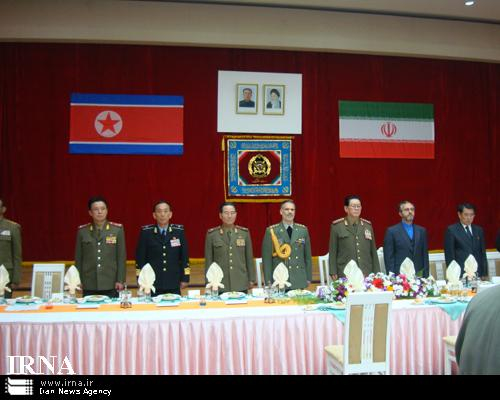
Earlier this week, the appearance of an Iranian-style nosecone on a North Korean missile raised eyebrows all over the wonk-o-sphere. That the two countries cooperate in missile development is not exactly new news, but the images from Kim Il Sung Square gave eloquent testimony to this relationship.
But just how far does the technical collaboration extend? Is it confined to ballistic missiles, or is there a nuclear angle as well?
As it turns out, Iran and North Korea have signed a series of three-year plans for “cultural and scientific exchange.” KCNA has announced three of these, with the most recent signing taking place this past April in Pyongyang. The contents of the plans have not been publicized.
Did Israel already launch a major attack on Iran? [UPDATED]
Labels:
Bomb Iran»
Bushehr»
cyber war»
Hackers»
Israeli Hacker»
Nuclear»
Nuclear Proliferation»
UN Nuclear Non-Poliferation Treaty
On August 5, I reported on the strong evidence that Iran had become the target of a state-sponsored cyber attack.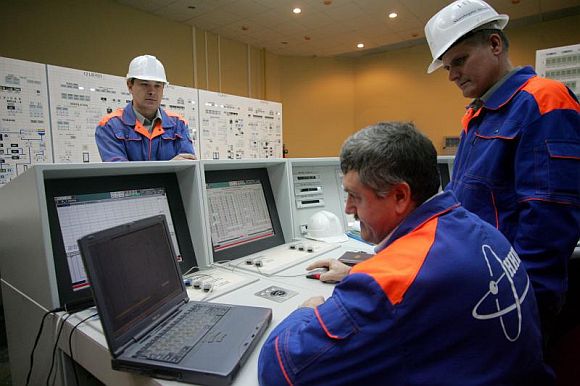
Russian technicians work at Bushehr nuclear power plant in Iran
At that point it was already understood that the Stuxnet computer worm was almost certainly targeting Iran since that was the location of 60% of the computer systems affected. Moreover, since the worm targets Siemens SCADA (supervisory control and data acquisition) management systems that control energy utilities, and since its design strongly suggested that it had been created for sabotage, it seemed likely that the specific target was Iran’s nuclear program.
A German team of industrial cyber security experts who have analyzed the way the worm operates now claim that it may have been designed to attack the newly operational Bushehr nuclear reactor.
Ralph Langner envisages that the highly sophisticated attack would have required a preparation team that included “intel, covert ops, exploit writers, process engineers, control system engineers, product specialists, military liaison.”
The Christian Science Monitor reports:
Since reverse engineering chunks of Stuxnet’s massive code, senior US cyber security experts confirm what Mr. Langner, the German researcher, told the Monitor: Stuxnet is essentially a precision, military-grade cyber missile deployed early last year to seek out and destroy one real-world target of high importance — a target still unknown.Langer speculates that Iran’s Bushehr nuclear power plant may have been the Stuxnet target. He also writes: “The forensics that we are getting will ultimately point clearly to the attacked process — and to the attackers. The attackers must know this. My conclusion is, they don’t care. They don’t fear going to jail.”
“Stuxnet is a 100-percent-directed cyber attack aimed at destroying an industrial process in the physical world,” says Langner, who last week became the first to publicly detail Stuxnet’s destructive purpose and its authors’ malicious intent. “This is not about espionage, as some have said. This is a 100 percent sabotage attack.”
On his website, Langner lays out the Stuxnet code he has dissected. He shows step by step how Stuxnet operates as a guided cyber missile. Three top US industrial control system security experts, each of whom has also independently reverse-engineered portions of Stuxnet, confirmed his findings to the Monitor.
“His technical analysis is good,” says a senior US researcher who has analyzed Stuxnet, who asked for anonymity because he is not allowed to speak to the press. “We’re also tearing [Stuxnet] apart and are seeing some of the same things.”
Other experts who have not themselves reverse-engineered Stuxnet but are familiar with the findings of those who have concur with Langner’s analysis.
“What we’re seeing with Stuxnet is the first view of something new that doesn’t need outside guidance by a human – but can still take control of your infrastructure,” says Michael Assante, former chief of industrial control systems cyber security research at the US Department of Energy’s Idaho National Laboratory. “This is the first direct example of weaponized software, highly customized and designed to find a particular target.”
“I’d agree with the classification of this as a weapon,” Jonathan Pollet, CEO of Red Tiger Security and an industrial control system security expert, says in an e-mail.
Langner’s research, outlined on his website Monday, reveals a key step in the Stuxnet attack that other researchers agree illustrates its destructive purpose. That step, which Langner calls “fingerprinting,” qualifies Stuxnet as a targeted weapon, he says.
Langner zeroes in on Stuxnet’s ability to “fingerprint” the computer system it infiltrates to determine whether it is the precise machine the attack-ware is looking to destroy. If not, it leaves the industrial computer alone. It is this digital fingerprinting of the control systems that shows Stuxnet to be not spyware, but rather attackware meant to destroy, Langner says.
If Bushehr was indeed the target, it may have presented itself first and foremost as a target of opportunity. From the point of view of governments with an interest in sabotaging Iran’s nuclear program, Bushehr would not be the most attractive target, but access provided to Russian contractors may have made it the easiest target.
Last September, Reuters reported: “Israel has been developing ‘cyber-war’ capabilities that could disrupt Iranian industrial and military control systems.”
So let’s assume that using Stuxnet, Israel has indeed launched the world’s first precision, military-grade cyber missile. What are the implications?
1. Iran has been served notice that not only its nuclear facilities but its whole industrial infrastructure is vulnerable to attack. As Trevor Butterworth noted: “By demonstrating how Iran could so very easily experience a Chernobyl-like catastrophe, or the entire destruction of its conventional energy grid, the first round of the ‘war’ may have already been won.”
2. The perception that it has both developed capabilities and shown its willingness to engage in cyberwarfare, will serve Israel as a strategic asset even if it never admits to having launched Stuxnet.
3. When it comes to cyberwarfare, Israel ranks as a major global power. It’s own tiny infrastructure makes it much less vulnerable to attack than is the sprawling infrastructure of the United States. It’s highly developed military IT industry means that it not only has great domestic human resources but that Israeli IT specialists, through research and employment, have the best possible access to most of the leading development facilities and vendors around the world.
4. As a cyber arms race takes off, we should not imagine that it will be like other arms races where power resides more in capabilities than in the use of those capabilities. “Whereas nuclear weapons have been used twice in human history, cyber weapons are employed daily and there is therefore an existential need to create some form of regulatory system that allows more than implicit deterrence,” says Robert Fry.
5. If AQ Khan demonstrated the ease with which a nuclear proliferation network can operate, the fact that the raw material upon which cyberwarfare is based is arguably the most easily transferable object on the planet — computer code — means that in certain ways the era of cyberwarfare may prove to be more dangerous than the nuclear era.
6. In the strategic landscape of cyberwarfare the most dangerous player may turn out to be a small but highly developed fortress-state that feels threatened by much of the rest of the world; that neither trusts nor is trusted by any of its allies; that sees its own stability enhanced by regional instability; that has seen its own economic fortunes rise while the global economy suffers; and that views with contempt the notion of an international community.
via warincontext.org
Paul Woodward says it like a Computer Virii Vs. Iran is a bad thing? Also... Israel is not the only people in the world that want Iran's Nuclear advancement to move offline. There are myriads of states that fear Iran. I probably shouldn't be posting this in that this site is beyond bias... but I was amused by the story.Langner's analysis also shows, step by step, what happens after Stuxnet finds its target. Once Stuxnet identifies the critical function running on a programmable logic controller, or PLC, made by Siemens, the giant industrial controls company, the malware takes control. One of the last codes Stuxnet sends is an enigmatic “DEADF007.” Then the fireworks begin, although the precise function being overridden is not known, Langner says. It may be that the maximum safety setting for RPMs on a turbine is overridden, or that lubrication is shut off, or some other vital function shut down. Whatever it is, Stuxnet overrides it, Langner’s analysis shows.
"After the original code [on the PLC] is no longer executed, we can expect that something will blow up soon," Langner writes in his analysis. "Something big."
For those worried about a future cyber attack that takes control of critical computerized infrastructure – in a nuclear power plant, for instance – Stuxnet is a big, loud warning shot across the bow, especially for the utility industry and government overseers of the US power grid.
"The implications of Stuxnet are very large, a lot larger than some thought at first," says Mr. Assante, who until recently was security chief for the North American Electric Reliability Corp. "Stuxnet is a directed attack. It's the type of threat we've been worried about for a long time. It means we have to move more quickly with our defenses – much more quickly."
Has Stuxnet already hit its target?
It might be too late for Stuxnet's target, Langner says. He suggests it has already been hit – and destroyed or heavily damaged. But Stuxnet reveals no overt clues within its code to what it is after.
A geographical distribution of computers hit by Stuxnet, which Microsoft produced in July, found Iran to be the apparent epicenter of the Stuxnet infections. That suggests that any enemy of Iran with advanced cyber war capability might be involved, Langner says. The US is acknowledged to have that ability, and Israel is also reported to have a formidable offensive cyber-war-fighting capability.
Could Stuxnet's target be Iran's Bushehr nuclear power plant, a facility much of the world condemns as a nuclear weapons threat?
Langner is quick to note that his views on Stuxnet's target is speculation based on suggestive threads he has seen in the media. Still, he suspects that the Bushehr plant may already have been wrecked by Stuxnet. Bushehr's expected startup in late August has been delayed, he notes, for unknown reasons. (One Iranian official blamed the delay on hot weather.)
But if Stuxnet is so targeted, why did it spread to all those countries? Stuxnet might have been spread by the USB memory sticks used by a Russian contractor while building the Bushehr nuclear plant, Langner offers. The same contractor has jobs in several countries where the attackware has been uncovered.
"This will all eventually come out and Stuxnet's target will be known," Langner says. "If Bushehr wasn't the target and it starts up in a few months, well, I was wrong. But somewhere out there, Stuxnet has found its target. We can be fairly certain of that."
via csmonitor.com


Subscribe to:
Posts (Atom)


