Gilad Shalit, for whom we gave up over 1,000 terrorist murderers, has admitted to military investigators (who went easy on him, since after all, this is the child of all Israelis) that he and his tank crew were incompetent, and did not fire a single bullet during his kidnapping. Two of the three other members of the tank crew died in the attack.
This story is the story of Gilad Schalit. This is his version, as told to the IDF investigators who questioned him. As stated, he feared his encounters with them; he was ashamed of what he had to tell them, yet he did so with an honesty that truly inspires respect. He didn’t try to conceal the truth; he told them he’d failed and acknowledged that he had not done his duty. He said this willingly, without any coercion or pressure.Read the whole thing.
Schalit has a phenomenal memory, he knows exactly what happened on each day of his captivity, when he was moved from place to place, what he ate, what was done and what happened.
And thus, for his interrogators, Gilad Schalit went over the details of the attack that led to his capture. Here is Schalit’s version, almost in its entirety (which the exception of the details that were redacted by the censor).
The attack took place in the pre-dawn darkness. Schalit’s tank crew was on guard duty outside the Gaza Strip. During the night, the crew took it in turns to rest – two keeping watch and two sleeping.
With the dawn, everyone was supposed to be awake, in his place and battle ready. At this stage, there is a communications check with the rest of the troops in the field, as well as with the operations room, and everyone reports that they are ready. This is what Schalit’s tank team should have been doing.
In reality, just one of the four-man team was awake – the rest were sleeping the sleep of the just. The driver was in the driver’s seat, the gunner (Schalit) was in his place, the comms guy in his and the commander in the commander’s turret.
Schalit was what is known in the army as “rosh katan” (literally, small head, and meaning someone with little or no initiative).
He was assigned for operational duty without knowing what was going on around him, the makeup of the area, or where the enemy lay. He had attended meetings and briefings before setting out on the mission, but had not immersed himself in the details. He was, after all, a member of a team, and trusted in his commander.
If he had listened to the company commander of the sector, who had issued detailed briefings, he would have known that there had been an explicit warning from the Shin Bet (Israel Security Agency) about a possible Hamas infiltration from Gaza, perhaps via a tunnel, and an attempt to kidnap a soldier. If he had been aware that in his vicinity – and just a few minutes away – there were reinforcements, perhaps it could have changed the face of the battle and even prevented the abduction.
In the briefing before the operation, it was clearly stated where everyone was located in the field, the deployment layout and more. A unit from the Engineering Corps had been situated 200 meters from Schalit’s tank, next to the border fence, throughout the night. Col. Avi Peled, the senior commander in the sector, who was suffering from a manpower shortage, had wanted to give back-up to the tanks in the field, and had brought in the team from the Engineering Corps, assigned as a personal favor.
It would have been possible for Schalit to call on this backup, had he known that they were there, but he had not been paying attention when the information was imparted.
“I didn’t listen,” he admitted to the investigators. “The commander was listening, and that was enough. I trusted him.”
When the attack began, he was sleeping in his gunner’s seat, deep inside the tank. His personal weapon was on the floor underneath him; he wasn’t wearing his helmet, his bullet- proof vest was hanging on the back of the chair, and maybe his flak jacket was on.
Maybe not.
As it turns out, the vest and the flak jacket saved his life.
Schalit went to sleep at 4:35 a.m. Until then, he had been on guard in the commander’s post, and had been relieved by a team member. Twenty-five minutes later, he was awoken by the impact of a rocket-propelled grenade striking the tank. He looked up to see the tank commander, Lt. Hanan Barak, and the driver, St.-Sgt. Pavel Slutzker, climbing out of the tank at speed.
“Gilad, get out of the tank!” Barak yelled at him. From beneath him, he could hear the voice of Cpl. Roi Amitai, calling “Hanan, Hanan,” but Barak and Slutzker were already out.
The command to leave the tank contravened operational orders. An RPG cannot do significant damage to a Merkava 3 tank, and this was a light strike on the side. Yes, it caused shock and agitation, but even so, this was no reason to abandon the tank – it wasn’t on fire, the grenade had caused minimal damage, the electronic systems were working, and no one on the team had been wounded.
Following the attack, after it was all over, an army technician went to the tank, turned on the engine and drove it away. The tank that Schalit had been in was capable of continuing to fight. A tank like this is a powerful war machine, with an effective, precise and swift cannon; it has three machine guns, primed and ready at the touch of the trigger, not to mention all the other advanced weaponry on board.
And yet the crew fled.
...
The officers questioning the post-captivity Schalit asked him if he had left the tank.
“No, I didn’t leave,” he replied.
“Why?” “Because the tank seemed safer than there, outside,” he said. “Outside is dangerous.
Inside was protected.”
With the departure of Barak and Slutzker, Schalit heard the rattle of light weapons being fired. It was this gunfire that killed the two crew members, and they fell from the tank onto the ground. Schalit heard them fall, then quiet, and realized that the two, one of whom was his commander, were either dead or seriously wounded.
Cpl. Roi Amitai, who had been fast asleep at the time of the attack, was trapped in his spot in the tank. Schalit understood that he was alone.
He decided to stay in the tank, and not get out and fight.
He had options, however, from inside. There was the machine gun, set up to be operated by the gunner without any need to stick his head out of the vehicle; he could have let off a few rounds and let the world know that the Merkava was still operational and in the fight. Yet he stayed put, in his seat, and hoped for the best.
Outside, at the same time, there were a total of two militants.
...
At this point Schalit was sitting in the gunner’s seat, praying for it to just be over. Then one of militants approached and threw two or three grenades into the turret. Schalit doesn’t recall the explosion of the grenades, but he does remember the smoke very well.
His bullet-proof vest and his flak jacket, hanging on the back of the chair, absorbed most of the impact. The chair was completely shredded.
Schalit, miraculously, was lightly wounded with shrapnel in his elbow and rear. He was scared, shocked. He stayed in the tank for a minute or two until the smoke spread throughout the turret and he found it hard to breathe. Then he decided, finally, to leave. He left unarmed. His gun, a deadly M-16, he left on the floor of the turret. In military terms, this is called abandoning your weapon.
If only Schalit had taken his gun with him when he left the tank; if only he had seen the militant approach the tank and start to climb up it. He could have taken him out easily, but he was not in battle mode. This is what Schalit himself told the investigators.
Schalit’s tank did not fire a single bullet.
This is clearly a soldier who didn't want to be in a combat unit. Maybe it's time to stop throwing soldiers like this at the front lines and go to a volunteer army?
Showing posts with label Gilad Shalit. Show all posts
Showing posts with label Gilad Shalit. Show all posts
Surprise: #GiladShalit's tank did not fire a single bullet | #JIDF

 Labels:
Gilad»
Gilad Schalit»
Gilad Shalit
Labels:
Gilad»
Gilad Schalit»
Gilad Shalit

Abbas AKA Abu Mazen: Hamas agrees to two states – Hamas: No we don't
Labels:
Abu Mazen»
Euronews»
Fatah»
Gilad Shalit»
Hamas Fatah Marriage»
Mashaal»
Prime Minister Netanyahu
It is bullshit... and it is known to be bullshit because Abu Mazen was the one who rejected the talks with Olmert. If he can't even be honest about this then there is no way that he is being honest about POPULATION resistance as opposed to WEAPONS resistance... and the wording of that is kind of disgusting. Are the Arabs intending to impregnate themselves into attrition?
In interview with Euronews, PA president says Fatah, Hamas agree on 1967 lines • Israel Radio: Hamas says its agreement with Abbas is temporary; will never relinquish any part of "Palestine," nor end armed struggle against Israel.
Rival Palestinian factions Fatah and Hamas may be getting closer to striking a unity deal, as they have found common ground, according to Palestinian Authority President Mahmoud Abbas.
Speaking to the Euronews channel in an interview that aired Friday, Abbas said the Islamist Hamas movement, which rules the Gaza Strip, now sees eye to eye with his own Fatah faction on several key issues. According to Abbas, the bitter rivals have agreed that any deal struck would be implemented in Gaza as well as the West Bank, where Abbas' Fatah holds sway. They also agreed that resistance must be peaceful, without the use of arms, and that elections would be held on May 5, 2012. Abbas told Euronews that the main point the two factions agreed upon was that a future Palestinian state could only be established along the 1967 borders.
"Around one month ago, I had talks with [Hamas political bureau chief] Khaled Mashaal, and we laid down the basis for an eventual agreement," Abbas recounted. "First, Hamas has come around on the following points: Peace and calm must be established in Gaza as in the West Bank; and resistance must be population-based, not with weapons. Frankly, this was a point we agreed on. The solution is a state based on the 1967 borders. There, again, Hamas agreed. Then there is the organization of legislature elections on May 5, 2012."
Israel Radio, however, reported that Hamas had recently stressed that an agreement such as that described by Abbas would only be acceptable as an interim solution, and that Hamas would not agree to relinquish any part of "Palestine," nor would it be willing to end the armed struggle against Israel.
Abbas, on the other hand, accused Israel of standing in the way of peace, saying, "We are a people under occupation. We claim our independence. We believe in peace. The main problem is that Israel refuses and the United States approves, and we are always in negotiation to convince them that peace is not only in the interest of the Palestinians but also the Israelis and the region, internationally. Therefore, pressure must be brought on those who refuse, and who stand in the way of peace. I say to them, ‘Here is our position. Frankly and clearly, tell me where my mistake is, and I am ready to correct my error.’ But they don’t find any error."
Addressing Sunday's release of 550 Palestinian prisoners from Israeli jails in the second phase of the prisoner swap for IDF soldier Gilad Shalit, Abbas criticized Prime Minister Benjamin Netanyahu's disregard for agreements the Palestinians made with his predecessor Ehud Olmert.
"What happened is that the soldier Shalit was kidnapped, negotiations for his liberation lasted for five years, and a deal was reached between Hamas and Israel [on] the number of prisoners to be exchanged. But I had made an agreement with the former Israeli Prime Minister Ehud Olmert: When Shalit was set free, Israel would free as many prisoners for the Palestinian Authority as were covered under the deal with Hamas. Netanyahu condemned this agreement. Even [U.S. President Barack] Obama stepped in around a year ago, and told me he would talk to Netanyahu about freeing prisoners, and that is what he really did, informing me that Netanyahu had accepted. I responded, ‘The same goes for me,' and then it was all forgotten."

Shalit went on hunger strike in Hamas captivity
Labels:
Gilad Shalit»
Hamas»
International Committee of the Red Cross (ICRC)
No wonder the Red Cross didn't make a visit. They had no problems visiting Gaddaffi's kid
(ynetnews.com) New revelations about Gilad Shalit's time in Hamas captivity are slowly coming out into the open. On Sunday Yedioth Ahronoth revealed that the kidnapped soldier decided to stop eating while captive and reached a point of malnutrition that put him in a life threatening situation.
According to the report, Shalit's hunger strike advanced his release as Hamas senior officials feared for his life.
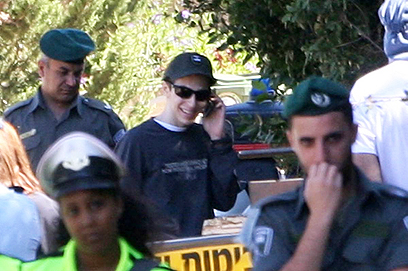 |
| Back home and getting better: Gilad Shalit (Photo: Moti Kimchi) |
According to the report, Shalit's hunger strike advanced his release as Hamas senior officials feared for his life.
- An intelligence source said that "there were those in Hamas who feared that the extreme conditions under which Shalit was being held would mean they could not offer him the help he needed and he would die on them," and so they compromised over the details of the prisoner exchange deal.
The report also reveals that Shalit was injured from shrapnel during the kidnapping which just barely missed his vital organs. The wounds eventually healed.
Newly released details also reveal that for the most part Shalit's captors did not physically abuse him, other than beatings that did not leave any long lasting or permanent damage.
The news of Shalit's abduction led to a flurry of activity in Israel in a bid to find out which organizations were behind the attack and a great deal of effort was invested in trying to locate the place where Shalit was being held.
At a certain point Israel believed the intelligence efforts would bear fruit. Information that reached Israel claimed that the captive soldier was being kept in a northern Gaza house surrounded by a wall. Israel exerted many efforts in trying to find out exactly what was going on in the house and was even considering the possibility of a rescue mission.
Luckily, they found out that Iran and Hamas were "feeding" the information to Israeli intelligence: The house was in fact empty and booby trapped. The scheme set up by Iran and Hamas was to lure the Israeli rescue forces into the house and then blow it up with the forces inside.
'Guards sentenced themselves'
The terrible disaster was averted but from that moment on, Israel had no idea of Shalit's whereabouts. The reason Israeli military and intelligence sources found it so difficult to find Shalit's location was because of the compartmentalizing on Hamas' part.
Shalit was guarded by four Hamas members who were brought in from abroad especially for the secret mission. The foreign operatives were not replaced at any time during Gilad's captivity. "The four guards basically sentenced themselves to the same conditions in which Gilad was being incarcerated," the Israeli intelligence source noted.
It was also reported that Shalit was not held in complete darkness, his cell in the basement room did get a little light through the boarded up windows.
US can prosecute terrorists freed by Israel
Labels:
Gilad Shalit
 (h/t Israel Matzav) The United States can and should prosecute many of the terrorists who were released by Israel last month in exchange for kidnapped IDF Corporal Gilad Shalit.
 Since the Antiterrorism Act of 1990, it has been a capital crime under American law, punishable by “death or imprisonment for any term of years or for life, or both,” to “kill a national of the United States, while such national is outside the United States.” A conspirator in such a crime can get up to 20 years imprisonment. No statute of limitations precludes prosecution of old offenses.
Another law, passed in 1994, made it a federal crime to use an explosive bomb “against a national of the United States while such national is outside of the United States.” In 2002 Congress authorized prosecution in American federal courts of anyone who, with criminal intent, injured “a national of the United States” outside the United States by detonating “an explosive or other legal device in, into or against a place of public use” or “a public transportation system.”
Prosecutions have been brought in American federal courts against individuals responsible for bombings that killed Americans in the Philippines, Colombia, Kenya, and Tanzania. Many of the individuals accused of these crimes were brought here for trial following their extradition, on the request of the United States, from foreign countries. American prosecutors have not, however, charged the Hamas perpetrators of bombings in Israel such as the 2001 and 2003 bombings in Jerusalem and Haifa, even though American citizens were murdered in these attacks. They have relied on the Israeli legal process to arrest and punish the perpetrators.
Tamimi, al-Jabaa, Sharakh, Amr, and Dar Musa were prosecuted and convicted in Israeli courts. They and other perpetrators of these murders received either multiple sentences of life imprisonment or long prison terms. Until they were released by Israel’s government under duress in order to bring Gilad Shalit home, they expected to spend the rest of their lives in Israeli prisons. They are now free in Jordan or Gaza.
The Department of Justice should now indict, extradite, and put to trial in United States courts, under American law, these killers of American citizens. Jordan has an extradition treaty with the United States that covers all offenses “punishable under the laws in both Contracting States by deprivation of liberty for a period of more than one year or by a more severe penalty.” A conspiracy to commit such an offense is also covered by Article 2(2) of the treaty.
No provision of any extradition treaty should preclude bringing these criminals to justice in the United States. The Jordan treaty bars extradition for “political offenses,” but it would be hard to claim that the mass terrorist killings of civilians in Jerusalem and Haifa were only “political offenses.” At the least, Jordan should be put to that test.
Nor could Jordan or any other requested country invoke the bar against double jeopardy that appears in many extradition treaties to prevent second punishment after a criminal prosecution for the extraditable offense has been conducted and fully carried out. That provision obviously does not prevent extradition of a fugitive who flees a country where he has been convicted in order to avoid imprisonment. It also should not prevent extradition if, by some other unlawful means such as Hamas’ extortionate demand, the criminal process is aborted.
Israel and the Hannibal Protocol – better to be killed than taken captive?
Labels:
Gilad Shalit»
Hannibal Protocol
IDF commanders are reviewing the “Hannibal Protocol: Rules of Engagement,” which declares that everything possible must be done to prevent soldiers from being abducted – even if it means endangering them.
For the Israel Defense Forces, this coming winter marks the beginning of a new post-Gilad Shalit era. Beyond the Iranian issue – which is at the center of almost all discussions and headlines – the term “capture” is being heard a lot on the battlefield and training grounds.The party atmosphere surrounding Shalit’s release has been replaced by the IDF’s newest serious headache: how to prevent the next abduction. One thing is known for sure – terrorist organizations are making major efforts to grab the next Shalit.Two words that have come up frequently in recent weeks are the “Hannibal Protocol,” which states that the abduction of a soldier must be prevented in every way possible, even if doing so endangers that soldier’s life. An example would be shooting at a car driven by terrorists who have a captive soldier inside.The protocol was developed in the mid-1980s by Likud MK Yossi Peled (then OC Northern Command), National Security Adviser Ya’akov Amidror (then a colonel and chief of intelligence), and former IDF Chief of General Staff Maj. Gen. (res.) Gabi Ashkenazi (then a colonel and head of intelligence at the Northern Command). It picked up support after the Jibril deal in 1985, in which 1,150 terrorists were exchanged for three soldiers.Even if the protocol has never become a standing order in the army, and sometimes appears to be the sole province of individual commanders and soldiers or Internet forums, the army understands that its ethical and strategic aspects must be considered. It is like a ghost come to haunt the IDF and its commanders, who must ponder it in the wake of the Shalit celebrations.The “Hannibal Protocol: Rules of Engagement,” drafted while the IDF was still in Lebanon, instructs a soldier how to act professionally to prevent an attempted abduction. But the highest levels of the IDF fear that the message is now being passed on to younger soldiers too radically, and that they are receiving the impression that a dead soldier is better than a live captured one. Unfortunately, this order has been misinterpreted both by commanders and by the media, which have been saying that it sanctions the killing of a soldier, either by his own hand or at the hands of his comrades, to prevent him from being taken alive by a terrorist organization.Many reserve officers, including those who filled senior positions in the past, refused to be interviewed for this article. It is a very delicate issue, walking a thin line between the permitted and the forbidden, between the legitimate and the clearly illegal.Every statement made about the matter is loaded, sensitive and has wide-ranging consequences –military and strategic on the one hand, compassionate and ethical on the other. Either way, the interviewees agreed, commanders in the field will still determine how far the protocol goes. It was used in previous abductions of soldiers, but to no avail.Indeed, it emerged from the army investigation after the Shalit capture that the commander of a tank in the Kerem Shalom region had seen two Palestinian activists crossing the border fence towards the Gaza Strip, Shalit with them. The commander requested permission to open fire, but because of noise on the army’s radio line, the commanders received the message too late. By the time firing was approved, Shalit was on Egyptian soil.The last time the Hannibal Protocol came up was two years ago, when civilian Yakir Ben-Melech tried to sneak into the Gaza Strip and was shot by IDF troops. The army denied that it had been following the protocol, saying that Ben-Melech had been trying to cross the border on his own.The question came up again during the serious terror attack in mid-August near Eilat, when terrorists tried to drag an Israeli into Egypt.Over the past two weeks there have been two meetings over the Hannibal Protocol. Professor Asa Kasher, who formulated the IDF’s code of ethics, was at the first one, which gathered commanders from OC Southern Command. Kasher said there was nothing wrong with the protocol, only with the way it was being interpreted. He and OC Southern Command Maj. Gen. Tal Russo told officers that they had to stress to their subordinates that interpreting the protocol too rigidly violated the IDF’s ethical code.The second meeting, held this week and attended by Chief of General Staff Lt. Gen. Benny Gantz, was for commanders of field units from lieutenant colonels up, and told them the protocol did not justify shooting a soldier.“It’s clear to me that this forum will be tested in the coming year,” Gantz told the commanders. “You’ll be tested in personal ways during ongoing security operations, in operative tests, and in the need to adapt in accordance with strategic changes, including a serious challenge regarding resources.”“What they were clearly trying to tell us was that the kidnapping of a soldier was something that we must prevent, period,” said a senior officer who attended both sessions. “But the senior officers made clear that the current protocol is enough, and only needs to be sharpened and adapted to the different areas … Ultimately, the commanders in the field will be the ones who decide with sensitivity on the protocol’s implementation.“There was a discussion on what to do if there’s an abduction – shoot or don’t shoot. And if we shoot, how to shoot, using what kind of weapons. The chief of staff said that there are no right or wrong answers. It’s not like in school. You have to use your judgment. Every area has its own instructions, but the overall instruction is that kidnapping is the kind of event that we must prevent.“Doing so sometimes also involves shooting at those who are trying to carry out the abduction. It’s clear this means possibly also hitting the kidnapped soldier, because he’s with the terrorists trying to take him. It all goes together. In the end, every officer in the field must interpret the order in accordance with the situation, but most importantly we must prevent the abduction by opening fire quickly.”Another senior officer said, “What was stressed to the officers is that ultimately the commander has the ability to prevent a kidnapping. It’s naturally better to prevent such incidents ahead of time, but we can prevent abductions in the midst of ongoing action.”Minister without portfolio Yossi Peled, who helped create the Hannibal Protocol, becomes angry about the vagueness on the subject and believes the army must be clearer about it. “We have to formulate the Hannibal Protocol so that the soldier in the field understands exactly what’s permitted and what’s forbidden. To say we have to prevent an abduction at any cost isn’t really saying anything, and to fight to recover the captured soldier even if it means he will definitely be killed isn’t ethical. We must never decide that we’re going to kill the victim.”One of the more complicated matters the IDF is grappling with is the possibility of a soldier being abducted into Egypt. The clear instruction is to prevent this, but shooting in Egypt’s direction could create a strategic problem for Israel and damage delicate relations with Egypt, especially at this sensitive time.“There is certainly a difference between a soldier being taken into Lebanon or into Egypt, in terms of what methods can be used and the degree of sensitivity,” a security source who attended the two gatherings said. “There is special sensitivity regarding the peace treaty with Egypt, and we have to recognize this during operations. On the other hand, we don’t always have to cross the border to prevent an abduction. Sometimes it’s enough just to open fire toward them. In the last terrorist attack near Eilat, we fired toward Egypt. We also have to take into consideration that soon it will be difficult to storm into Egypt because of the obstacles they are building there now intended to prevent infiltrators from coming into Israel.”Soldiers in the field, whether they are new recruits who have only started their service or veterans who fought in the Second Lebanon War and Operation Cast Lead, say they face no dilemmas. They all agree that it is better to be killed than to be taken captive. At least that’s what they say.“The Second Lebanon War was conducted in the spirit of the Hannibal Protocol,” says A., who fought in that war and was at the Battle of Wadi Saluki. “The war started with the Hannibal Protocol in effect after Ehud Goldwasser and Eldad Regev were captured [and killed], so no one had to tell us anything; we understood it ourselves. We all agreed that no one would be abducted. We didn’t even discuss what would happen should this occur, because it was clear to everyone. There were stories about soldiers who were killed by friendly fire, but I personally didn’t run into these things.”“Every soldier must fight if they try to abduct him; a soldier must understand that he simply must not be taken,” a senior officer said. “A soldier must do everything he can not to fall into captivity.” Asked what he meant by “everything,” he refused to answer.On the other side, naturally, are the parents, those who must pay a heavy price if their sons are abducted or killed. Haim Avraham, father of the late Staff Sergeant Benny Avraham, who was captured by Hezbollah on Mount Dov in October 2000, surprisingly came out in favor of the Hannibal Protocol.“When I saw the investigative report into my son’s abduction along with Omar Souad and Adi Avitan, of blessed memory, I discovered that the Hannibal Protocol was put into effect to prevent their capture,” he said. “The army tried to prevent cars from leaving Lebanon’s Kfar Shouba, and to the best of my knowledge 26 cars were hit by our planes. But the kidnappers were no longer there. They managed to drive 7 kilometers into Lebanon before they had a car accident. Then they booby-trapped their cars and disappeared with our sons.“If they told me that our son had died from friendly fire during the abduction, it would hurt emotionally and perhaps anger me, but I could take it. The state needn’t act based on the viewpoint of a father and his family, but rather out of concern for all of its seven million citizens. The law of the land is the law. A soldier’s job is to guard the country, and he is liable to fall in battle as a result.”
And the fact that Benny could still be alive today if not for friendly fire wouldn’t make it harder to deal with?
“It certainly would. There’s a black flag flying over this order. But I think in our current reality it has a certain logic. It’s a dilemma. A kidnapping, which is a localized event, becomes a strategic event which changes Israel’s balance of power in the whole Middle East. Look at what happened following the abductions of Benny and Gilad Shalit. We must also consider the suffering to be faced by the captive soldier, his family, all the Jewish people, and I’m sure whoever initiated the order. Such an order determines policy, and essentially the army takes responsibility in places where the statesmen can’t.”Yossi Peled puts a finer point on Avraham’s remarks: “The abduction of a soldier places the state in the midst of a very complicated problem, so we must prevent it even at the cost of the captive soldier’s life, but not execute him. When I arrived at Northern Command, I described the matter of the abductions as one of the greatest dangers in our ongoing security operations. That’s when we forbade the use of shells and anti-tank weapons, because if they hit a car, it’s instant death for those inside. We only approved using light weapons to be fired at the abductors, since then we are taking a reasonable risk that the soldier won’t be hurt. The fact that we forbid the use of certain kinds of ammunition has clear significance: I don’t want to kill the kidnapped soldiers, but I’m willing to endanger them to stop the kidnapping.”
Do you feel the instructions given to the commanders today are as clear as they should be?
“I can tell you how the order was born, but I don’t know how it has developed since then and how it is defined today. I don’t have a better definition today for the order than the way we defined it back then.”
You don’t see anything problematic in an IDF soldier firing at another?
“There is something that exists in the army called ‘friendly fire.’ When a unit gets into trouble, it sometimes asks for artillery cover nearby to get it out of a difficult situation. So should we rule that out too?”The late Dan Shomron, who was an operations officer in the IDF before becoming chief of staff when the doctrine took root, always repeated the saying: “It’s risk against risk. Is there anybody (standing on the other side) with a copy of the Geneva Convention?”The officers of the time remember that this line made it easy for them to understand that they could shoot in every situation and at every price, and no one thought to ask questions.Brig. Gen. (res.) Shmuel Zakai was the commander of a Golani company when the Hannibal Protocol came along. Later he faced it as the commander of a brigade and as commander of the Gaza division. “This procedure was an inseparable part of operational activities, and the soldiers in Lebanon and Gaza were briefed about it all the time as a way of preventing a possible abduction,” he recalls.The very public discussion over the legality and morality of the protocol angers Zakai. “There’s no doubt that it’s better to ask questions and express doubts rather than just accept it as understood. But someone decided that what we are essentially saying is, ‘If a soldier is kidnapped, shoot him,’ and that’s just not true. The IDF doesn’t fire on its own soldiers; that doesn’t happen.“It’s clear that a tactical failure involving the kidnapping of a soldier has the entire country facing a strategic problem, and we need to do everything we can to avoid such a situation. But “everything we can” definitely does not include shooting a soldier. Not even if you saw them taking a soldier and putting him in a car. You do not immediately shoot at the car. You first fire a few shots ahead of the vehicle so it will go off the road and stop, and then maybe an infantry unit can charge the car and arrest the abductors. Hurting the soldier is not part of the doctrine, and I’m certain that’s how it’s being explained to the soldiers. What is true is that in such situation, you can increase the risk factor a bit.”
As a commander, didn’t you ever run into a soldier who said he would refuse the order, or had some doubts about it?
“When you know how to explain it clearly and truthfully, there won’t be any opposition. I didn’t run into any soldier who considered refusing to carry it out,” Zakai said.And Maj. Gen. (res.) Elazar Stern, former head of IDF Personnel Branch, Chief Education Officer and commander of an officers’ training unit, said, “There were questions, of course, but we unequivocally clarified that we don’t shoot at those being taken, then the doubts disappeared. The commanders in the field don’t want their soldiers abducted. Not out of fear, but because of the price that has to be paid to get them back. Soldiers, as part of their jobs, endanger themselves and their lives to protect citizens, and what really happens is that the state of Israel endangers its citizens to protect the soldiers.“A lie was planted in Israeli society claiming that IDF soldiers want to know that if they are captured, any price necessary will be paid for their release. And if not, then the youth won’t want to enlist and soldiers won’t want to fight.“Today we know that there is no drop in motivation, even in the school Gilad Shalit studied in, despite what some advertising agencies tried to sell us while he was a prisoner. The Hannibal Protocol is an example of this: The soldier says: ‘I don’t want them to pay every price for me,’ and that’s the true spirit in the army unit.”According to Stern, the clarification of the Hannibal Protocol indicates the revival of values that seemed to have disappeared from the IDF. “I hope that the army is uncomfortable with all the recent deals, which took place as a result of incidents in which not one bullet was fired: the Jibril exchange, the Tannenbaum deal, and of course the Shalit deal,” he said.“There’s a pattern here that is too widespread of easily becoming a prisoner, without fighting, and this is a harsh failure of the military system. Once we fight being abducted, there’s another message the soldiers receive. Today, the commanders understand what prices the country will pay and how much its defense suffers if a soldier is captured and a deal is made. It seem that the army doesn’t want to have the nation face a dilemma.
Is it easier for Israeli society to deal with a dead or a kidnapped soldier?
“For the families, it’s harder to deal with the death of a loved one. But unfortunately in Israeli society, it’s the opposite — it’s harder for it to deal with a kidnapped soldier. And that means we have a long way to go.’
Isn’t there an ethical problem with shooting at a soldier?
“I’m opposed to shooting directly at one of our soldiers. The significance of the Hannibal Protocol is that I take on greater risk to prevent the kidnapping. Unethical? There are some deals that are unethical, and sometimes the prices we pay are unethical. The Hannibal Protocol was born as a reaction to the Jibril exchange. At the time I was commander of Paratroopers Battallion 202. And we, as commanders, took into account that we could also be the ones abducted.““Danger may be part of army life. But when you knowingly endanger your soldier to prevent an abduction, this is an unwanted standard,” jurist Professor Emanuel Gross said. He said that “intentional shooting which will almost certainly lead to the death of the kidnappers and your captive soldier is an unlawful order that must be refused. We know that the shooting is endangering someone. If the intention is to prevent the abduction for strategic reasons, then we’re no longer talking about saving the soldier but about an order that is clearly illegal. I don’t accept that the strategic ramifications permit the sacrifice of the kidnapped soldier.“From a legal standpoint, there’s nothing wrong with an order that says we must try to prevent the kidnapping, but not at all costs, and certainly not a cost that endangers the captive. Such an order would be opposed from the beginning, especially because it was not clearly formulated. It’s a very blurry order which doesn’t say what is and isn’t permitted to prevent an abduction, and still leaves most of the considerations with the commander. The biggest problem with it is what is caused by it: As soon as you’re certain that your order to fire endangers the captive, it’s not ethical or legal.”Israeli Nissim (Salam) Shalem, who was released as part of the Jibril deal in 1985, spent three years as a Syrian captive. Gilad Shalit’s release returned him to those difficult days. “Twenty-six years have passed and up to Gilad we were the only captives who returned home alive,” he said. “When he was circling over Mitzpe Hila, I felt the same way I felt on the plane that brought me home. It’s harder for me to sleep at night now, because all those experiences keep popping back up and gnawing at me.”When Shalem and seven of his comrades were kidnapped in an ambush in Lebanon in 1982, the Hannibal Protocol didn’t exist. “Only after a few hours did the army figure out what happened to us,” Shalem recalls. “And there was no change made to rescue us at that moment.”Shalem is careful when he speaks about the Hannibal Protocol. “To this day people talk to me about it and no one accurately quotes what’s written there. After all, there’s a difference between shooting at a car’s tires with a light weapon or firing tank shells directly into the car.”This lack of clarity bothers Shalem. “You can’t place the soldiers in such a dilemma. There’s a lot of room for consideration in the field, of course, but the army orders have to be clear. I, at least, never heard a clear order on trying to prevent yourself from becoming a captive.”
Can you imagine a situation in which your comrades would shoot at you while you were being abducted?
“When you go out to fight, harsh things can happen, like death, being wounded or falling into captivity. You have to deal with all these things. The guys deal with the situation of having a kidnapped soldier much better than they did 25 to 30 years ago. Now we know the value of life. We don’t send soldiers to die but to guard those on the home front and their own lives as well. No one is asking anyone else to die.”Asked to comment for this article, the IDF Spokesperson’s Unit said, “The Hannibal Protocol hasn’t changed and is still in effect.”Arale Weisberg and Adi Rubinstein – Israel HaYom –
JSSNews

via jssnews.com
Gilad Shalit: Not Bibi's Fault
Labels:
Gilad Shalit»
Prime Minister Netanyahu
This is the first commenter I've seen who actually is glad for the Gilad Shalit deal. It is also the first time a writer clarified that Bibi is not responsible for a lack of death penalty in Israel or other strategic losses that makes a hostage situation more likely, for example a poor land concession deal that gives Israel no security from people that are still dedicated to kill Jews | (Simply Jews) The message that the Shalit's return home sent to soldiers is a shot in the arm for people who protect Israel. Saying this, however, I cannot deny the problems created by exchange deals of this kind (without going into much bandied details). Only it will be unfair to blame the current government - after all, it inherited the Shalit issue and most of its solution's parameters from the previous one, and the fact that Israel abandoned its own policy of never talking to terrorists many years ago couldn't be in all fairness placed at Bibi's doorstep. Whatever issues Shalit deal reopened, it is far from being the first (or last) one of the kind. |
|---|
Rockets continue to fall in South, ceasefire reported
Labels:
Gaza»
Gaza Rocket Attacks Again»
Gilad Shalit»
Hamas Rockets»
hostages»
Katyusha rockets
 what cause did they have to shoot rockets right after the trade? Hamas called a cease fire so Israel would not retaliate...
YAAKOV LAPPIN, LAHAV HARKOV, JPOST.COM STAFF
10/30/2011(h/t Docs Talk)
Man killed in Ashkelon from rocket; South pounded by 37 projectiles from Gaza in total; IAF responds with strikes on 6 terror targets; Egyptian officials report that Cairo mediated truce between Israel, Palestinian factions.
10/30/2011(h/t Docs Talk)
Man killed in Ashkelon from rocket; South pounded by 37 projectiles from Gaza in total; IAF responds with strikes on 6 terror targets; Egyptian officials report that Cairo mediated truce between Israel, Palestinian factions.
According to reports from Egyptian officials late on Saturday night, Cairo mediated a truce between Israel and Palestinian factions in Gaza, set to take effect at 6 a.m. on Sunday. Meanwhile however, another two rockets exploded early Sunday morning, one north of Ashkelon and one just outside of Beersheba.
A man was killed and four people were wounded when southern Israel was bombarded with long-range Grad rockets fired by Islamic Jihad from Gaza on Saturday. The rocket casualty was later named as Ami Moshe, 56, of Ashkelon. Moshe was on his way home to his family when the air raid siren went off. He left his vehicle and ran for cover, but was mortally injured by flying shrapnel from the rocket fired at a residential neighborhood in Ashkelon. He was rushed to the Barzilai Medical Center in the city, but doctors were unable to save his life. Moshe was able to answer a call from his concerned wife and tell her that he had been injured before being evacuated to hospital.
Security chiefs searched for a way to contain the situation on Saturday, as the Air Force went into action to strike terror cells preparing rockets for launch in northern and southern Gaza. The IAF attacked six targets in the Gaza Strip on Saturday night, the IDF declared in a press release. In the northern Gaza Strip it attacked three terror tunnels and three rocket launchers, and in the northern Gaza Strip it attacked two centers of terrorist activity.
"The attack was a response to a barrage of rockets fired over Israel," the IDF stated.
"The IDF will not hesitate to act decisively and forcefully against anyone who uses terror against the citizens of Israel, until quiet returns to area. Hamas is a terrorist organization and bears the responsibility."
IDF confirmed killing 10 Islamic Jihad members on Saturday. It struck four terror targets in Gaza between 9 p.m. and 10:30 p.m. Saturday night. The targets included a terror cell in southern Gaza planning to fire a projectile, a terrorist planning a rocket strike, and two rocket launch sites in northern Gaza. An additional terrorist in southern Gaza planning a rocket attack was also struck from the air on Saturday night. Furthermore, a cell in northern Gaza was also hit by the Air Force.
Some 200,000 school children will stay at home as classes in Ashdod, Beersheba and Kiryat Malachi were canceled by local officials, and the IDF Home Front Command asked people who live within 40 kilometers of the Gaza Strip to stay near structures protected against rockets.
On Saturday, 35 projectiles, including Grads and mortar shells, were fired at southern communities, hitting built-up areas in Ashdod, Ashkelon and regional councils across the region. A number of the rockets caused extensive damages to buildings.
The IDF struck a rocket-launching cell in Rafah, in the southern Strip, following the upsurge in attacks, reportedly killing two terrorists.
“Hamas is responsible for what takes place in Gaza,” the army said.
Ashdod bore the brunt of the attacks, and was targeted by at least three Grad rockets. One slammed into an empty school, and a second struck in the nearby Gan Yavne Regional Council, moderately wounding a man who was searching for his son.
TV footage showed bloodstained pavement where the man had been injured before running indoors and contacting paramedics.
A third rocket slammed into a parking lot between two multi-story residential buildings in Ashdod. It set several vehicles on fire and left behind extensive wreckage. The flames were doused by Israel Fire and Rescue crews, who also broke into homes in nearby buildings to rescue residents.
“This was a miracle, it could have been much worse,” Magen David Adom director-general Eli Bin said.
“Ashdod is under attack, without a doubt,” Mayor Yehiel Lari said.
A rocket fired at Ashkelon sent shrapnel flying that moderately wounded a man.
He was taken by MDA paramedics to the city’s Barzilai Medical Center. A second rocket fired at Ashkelon scored a direct hit on a home, setting gas canisters on fire.
Fire crews doused the flames.
The wave of rockets came after the IDF, working with the Shin Bet (Israel Security Agency), identified and struck an Islamic Jihad rocket cell in Gaza earlier on Saturday, killing five terrorists, including senior Islamic Jihad commander Ahmed Sheikh Khalil, who was responsible for the group’s considerable rocket production facilities.
Army sources said the cell was the same one that fired the unprovoked long-range Grad that struck near Rehovot last week. That rocket was supposedly launched to mark the anniversary of the 1995 assassination in Malta of Islamic Jihad leader Fathi Shikaki, the first person to publish a booklet that legitimized suicide in jihad.
“The cell was preparing to fire another rocket into Israel,” an IDF spokesman said. Other reports added that the cell was targeted at an Islamic Jihad training camp. The terrorist organization vowed a major response to the air strike.
Islamic Jihad’s propaganda wing released a video on the Internet on Saturday showing a multi-rocket launcher mounted on a truck and firing several projectiles in succession.
The video is part of a boast by the Iranian-backed group that its rocket launching capabilities have improved over recent years.
The group’s claim that the video was taken on Saturday in Gaza could not be confirmed.
But the organization has been the recipient of large-scale Iranian support, both military and financial.
Late Saturday night, Islamic Jihad’s Quds Brigades said the first wave of rockets was its “initial response” to the strike on its rocket cell, adding that “the enemy should expect the worst in the coming hours,” Channel 10 reported.
The organization’s leader in Syria, Ramadan Abdullah, recently attended a conference in Iran calling for Israel’s destruction.
During the conference, Abdullah said Iran’s supreme leader Ayatollah Ali Khamanei’s “plan is a road map to the liberation of the occupied territories,” referring to the whole of Israel.
Islamic Jihad has long been Iran’s closest proxy in the Palestinian territories.
In the past, the organization’s leadership described itself as “one of the many fruits on our leader [former Iranian supreme leader Ayatollah Ruhollah] Khomeini’s tree.”
A spokesman for Robert Serry, the UN’s special envoy for the Middle East peace process, said in a statement, “The recent escalations are very worrying. It’s vital to deescalate now, without any delay. We strongly appeal for calm and an end to violence and bloodshed.”
Prime Minister Binyamin Netanyahu was receiving regular briefings on the security situation, officials said.
Foreign Minister Avigdor Lieberman, who was on a trip to Bosnia-Herzegovina on Saturday, warned that “if the rocket fire isn’t halted, there will be serious consequences in the coming days.”
Lieberman said that Israel hasn’t been insisting that its security needs must be met in any final-status agreement with the Palestinians without good reason.
“Just today we have seen why this is necessary,” he said.
“We are not seeking violence with the Palestinians and we do not want to ‘heat up’ the situation, but we won’t suffer one rocket barrage after another without a response. Therefore I hope that already tonight, the rocket barrages will stop with the intervention of neighboring countries, the international community and the Palestinian Authority,” he said.
Opposition leader Tzipi Livni (Kadima) visited Gan Yavne, where one of the rockets stuck, on Saturday evening.
“I will support any action the government chooses in order to stop the attacks,” she said. “Residents of the South bravely deal with constant attacks, and we will all try to support them.”
The rockets “remind everyone that the South is full of terrorist extremists, whom Israel must weaken directly and by negotiating with moderates who do not use violence,” Livni wrote on her Facebook page.
“Now, when Hamas feels strong following the Schalit deal, we must be aggressive in order to bring back Israel’s deterrence,” MK Tzipi Hotovely (Likud) said. “We must make the residents of the towns surrounding Gaza, and all of Israel’s citizens, feel safe again.”
MK Arye Eldad (National Union) said, “After avoiding a military attack on the heads of terrorist organizations and instead surrendering to Hamas and freeing hundreds of murderers, we will now have to act.
“The excuse that Schalit will be hurt can no longer disguise the disgrace of our capitulation,” Eldad said.
“Now Israel must stop reacting and start preventing.
Only methodically wiping out the heads of terrorist organizations, especially [Hamas’s Ahmed] Jabari who held Schalit, will bring back our deterrence that was worn out by the deal [for Schalit’s release].”
Police have gone on the second highest level of alert, and have called on members of the public to refrain from gathering at rocket impact zones, to avoid additional injuries.
Tovah Lazaroff and Reuters contributed to this report
The hypocrisy of the Israeli Left, perfectly captured
Labels:
Alon Idan»
Gilad Shalit»
Haaretz»
Hamas»
prisoner

The Shalit deal is, in fact, a public display of Israel's racist price index. The ceremony occurs every few years, and the index is designed to update the market values of the region's various races. As of October 2011, in the Israeli market, the price of one Jew equals 1,027 Arabs. And the price increases every day.But a few months ago, during Shalit's fifth anniversary in captivity, here is what Idan wrote:
Shalit will not be freed because, contrary to conventional wisdom, the push for his release is not nonpartisan; it is part of a struggle that falls along classic political lines.The absence of such pressure is no accident. It faithfully reflects the fact that the issue fall along classic political lines: the left is in favor of releasing Shalit, the right is against it, and the center says it's in favor but acts against it.
Suffice it to look at reality itself - Gilad Shalit is still in captivity.... The seeming gap between the public's desire to "pay any price" for Shalit's freedom and the government's opposition to doing so is deceptive. The fact that the situation has not changed means there isn't really a gap, that pressure isn't really being exerted from below - and if it is, it's not strong enough to break the ruling paradigm.
Besides how obviously wrong he was about how the right were indeed the ones that freed Shalit, Idan is identifying the desire to free Shalit "at any price" with the Left that he is a part of.
But when Israel does release Shalit for 1027 prisoners, he deems that to prove Israel's racism!
So by the calculus of his later article, the Israeli Left must be racist, since in his words they would have been willing to release many, many more prisoners to get Shalit back!
As usual, the anti-Zionist Left will twist whatever facts they can to make a political point, consistency be damned.
Israel's Total Failure: Schijveschuurder Family Plans to Leave Israel
Labels:
Gilad Shalit»
Sbarro»
Schijveschuurder

(h/t Doc'sTalk) (Jameel @ The Muqata)A Palestinian Suicide Bomber entered the Sbarro Pizza restaurant at Jerusalem's busiest intersection (the corner of King George Street and Jaffa Road) and detonated a bomb containing 5-10 kilo of explosives, nails, nuts and bolts -- 15 civilians were killed and 130 wounded.
Among those killed were the parents of the Schijveschuurder family from the Neria community: Mordechai (43), his wife Tzira (41) and 3 of their children; Ra'aya (14), Avraham Yitzhak, (4), and Hemda aged 2.
Channel 10 TV aired the regular "Makor" program in which the remaining members of the family were interviewed last week. (Only a promo is available now)
The TV program documented ten years of failure by all of Israel's systems, to adequately care of the orphaned children - social services, Bituach Leumi (Social security) and the educational system. They fell into a non-existent category and no-one seems to have had the presence of mind to work around that.
The program began with a little biographical detail about the family - olim from Holland. It then moved on to the actual terror attack itself. The three older boys, Ben Tzion (who now lives abroad), Meir and Shvuel were not present. Ben Tzion and Meir were both in the army and Shvuel (who was 16.5 at the time) was on his way back from the Klezmer festival in Tzfat.
The program documented their search for the members of their family in various hospitals, without any outside help from any State service. As Meir did not have any ID proving his connection to one of his sisters, he was not allowed to see her as she lay dying in the operating room, yet minutes later was asked to identify her body.
Meir, an 18/19 year old, ended up organizing the funerals all by himself. The Jerusalem Hevra Kadisha (Burial Society) even had the gall to demand money from him (20,000 shekels - later returned) for two additional burial plots, stating that he could only have three (he had to bury 5 members of his family).
He and his older brother took care of the younger surviving children (the youngest was 8) in the family home with no outside help. At some point the social services tried to take the two younger girls into care, but they objected. Afterwards the girls were sent to live with a distant relative in Switzerland for about a year, but were very unhappy there and came back to Israel. Later they were sent to live with another distant relative in Israel, but that didn't last long either and Meir and his wife took them in, whilst also raising their own young family.
Shvuel seems to have 'fallen between the chairs' perhaps most of all. He is obviously in need of psychological help, and clearly knows that himself, but his attempts to get that help from Bituach Leumi have been rejected.
The program ended with a 'right of reply' statement from Bituach Leumi which the presenters said they had fact checked and found to be lacking on certain points.
Apparently there is a serious problem with people who, as children, lost both parents in terror attacks. (A lady orphaned by the Ma'ale Akrabim masscare briefly mentioned similar problems, and the issue was raised regarding the Fogel family).
The system does not cater for them properly and seems to work on the premise that they will be taken care of by the extended family, but in this case there was not much extended family to help. There is an attempt ongoing to try to change the law, but it is clear that this family has already sustained far too much damage because of the system's shortcomings.
And then...comes the final blow.
The terrorists who planned the attack, go free. Translated from Channel 2.
After they realized their lost battle, the Schijveschuurder family went to the graves of their loved ones - to tell them that those responsible for their murder, are now free.
"We have every intention and desire to take what you see here, break the headstones, remove the remains buried here and take them outside the country who betrayed them," says Meir Schijveschuurder -- his parents and three siblings were killed in the attack at the Sbarro restaurant. "Because the State of Israel betrayed everyone who lies here and there are several hundred of them, only in this area [of the cemetery]."
The Schijveschuurder family, originally from Holland, is one of the families that has paid the heaviest price in the history of terrorism against the State of Israel. Two parents and three of their children were killed in the attack at the Sbarro restaurant, and two other children were seriously injured. When Meir Schijveschuurder learned this week that those who planned the attack, drove the terrorist to Sbarro, and were now released from prison, the son desecrated the monument in memory of Yitzhak Rabin in Tel Aviv in protest. He was arrested and released.
The children tried to appeal their arguments to the Supreme Court, but were also rejected. The brothers say the High Court's ruling was predetermined before hearing any of their claims. "We will not allow terrorists to leave the country! And if they leave the boundaries of the country, the residents of the United States and United Kingdom should know that Israel betrays its population," said Shvuel angrily.
"I lost faith in everything that I felt"
Regaining his composure, Shvuel promised he would avenge the death of his family.
"Unfortunately the State of Israel has a bankrupt legal and ethical system, and they have abandoned the issue of upholding justice for the killers and murderers of my parents -- to me. A victim of a crime has the right to go to make a "price tag" for those who committed the crime and punish him, [when the system doesn't do anything]" says Shvuel.
Former Prime Minister Ariel Sharon promised the brothers that the murderers would rot in jail until the end of their days, but that promise was broken today. "I feel like I was exploding all over again. I feel that what we built over the past 10 years and everything we've been able to constructively do with our bereavement -- I feel that everything we did in those 10 years, rebuilding our lives, is just in vain. Now I lost faith in anything, everything I felt," says Leah Schijveschuurder, the youngest sister, sadly.
The family is very hurt by the atmosphere of joy and jubilation that enveloped the nation in recent days. It would be better that the Shalit family celebrate quietly in their house -- this festival going on is so difficult for us.
As of the writing of this blog post, the orphans of the Schijveschuurder family have announced they are leaving Israel to Holland within 2 months -- during the Makor program, one point one of the daughters cut her Teudat Zehut, her ID card into pieces telling one of the children that she did not need it anymore.
The Schijveschuurder family has been betrayed by Israel; the Palestinian terrorists have won this battle. They physically slaughtered a family, their terrorists were released from prison, they gleefully watched the State ignore the remaining orphans...and cheer as the broken spirits plan to leave forever.
Postscript: Days before the terrorist release, the JPost reported:
On the eve of Tuesday’s swap for kidnapped soldier Gilad Schalit, Prime Minister Binyamin Netanyahu reached out to the families of terror victims, many of whom will watch in horror as the murderers of their loved ones are set free.
"I write to you with a heavy heart," Netanyahu said in an open letter to the families of terror victims. "I understand and know your pain."
Writing that he lost his brother in an operation to free hostages, Netanyahu said, "I know that you have a heavy heart, that your wounds have been opened anew these past days; that your thoughts are not at ease."
Netanyahu said the families "were in my thoughts” during the painful decision-making process and negotiations for Schalit’s return."
"The decision regarding the release of Gilad Schalit was among the most difficult I have made," he wrote. "It is difficult for me for the same reasons it is difficult for you."
Meir Schijveschuurder said that to the best of his knowledge, only 200 letters were send out to families of terror victims, explaining the Shalit deal.
The Schijveschuurder orphans did not receive any letter.
Nor were they contacted by any government official during the period before and after the Shalit deal.
Red Cross Did Not Examine Gilad Shalit Before Controversial Egyptian Interview
Labels:
Gilad Shalit»
psychology»
Red Cross»
Shahira Amin
(writingtw)
Last week, I sent an email to the interviewer, Shahira Amin, Egypt’s most famous TV journalist – posted afterwards in a news story.
Three days ago, she responded at great length in an email, most of which she subsequently published in an open letter in the Jerusalem Post. In her email to me, Amin defends her decision to conduct the interview with Shalit – in part because she says the interview was conducted “AFTER [her caps] he had been released by Hamas and had a medical checkup by the Red Cross.”
(h/t WritingTW) Pesach Benson
That Egyptian interview with Gilad Shalit took place before any medics had a chance to check his condition. Investigative journalist Robert Behar (Forbes) blows the lid:Last week, I sent an email to the interviewer, Shahira Amin, Egypt’s most famous TV journalist – posted afterwards in a news story.
Three days ago, she responded at great length in an email, most of which she subsequently published in an open letter in the Jerusalem Post. In her email to me, Amin defends her decision to conduct the interview with Shalit – in part because she says the interview was conducted “AFTER [her caps] he had been released by Hamas and had a medical checkup by the Red Cross.”
But here’s the problem: Red Cross spokesman Hicham Hassan wrote me today that “ICRC representatives met Mr. Shalit briefly after his transfer to the Egyptian authorities. However, he was not met by an IRC doctor as this has [sic] not been solicited.”
And just what did that mean for the interview?
Dr. Nancy Zarse
“This was an illusion of choice,” says Dr. Nancy Zarse of the Chicago School of Professional Psychology, an expert in hostage negotiations for the FBI, federal prisons, and the Chicago Police. “I watched the video of the interview. There was evidence of increased autonomic [nervous system] arousal, a lot of heavy breathing, and there were times that I thought he looked scared. This wasn’t really that you have the option to say no. I haven’t met or spoken with him, but I would understand that an individual like this still feels captive – that an interview like this would become part and parcel of the captivity.”
The Geneva Conventions of 1949 have long been used to protect the human dignity of current and former war prisoners. While those laws apply to governments, and not media organizations, keep in mind that the Shalit interview was conducted for Egyptian state TV – an arm of government. Since 2003, the British Red Cross and the British Government have made efforts to provide an updated interpretation of the requirement to protect prisoners of war or civilian internees against “insults and public curiosity” by TV media. For one thing, the Red Cross notes, publicity can humiliate the person and make his return to his own country more difficult. And many of those interviews are done “under duress.”
The interview wasn’t just exploitative, it was abusive and clearly a humiliating extension of Shalit’s captivity. image via CAMERA Snapshots: Shahira Amin: Just Looking Out for Gilad
And just what did that mean for the interview?
Dr. Nancy Zarse
“This was an illusion of choice,” says Dr. Nancy Zarse of the Chicago School of Professional Psychology, an expert in hostage negotiations for the FBI, federal prisons, and the Chicago Police. “I watched the video of the interview. There was evidence of increased autonomic [nervous system] arousal, a lot of heavy breathing, and there were times that I thought he looked scared. This wasn’t really that you have the option to say no. I haven’t met or spoken with him, but I would understand that an individual like this still feels captive – that an interview like this would become part and parcel of the captivity.”
The Geneva Conventions of 1949 have long been used to protect the human dignity of current and former war prisoners. While those laws apply to governments, and not media organizations, keep in mind that the Shalit interview was conducted for Egyptian state TV – an arm of government. Since 2003, the British Red Cross and the British Government have made efforts to provide an updated interpretation of the requirement to protect prisoners of war or civilian internees against “insults and public curiosity” by TV media. For one thing, the Red Cross notes, publicity can humiliate the person and make his return to his own country more difficult. And many of those interviews are done “under duress.”
The interview wasn’t just exploitative, it was abusive and clearly a humiliating extension of Shalit’s captivity. image via CAMERA Snapshots: Shahira Amin: Just Looking Out for Gilad
Tell CNN to fire Shahira Amin - Action Alerts
Labels:
CNN»
CNN is FRAUD»
Gilad Shalit»
Shahira Amin

Egyptian journalist Shahira Amin conducted a forced, demeaning and immoral interview with Gilad Shalit just before he was released from five years of captivity by the terrorist organization Hamas. This gross violation of Gilad Shalit’s rights, and human decency, could possibly amount to torture and be punishable by law.
During the interview Shalit was so tired and weak from his mistreatment in captivity that he was hardly able to answer Amin’s questions. Masked Hamas men were in the room during the interview.
You can read more about the interview and watch the video on our blog posting or at Honest Reporting’s analysis of the incident.
Shahira Amin is a journalist for CNN. Amin proved yesterday that not only can she not be trusted to fairly report the news but that she may even be complicit in greater crimes.
In order for CNN to deliver fair and unbiased news coverage of the Middle East they must drop Shahira Amin as a journalist.
Send an email to CNN today telling them that they cannot continue to employ a “journalist” who is willing to torment a scared and sick boy.
Here is the link to contact CNN: CNN News Room
Sample Letter
(You may highlight/select and copy… paste into your message to CNN)
Dear News Editor,
CNN reporter Shahira Amin violated all journalistic standards and human decency during her forced interview of the released Israeli soldier Gilad Shalit. Her claims that the scared and sick soldier was not under duress at the time simply do not match the facts or fit with the video she has released of the interview.
With armed Hamas gunmen nearby and a masked Hamas terrorist in the room it is obvious that Shalit had no choice but to agree to the interview and answer questions in a way so as to not upset the terrorists around him. Looking sick from over five years of mistreatment by Hamas terrorists, Shalit obviously barely had enough energy to conduct the interview. Shalit’s breathing was labored and he had trouble composing himself.
As a respected international news organization CNN must immediately cease to work with the disgraced journalist Shahira Amin. If CNN’s trusted word is to remain just that it cannot continue its relationship with a journalist who is willing to torment a scared and abused prisoner and delay his release. Amin violated what of the most fundamental rules of journalism by becoming part of and influencing the story rather than reporting on it. Shahira Amin’s actions have proven that she cannot accurately and fairly report from the Middle East and it would be unbefitting of CNN to publish her biased work. I ask you to immediately and unconditionally end CNN’s agreement with Amin.
Your support and participation is deeply appreciated. Let’s make a difference! via actforisrael.org
Hamas used 19 white Toyota 4x4s to hide Shalit
Labels:
Gilad Shalit
A video from Hamas showing the motorcade used to obfuscate which truck Gilad Shalit was being transported in:
What crushing poverty Gaza suffers.
Hamas Wins! PA Dishes Out Conspiracy Theories
Labels:
Abbas»
Abu Mazen»
Gilad Shalit»
Riad Malki
 (Hudson NY) The agreement sends a message that the only way to get Israel to release prisoners is by kidnapping Israeli civilians or soldiers and not through negotiations, as advocated by Abbas. Palestinian Authority officials in Ramallah have expressed deep concern over the prisoner swap, saying it would bolster Hamas's standing among Palestinians and significantly weaken Abbas and his Fatah faction. But instead of sitting quiet and waiting until the storm passes away, the Palestinian Authority leaders have been trying to convince the Palestinian public that Israel and Hamas were "colluding" to undermine Abbas's regime. The first statement came from Riad Malki, the foreign minister in the Palestinian Authority government, who announced that the timing of the deal, only a few weeks after Abbas submitted the controversial statehood application to the UN, was "suspicious."Since then, several other Abbas loyalists have claimed that Israel and Hamas struck the deal now in a clear attempt to foil Abbas's statehood plan.
Listen Up Hamas: Israel is rethinking the Shalit deal
Labels:
Ahmed Yassin»
Amal Militia»
Beirut»
E Goldwasser»
E Regev»
E Tannenbaum»
G Hever»
Gilad Shalit»
H Shai»
Hamas»
Jibril»
K Okamoto»
Lod Airport Massacre»
R Arad»
Russians»
Sbarro»
Terry Anderson»
Y Baumel»
Y Katz

...the Amal Militia in Lebanon kidnapped two Soviet diplomats. But the Russians do not think like Westerners. The very next day, the Russians kidnapped two Amal commanders, and sent a box to Amal headquarters in Beirut with two index fingers and two ears, and a message saying the Amal militia would receive two new body parts every day until they ran out of body parts, and then they would kidnap two new Amal commanders and start over again. The two Russian diplomats were released the very next day.
One reason Shalit looked so ill at ease in his interview (UPDATE)
Labels:
Gilad Shalit
A number of people have noted how cruel it was to force Shalit to be subjected to an inane interview on Egyptian TV, delaying his release for ten excruciating minutes:
And while we can attribute his hesitation to answer and his discomfort to the idiotic questions, there is another reason for his distress, as can be seen from this photo immediately before or during the interview:
(Getty Images claims this was an interview with Hamas TV before he was released, but no such interview seems to have occurred and the microphone, background wall and chair seem to match those in the Egyptian interview.)(h/t JSSNews)
UPDATE: AP verifies it was in Egypt:
UPDATE 2: AP wrote about it as well:
Armed Hamas militants were in the area during the interview. One of them stood behind Schalit's chair, wearing a a black face mask, a green headband of the Qassam brigades – Hamas' military wing – and a video camera in his hand.(h/t David)


Prof. Gerald Steinberg, IBA English News, Shalit and Failure of Human Rights NGOs - YouTube
Labels:
Gilad Shalit»
NGO»
NGO Monitor»
Prof. Gerald Steinberg
Gilad Shalit is in Israel
Labels:
Gilad Shalit
 Gilad Shalit to Egyptian television: "I will be very happy if the Palestinian prisoners in Israeli jails are released, as long as they don't return to attack Israel."
Israel Defense Forces soldier Gilad Shalit said Tuesday that he had been treated well by his Hamas captors during the five years he was held hostage, telling Egyptian television in the first interview following his release that he was relieved to finally be surrounded by people.
"I'm very emotional. I haven't seen people in a long time. I missed my family. I missed seeing people, and talking to them," he said.
Glick - A pact signed in Jewish blood
Labels:
Caroline Glick»
Damascus»
Gilad Shalit»
Hamas»
Muslim Brotherhood»
Syria
Regardless of any liberal slant of mine.... I believe that Israel needs a death penalty for terrorism to avoid creating future incentives for Israeli abductions. That said I disagree with Glick and other Conservative pessimism concerning the Shalit deal.
 (Caroline Glick) ...Netanyahu's decision to sign the deal with Hamas lacks any political rationale.
WHAT HAS really changed since the deal was first put on the table two years ago is Hamas's position. Since the Syrian people began to rise up against the regime of Hamas's patron and protector President Bashar Assad, Hamas's leaders, who have been headquartered in Syria since 1998, have been looking for a way to leave. Their Muslim Brotherhood brethren are leading forces in the Western-backed Syrian opposition.
Hamas's leaders do not want to be identified with the Brotherhood's oppressor.
With the Egyptian military junta now openly massacring Christians, and with the Muslim Brotherhood rapidly becoming the dominant political force in the country, Egypt has become a far more suitable home for Hamas.
But for the past several months, Hamas leaders in Damascus have faced a dilemma. If they stay in Syria, they lose credibility. If they leave, they expose themselves to Israel.
According to Channel 2, in exchange for Schalit, beyond releasing a thousand murderers, Netanyahu agreed to give safe passage to Hamas's leaders decamping to Egypt.
What this means is that this deal is even worse for Israel than it looks on the surface.
Not only is Israel guaranteeing a reinvigoration of the Palestinian terror war against its civilians by freeing the most experienced terrorists in Palestinian society, and doing so at a time when the terror war itself is gradually escalating. Israel is squandering the opportunity to either decapitate Hamas by killing its leaders in transit, or to weaken the group by forcing its leaders to go down with Assad in Syria.... (h/t Calev Ben Yefuneh)
Does Glick really believe that the only way Hamas can go from Syria to Egypt is by Israel's consent? Schalit would of been tortured for years while the thousands of captives in Israeli jails would of been treated humanely at the expense of the tax payer with Red Crescent visits. These terrorists that are freed are now targets for extermination as opposed to living martyrs in jails. Does Glick really believe that the Palestinians have any shortage of future terrorists? I don't see any mistake on Bibi's part. This deal was a one time offer. Any negotiating partner with Egypt will be gone shortly.
Barry Rubin says:

WHAT HAS really changed since the deal was first put on the table two years ago is Hamas's position. Since the Syrian people began to rise up against the regime of Hamas's patron and protector President Bashar Assad, Hamas's leaders, who have been headquartered in Syria since 1998, have been looking for a way to leave. Their Muslim Brotherhood brethren are leading forces in the Western-backed Syrian opposition.
Hamas's leaders do not want to be identified with the Brotherhood's oppressor.
With the Egyptian military junta now openly massacring Christians, and with the Muslim Brotherhood rapidly becoming the dominant political force in the country, Egypt has become a far more suitable home for Hamas.
But for the past several months, Hamas leaders in Damascus have faced a dilemma. If they stay in Syria, they lose credibility. If they leave, they expose themselves to Israel.
According to Channel 2, in exchange for Schalit, beyond releasing a thousand murderers, Netanyahu agreed to give safe passage to Hamas's leaders decamping to Egypt.
What this means is that this deal is even worse for Israel than it looks on the surface.
Not only is Israel guaranteeing a reinvigoration of the Palestinian terror war against its civilians by freeing the most experienced terrorists in Palestinian society, and doing so at a time when the terror war itself is gradually escalating. Israel is squandering the opportunity to either decapitate Hamas by killing its leaders in transit, or to weaken the group by forcing its leaders to go down with Assad in Syria.... (h/t Calev Ben Yefuneh)
“The number 1000 is impressive but most will be chosen by Israel, meaning they will be prisoners with the lightest sentences and crimes — in other words, people who would have been released anyway during the next year or two. Israel rejected Hamas’s demand to release those being called “arch-terrorists” who were major organizers of attacks or responsible for a larger loss of life….”
It was a good deal. Here is EOZ Agreeing with this. Israelly Cool disagrees. You can read why here: Elder of Ziyon Misses The Point by Israellycool:
From 10million.org:
On the night of January 1, 1970, a group of Fatah terrorists infiltrated Metula from Lebanon and abducted a night watchman named Shmuel Rosenwasser. The terrorists, together with the abduction victim, withdrew to Kfar Kila which is located about two kilometers west of Metula in Lebanon. This was the first abduction attack perpetrated by a Palestinian terror organization inside Israel.
This terror attack was perpetrated to mark the anniversary of the Fatah’s first terror attack (placing a demolition charge at Israel’s national water conduit). January first was also considered the anniversary of the organization’s establishment. The Fatah claimed responsibility for the abduction several days after the attack and demanded that the State of Israel release 100 terrorists incarcerated in Israel while giving first priority to the terrorist Mahmoud Hijazi
Mahmoud Hijazi was a terrorist who served in the Fatah organization. On January 7, 1965 Hijazi commanded the Fatah’s first terror attack. Hijazi’s terror squad, which included 5 additional terrorists, detonated an explosive device at the water institute in moshav Nechusha situated in the Ela Valley in Israel. Hijazi was wounded and apprehended.
He stood trial at a military court which sentenced him to death. Hijazi appealed this verdict in the military appeals court, which ordered a retrial. During the trial, Hijazi demanded to be recognized as a prisoner of war. The court turned down this request and in May 1966, Hijazi was sentenced to 30 years in prison.Hijazi was only the second person in Israeli history to be sentenced to death, after Adolf Eichmann.
The decision to swap him for Rosenwasser was only a one-to-one swap. However, and in retrospect, that was the decision that emboldened Palestinian Arabs to continue to kidnap Israelis in order to bargain for Israel’s release of other terrorists.
The Rosenwasser abduction was followed by a number of others kidnappings and attempted hostage taking, such as a 1974 attack in Beit She’an where terrorists broke into a family home for the purpose of taking them hostage and negotiating a release of terror prisoners. The 1974 Ma’alot massacre started off as a hostage drama as well. Even though Israel did not capitulate in any of the attacks on Israeli soil and usually killed the terrorists, their incentive to mount hostage-taking attacks did not lessen.
The prisoner-exchange train had already left the building in 1970. It is not possible to turn the clock back. Even if the current Israeli government had publicly announced that Shalit was considered dead and that there will be no negotiations, the public pressure in Israel would not have closed the door and Hamas would have waited for a different government to renew its demands.
For these reasons, I do not accept the argument that it is possible to remove the incentive for kidnappings by refusing to negotiate. The terrorists will continue no matter what.

I should probably also give the other argument... (and also say that I have never disagreed with Glick before... and have full respect for her)
(Princess Pana)
* After his release in 1996, Abbas ibn Muhammad Alsayd was involved in three terror attacks in Netanya, including the Park Hotel Passover massacre on March 27, 2002, in which 31 people were murdered and 155 wounded.
* After his release by the Netanyahu government as a “goodwill gesture” to Yasser Arafat, at the behest of Bill Clinton in 1998, Iyad Sawalha perptrated the June 5, 2002 bus bombing at the Megiddo junction, murdering 17 people and wounding 42.
* Seven months after his release, Ramez Sali Abu Salmim blew himself up in Jerusalem’s Café Hillel on September 9, 2003, murdering 7 young people and wounding over 50.
* Matsab Hashalmon was released from jail as part of the “Tennenbaum deal” on January 29, 2004. Three months later, on August 31, 2004, he masterminded the attack on two buses in Beersheba, that killed 16 civilians and wounded scores of others.(MORE)
as you can see... even I am not sure Bibi made the right decision... I'm not even sure Bibi is sure.
* After his release in 1996, Abbas ibn Muhammad Alsayd was involved in three terror attacks in Netanya, including the Park Hotel Passover massacre on March 27, 2002, in which 31 people were murdered and 155 wounded.
* After his release by the Netanyahu government as a “goodwill gesture” to Yasser Arafat, at the behest of Bill Clinton in 1998, Iyad Sawalha perptrated the June 5, 2002 bus bombing at the Megiddo junction, murdering 17 people and wounding 42.
* Seven months after his release, Ramez Sali Abu Salmim blew himself up in Jerusalem’s Café Hillel on September 9, 2003, murdering 7 young people and wounding over 50.
* Matsab Hashalmon was released from jail as part of the “Tennenbaum deal” on January 29, 2004. Three months later, on August 31, 2004, he masterminded the attack on two buses in Beersheba, that killed 16 civilians and wounded scores of others.(MORE)
Subscribe to:
Posts (Atom)


