Showing posts with label AIPAC. Show all posts

Why is AIPAC Suddenly Part of the Syria Strike Push?

Labels: » »
Rosen wrote about AIPAC’s desperate effort to ensure that no one would blame “the Jews” for pushing the U.S. into a war with Iraq: AIPAC never openly endorsed the authorization; AIPAC organized a letter from 16 members of congress swearing that AIPAC did not take an official position on the war and never lobbied them on the war; former Israeli Prime Minister Ariel Sharon warned George W. Bush that attacking Iraq was a mistake. Of course, none of those efforts to prove non-participation bore any fruit.  The Jews, by whatever name people chose to use – the Israel Lobby, the Jews, or the Neocons – were and still are blamed for pushing the U.S. into a massively unpopular war with Iraq. (That’s the Big Blame Theory)(MORE)

Report: #Hagel Said #Israel Headed Toward #Apartheid, #Netanyahu a ‘Radical’

Labels: » » » » » » » » » » » » » »
(Report: Hagel Said Israel Headed Toward Apartheid, Netanyahu a ‘Radical’ | Washington Free Beacon)
BY:
February 19, 2013 12:51 pm
Secretary of defense nominee Chuck Hagel said Israel is on its way to becoming an apartheid state during an April 9, 2010, appearance at Rutgers University, according to a contemporaneous account by an attendee.
Hagel also accused Israel of violating U.N. resolutions, called for U.S.-designated terrorist organization Hamas to be included in any peace negotiations, and described Israeli Prime Minister Benjamin Netanyahu as a “radical,” according to the source.
Kenneth Wagner, who attended the 2010 speech while a Rutgers University law student, provided the Washington Free Beacon with an email he sent during the event to a contact at the American Israel Public Affairs Committee. The email is time-stamped April 9, 2010, at 11:37 AM.
“I am sitting in a lecture by Chuck Hagel at Rutgers,” Wagner wrote in the email. “He basically said that Israel has violated every UN resolution since 1967, that Israel has violated its agreements with the quartet, that it was risking becoming an apartheid state if it didn’t allow the Palestinians to form a state. He said that the settlements were getting close to the point where a contiguous Palestinian state would be impossible.”
“He said that he [thought] that Netanyahu was a radical and that even [former Israeli foreign minister Tzipi] Livni, who was hard nosed thought he was too radical and so wouldn’t join in a coalition [government] with him. … He said that Hamas has to be brought in to any peace negotiation,” Wagner wrote.
AIPAC had no comment.
Wagner said the remarks were made during the Q amp;A session. The speech took place at the Rutgers School of Law in Newark.
Wagner, a pro-Israel activist, reiterated the account in an interview with the Free Beacon and called Hagel’s comments “pretty shocking.”
“I was very surprised at his attitude because I had been listening to politicians speak about the situation in the Middle East and the U.S. Israel relationship for about two decades,” Wagner told the Free Beacon. “And it was probably the most negative thing I’d ever heard anybody in elected office say.”
The news of the comments given during the 2010 speech comes at a time when the embattled secretary of defense nominee has been forced to respond to a report that he called the State Department an adjunct of the Israeli foreign ministry during the Q amp;A portion of a 2007 speech at Rutgers.
The Free Beacon reported Thursday on a contemporaneous account of another speech then-Senator Hagel gave at Rutgers in 2007. The report, written by Hagel supporter and political consultant George Ajjan, claimed Hagel had described the U.S. Department of State as an extension of the Israeli government.
Sens. Lindsey Graham and Kelly Ayotte on Friday sent a letter to Hagel requesting an explanation of the alleged comments. The Anti-Defamation League also called on Hagel to explain, and the American Jewish Committee said, “Further Senate deliberation is called for before any final vote is taken.”
Hagel has disavowed the remarks and says he does not recall making them.
“I do not recall making any such statement, or ever making any similar statement,” he wrote in a reply letter to Graham and Ayotte on February 16. “I completely disavow the content of the alleged statement attributed to me.”
According to one of the 2007 event’s organizers, Hooshang Amirahmadi, who is currently running for president of Iran, Ajjan’s account of the 2007 speech is “complete nonsense.”
Amirahmadi told the Free Beacon that some of his “very good Jewish colleagues who are very pro-Israel” did not appear offended at any point during the speech.
The Daily Caller reported on Monday that Amirahmadi accepted funding grants from the Alavi Foundation, which federal law enforcement officials have called a front group for the Iranian regime.
Amirahmadi is also the head of the American Iranian Council, which awarded Hagel an expensive clock in 2002.
Another attendee at the 2007 speech, Rutgers Professor Charles Häberl said he is “certain” Hagel did not say the State Department was an adjunct of the Israeli government, BuzzFeed reported today.
When the Free Beacon contacted Häberl about the 2007 speech last Thursday, he said he was not the best person to talk to about the event.
“Have you been in touch with Hooshang Amirahmadi?” Häberl wrote in an email. “He’s the one who organized the event, and he would be the best situated to talk about it. At the time, I was just a lecturer.”
Meanwhile, Ajjan stood by his account and said he is the only person who has provided a written report from the time.
“If somebody comes out with a transcript and those words aren’t uttered, I’d be the first one to say, ‘My apologies. I wrote something down that was wrong—I misheard it, or I misreported it,’ if that’s the case,” Ajjan told the Washington Free Beacon.
“I’m a conscientious person,” Ajjan said. “When I was blogging at that time, I did my best to record things accurately … there’s no way that I would pick a phrase like ‘adjunct of the Israeli foreign ministry.’ That’s a pretty odd combination of words to use. I wouldn’t have just pulled those out of thin air.”
When asked about Häberl disputing his account, Ajjan said he wants to make it clear he is not trying to undermine Hagel’s confirmation or the Rutgers event. He said he is still a supporter of Hagel.
“I suppose [Häberl] thinks that I’m somehow trying to disparage Chuck Hagel or cast a dark shadow over his confirmation hearings. That’s not the case at all. And I certainly don’t wish to besmirch the people who organized the event,” said Ajjan. “I very much enjoyed the event, I appreciate the people who organized it.”
The Free Beacon is working to obtain transcript and video of Hagel’s comments during the question and answer sessions at Rutgers in both 2007 and 2010, and is continuing to speak to others who attended both events.
A representative for Hagel did not respond to a request for comment by press time.
Time for some more research into what really happened here

NYT columnist Nicholas Kristof retweets message comparing pro-Israel group to pigs

Labels: » » » » » »
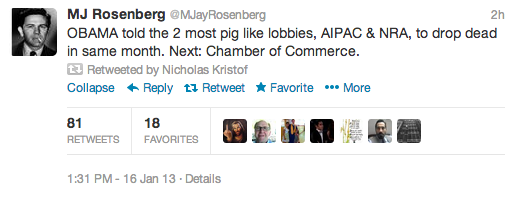
columnist (Nicholas Kristof )is facing criticism after retweeting a controversial message that referred to the American Israel Public Affairs Committee and the National Rifle Association as “the 2 most pig like lobbies” in America.
Longtime Israel critic M.J. Rosenberg, who was dumped by the liberal Media Matters for America for his use of borderline anti-Semitic language, authored the controversial tweet Wednesday afternoon. It called to mind recently unearthed statements by Egyptian President Mohamed Morsi that referred to Jews as “pigs.”
“OBAMA told the 2 most pig like lobbies, AIPAC & NRA, to drop dead in same month. Next: Chamber of Commerce,” Rosenberg wrote.
The missive was then retweeted by Kristof and a slew of others.
this apparently went on the same day that the New York Times attacked Morsi in an editorial criticizing the Egyptian leader for comparing Jews to Apes and Pigs

More Controversy At Democratic National Convention On Support For Israel

Labels: » » »
"Peace and Good Will" at  Democratic National Convention 1872
Credit: Wiki Commons
Now DNC lies about AIPAC?(Daled Amos): More Controversy At Democratic National Convention On Support For Israel

In addition to the controversy surrounding Debbie Wasserman Schultz's claim that Israeli Ambassador Oren thinks Republicans are dangerous, the Democratic Platform is another issue raising doubts about the Democratic Party's support for Israel.
I blogged yesterday asking Can You Guess What Israel Points Are Missing From The 2012 Democratic Platform?, noting omissions from the Democratic Platform first pointed out by the Republican Jewish Coalition both on Twitter and on their website (Democrats Strip Critical Pro-Israel Language from Platform)
In an effort to blunt criticism of their plaform, Democrats have attempted to give it the seal of approval of a major Jewish group: DNC Israel Platform Reviewed, 'Loved' By AIPAC, Sources Say. The result has been another debate on what was actually said.
According to the post, it is true that the 2004 and 2008 platforms had stronger pro-Israel platforms:

But the aide and a second source affiliated with the party -- both of whom were not authorized to speak on the drafting process -- added that officials with the American Israel Public Affairs Committee (AIPAC), the hardline pro-Israel interest group, had reviewed and approved the language prior to its finalization.
"They loved it," said the aide who worked on the platform.
But the question is whether in fact AIPAC actually reviewed and approved -- let alone loved -- the 2012 Democratic Platform.
AIPAC says they didn't.
Instead, their version of the story is very different, namely that AIPAC Not Consulted on Final DNC Platform:

Officials from the American Israel Public Affairs Committee (AIPAC) were not consulted on the final version of the Democratic National Committee’s controversial language regarding Israel and the peace process, a revelation that calls into question numerous reports that the pro-Israel juggernaut was pleased with the party’s platform, according to a source close the group.
“AIPAC officials were not in the room when the platform was drafted,” the source told the Free Beacon Tuesday evening. “AIPAC was never provided with a full draft of the Middle East section of the platform.”
...“Jerusalem as the capital is Israel was part of the AIPAC submission to the platform committee,” the AIPAC source said.
The source claiming AIPAC approved and "loved" the platform is -- like Debbie Wasserman Schultz -- sticking by their story.

Obama makes a bold statement in front of AIPAC. And then takes it back

Labels:
(Daled Amos)Once again, Obama makes a bold statement in front of AIPAC. And then takes it back.

In case you missed Netanyahu at AIPAC

Labels: » »

Anonymous threatens AIPAC

Labels: »
(Carl) The hackers' group Anonymous is threatening AIPAC.
Let's go to the videotape.
I hope AIPAC has Israeli security on their computers. It's the best that's available.
Media_httpuploadwikim_aheoi...I'm so confused with Anonymous. some of their videos are Pro Israel and Muslim Brotherhood sites were shut down by Anonymous.  It is very obvious that the media and blogosphere needs to be very careful in accusing the hacker group of some kind of centralized command. Anonymous has no leader... and because of this... it can be co-opted by a hateful element.

OccupyWallStreet aka OWS supporting Occupy AIPAC

Labels: » »
Barack Hussein Obama's and Debbie Wasserman Schultz's good friends at #Occupy Wall Street announced that they are supporting Occupy AIPAC, after a radical leftist interrupted an AIPAC session about college campuses on Sunday. Let's go to the videotape.

More from Jim Hoft here.
There is a civil war going on over Israel in America. I have no doubt in my mind that this is what is happening... There will be media suppressed violence. There probably already is... no wait. .....I know there is media repressed violence.

Media Matters boss paid former domestic partner $850,000 'blackmail' settlement

Labels: » » » » » » »
(Commentary)“Not only will [the Media Matters controversy] be an election matter, I will personally make it an election matter,” Dershowitz, a professor at Harvard Law School, told WABC’s Aaron Klein today. …AIPAC spokesman Josh Block criticized Media Matters staffers for making anti-Semitic comments late last year, the Truman Institute cut its association with him, claiming Block was trying to shut down “honest debate.”

(EYE)The irony is that this is the man [Brock] who's been pushing to hire private investigators to look into private lives and finances of Fox News personalities in order to destroy them.
(Fox News) Media Matters chief David Brock paid a former domestic partner $850,000 after being threatened with damaging information involving the organization’s donors and the IRS – a deal that Brock later characterized as a blackmail payment, according to legal documents obtained by FoxNews.com.
In an acrimonious lawsuit settled at the end of last year, Brock accused William Grey of making repeated threats to expose him to the "scorn or ridicule of his employees, donors and the press in demanding money and property." Brock claimed in legal papers that he sold a Rehoboth Beach, Del., home he once shared with Grey in order to meet Grey’s demands, which he called "blackmail" in the lawsuit.
Brock, 49, heads the non-profit Media Matters for America, which bills itself as a watchdog of the conservative media but has recently come under fire for allegedly coordinating with Democrats in what could be a violation of its tax-exempt status.
Brock’s bitter legal battle with Grey, who is described in a Sept. 14, 2010, police report obtained by FoxNews.com as his domestic partner of more than 10 years, began after Brock began dating Washington, D.C., restaurant impresario James Alefantis about five years ago. For the next three years, Brock and Grey traded angry accusations, which were documented in the police report and were the foundation of a pitched legal battle replete with charges of blackmail, theft and financial malfeasance.
Read the police report detailing the lawsuit
Alefantis was also named as a defendant in Grey's lawsuit.
In his response to Brock's lawsuit, Grey "denies that he committed any "acts of blackmail.""
Grey threatened to go public about Brock and Media Matters' finances after he accused Brock in a civil suit filed in Washington of taking $170,000 in possessions, including an $8,000 Louis Vuitton suit bag, paintings, a rug, a chandelier, a painted bust of a Roman soldier and a pair of carved wooden chairs upholstered with purple fabric. Those possessions were displayed in the Washington townhouse where the couple entertained liberal movers and shakers in happier times.
Brock took Grey’s threats seriously and called police in 2010. In the police report, filed by Metropolitan Police as a stalking incident, Brock accused Grey, also 49, of attempting to blackmail him with a series of emails threatening to "release specific derogatory information about [Brock] and his organization to the press and donors that would be embarrassing to him and cause harm to the organization …"
Some of those emails came out as the lawsuit, filed by Grey on Jan. 28, 2011, wound its way through Superior Court of the District of Columbia last year.
Read the complete lawsuit filed by William Grey
"Please finish this today so I don’t have to waste my time emailing anyone – Biden, Coulter, Carlson, Huffington, Drudge, Ingraham," Grey wrote in a 2008 email.
Nearly two years later, Grey accused Brock of "financial malfeasance" and threatened to undermine Brock’s fundraising efforts.
"Next step is I contact all your donors and the IRS," Grey wrote in an email dated May 19, 2010. "This is going to stink for you if you do not resolve this now."
Brock said in court papers that he paid Grey "under duress."
On March 8, 2011, Brock filed his own suit against Grey for more than $4 million, demanding Grey return the $850,000, plus pay millions more in punitive damages. The two settled two months ago under terms that remain confidential.(More)
I believe the argument was that gay people should suffer the same way straight people do and therefor they should be considered by law in the same way for marriage... but it appears the shit hits the fan anyway... without gay marriage.

Occupy Birthright Israel, Un-Occupy Palestine

Labels: » » » » » » »
(h/t Carl) what the leftist Jews are up to. They have to reinforce themselves and say everything twice. should anyone feel animosity towards misogyny I suggest they educate these ladies. Listening to their voice is like hearing a fork on a chalkboard. My immediate reaction is one of having to restrain any violent thoughts I have. I'm not sure if they really believe in the cause they are pushing or if they are interested in bothering people. The smirks on their faces betray them. There has got to be a better outlet for the ladies. I'm fairly certain that is Max Blumenthal in the vidie, but not certain. Corrupting the ladies. Some guys will go to incredible lengths to... well you know. Also mentioned in the video is the Jewish Federation. I wish they were the right wing Jews these ladies are making them out to be, because the fact is that they fund many events that are critical of Israel, but this just shows you how far out in left field these freaks are. They have no sense of balance, proportion or reason. AIPAC itself is not the institution that these ladies are making it out to be. Also... another issue. I think this group of leftists are breaking the law. they are infringing the right of an assembly to free expression. (that was proven at U C Irvine in the courts)

Where are the 67 borders?

Labels: » » » » » » » » » » » » »

I have often written about the manipulation of technology to fabricate an ahistorical and counter-factual narrative; for example the replacement geography in Google Earth, and the relocation of East Jerusalem to Palestine in Yahoo Weather. History is a critical part of the Jewish claim to the Land of Israel. Getting it right is important. The current discourse over “67 borders” in the media, blogosphere and social media, presents a narrative so removed from fact that its propagandistic nature can be exposed even by someone with only Google Maps and Wikipedia to guide them. The propaganda has been triggered by discussion over the Palestinian unilateral declaration of statehood. More and more people are speaking about Israel’s borders, and in particular the idea of “returning to the 67 borders.” Those with a knowledge of history would know there is no such thing. For a start, they mean pre-1967, not 1967, and to be fully accurate, they mean boundaries or lines not borders. The loss of the “pre” prefix is the most blatant attempt to wipe clear the historical narrative, see for example the recent Washington Post op-ed by Turki al-Faisal, Saudi Arabia’s Former Ambassador.
Even in Israel there has been a move away from the “green line” to “67 borders,” articles in both Haaretz and Jerusalem Post have used this terminology. This is unsurprising given the use of this terminology by Israeli leaders, the British Prime Minister, and many other. The White House, whatever one thinks of their policy, at least have the terminology right, despite media headlines and reporting to the contrary, at AIPAC, President Obama’s actual words referred to “pre-1967 lines,” a formulation that the White House press office has also used consistently.
The 1949 Armistice Agreement Line shown on Google MapsOn Google Maps the line is clearly and correctly labelled the “1949 Armistice Agreement Line.” In Wikipedia, the article on the Green Line, refers to the boundary as “the demarcation lines set out in the 1949 Armistice Agreements between Israel and its neighbours (Egypt, Jordan, Lebanon and Syria) after the 1948 Arab-Israeli War.” The narrative of ’67 borders is a Palestinian one. It obfuscates the fact that a return to these borders would be a return to the unstable position after the war of independence.
The Wikipedia article itself notes this was never an “international or permanent border,” it also notes the position in international law, expressed by the deputy legal advisor to the US Department of State in the American Journal of International Law (1970). He said “...modifications of the 1949 armistice lines among those States within former Palestinian territory are lawful... whether those modifications are...'insubstantial alterations required for mutual security' or more substantial alterations - such as recognition of Israeli sovereignty over the whole of Jerusalem.” The Palestinian narrative seeks to lock in the minimalist idea of insubstantial changes and make even that look like a serious sacrifice that is almost too much to ask of them.
History is important. Last week was the anniversary of the Six Day war, and the relevance to today was well outlined by David Harris last week. Language and rhetoric are also important. Let’s stop the downwards slide into a Palestinian narrative. Let us begin to speak of the 1949 ceasefire lines, the psychological trauma of insecurity they imposed, the real danger they created in the face of a conventional warfare threat, and why Abba Eban referred to these indefensible borders as Auschwitz borders, meaning they put Jews, at the time many of them Holocaust survivors, again at the mercy of being slaughtered on mass by those who wished them harm. Israel’s recent experience with Hamas in Gaza justifies a continual concern about such dangerous borders. Not only are there the rockets on Sderot, let’s also remember Gilad Shalit kidnapped by terrorists who made the short journey from Gaza almost 5 years ago.
A two state solution is possible, and large parts of the future border may indeed be along the green line, but the negotiation and public discussion must have a basis in history and fact. It cannot be built on the ahistorical changing sands of Palestinian propaganda. In the mean time, all of us, from international leaders and the media to Facebook users, should watch our language and ensure we don’t strengthen a narrative that will lead not to peace but potentially to renewed bloodshed. If, despite all their flaws, Google Maps and Wikipedia can get this right, so can the rest of us.

Ali Abunimah, Edward Said, Rashid Ismail Khalidi, Bill Ayers and Obama

Labels: » » » » » »
From left to right, Michelle Obama, then Illinois state senator Barack Obama,
Columbia University Professor Edward Said and Mariam Said
at a May 1998 Arab community event in Chicago
at which Edward Said gave the keynote speech.
(Image from archives of Ali Abunimah)
“Hey, I’m sorry I haven’t said more about Palestine right now, but we are in a tough primary race. I’m hoping when things calm down I can be more up front.” He referred to my activism, including columns I was contributing to the The Chicago Tribune critical of Israeli and US policy, “Keep up the good work!”
Michelle Obama and Barack Obama listen to Professor Edward Said
give the keynote address at an Arab community event in Chicago, May 1998.
(Photo: Ali Abunimah)
...If disappointing, given his historically close relations to Palestinian-Americans, Obama’s about-face is not surprising. He is merely doing what he thinks is necessary to get elected and he will continue doing it as long as it keeps him in power.  via electronicintifada.net
what Americans Voted for is frightening.  Obama’s hard-Left tilt is real.
It’s time to revisit the issue of President Obama’s Palestinian ties. During his time in the Illinois state senate, Obama forged close alliances with the most prominent Palestinian political leaders in America. Substantial evidence also indicates that during his pre-Washington years, Obama was both supportive of the Palestinian cause and critical of America’s stance toward Israel. Although Obama began to voice undifferentiated support for Israel around 2004 (as he ran for U.S. Senate and his national visibility rose), critics and even some backers have long suspected that his pro-Palestinian inclinations survive.
The continuing influence of Obama’s pro-Palestinian sentiments is the best way to make sense of the president’s recent tilt away from Israel. This is why supporters of Israel should fear Obama’s reelection. In 2013, with his political vulnerability a thing of the past, Obama’s pro-Palestinian sympathies would be released from hibernation, leaving Israel without support from its indispensable American defender.
To see this, we need to reconstruct Obama’s pro-Palestinian past and assess its influence on the present. Taken in context, and followed through the years, the evidence strongly suggests that Obama’s long-held pro-Palestinian sentiments were sincere, while his post-2004 pro-Israel stance has been dictated by political necessity.
Let’s begin at the beginning — with the controversial question of whether Obama’s cultural heritage through his nominally Muslim Kenyan father and his Muslim Indonesian stepfather, along with his having been raised for a time in predominantly Muslim Indonesia, might have had some effect on the president’s mature foreign-policy views. Obama supporters often mock this idea, but we have it on high authority that Obama’s unusual heritage and upbringing have had an effect on his adult views.
Top presidential aide and longtime Obama family friend Valerie Jarrett was born and raised in Iran for the first five years of her life. In explaining how she first grew close to Obama, Jarrett says they traded stories of their youthful travels. As Jarrett told Obama biographer David Remnick: “He and I shared a view of where the United States fit in the world, which is often different from the view people have who have not traveled outside the United States as young children.” Remnick continues: “Through her travels, Jarrett felt that she had come to see the United States with a greater objectivity as one country among many, rather than as the center of all wisdom and experience.” Speaking with the authority of a close personal friend and top political adviser, then, Jarrett affirms that she and Obama reject traditional American exceptionalism. One hallmark of America’s exceptionalist perspective, of course, is our unique alliance with a democratic Israel, even in the face of intense criticism of that alliance from much of the rest of the world.

Edward Said - Orientalism

Center for 'Palestine' Studies
at Columbia University
AKA Bir Zeit on the Hudson
and taqiyyah

Obama’s close friend and longtime ally, Rashid Khalidi, Edward Said’s successor as the most prominent American advocate for the Palestinians, goes further. Khalidi told the Los Angeles Times that as president, Obama, “because of his unusual background, with family ties in Kenya and Indonesia, would be more understanding of the Palestinian experience than typical American politicians.” Khalidi’s testimony is important, since he speaks on the basis of years of friendship with Obama.
Those who know Obama best, then, affirm that his foreign-policy views are atypical for an American politician, and are grounded in his unique international heritage and upbringing. That is important, because our core task is to decide whether Obama’s pro-Palestinian past was a stance rooted in sincere sympathy, or nothing but a convenient sop to his leftist Hyde Park supporters. Jarrett and Khalidi give us reason to believe that Obama’s decidedly pro-Palestinian inclinations are rooted in his core conception of who he is.
Obama came to political consciousness at college, and prior to his discovery of community organizing late in his senior year, his focus was on international issues. Obama’s memoir, Dreams from My Father, highlights his anti-apartheid activism during his sophomore year at California’s Occidental College. Obama’s anti-apartheid stance, however, was part of a far broader and more radical rejection of the West’s alleged imperialism. Obama himself tells us, in a famous passage in Dreams, that he was taken with criticism of “neocolonialism” and “Eurocentrism” during these early college years.
What Obama doesn’t tell us, but what I reveal in Radical-in-Chief, my political biography of the president, is that he was a convinced Marxist during his college years. More important, once Obama graduated and entered the world of community organizing, he absorbed the sophisticated and intentionally stealthy socialism of his mentors. Obama’s socialist mentors strongly supported what they saw as the “liberation struggles” carried on by rebels against American “oppression” throughout the world. So Obama’s continuous radical political history strongly suggests that his early support for Palestine’s “liberation struggle” grew out of authentic political conviction, not pandering.
Although Obama has long withheld his college transcripts from the public, the Los Angeles Times reported in 2008 that Obama took a course from Edward Said sometime during his final two undergraduate years at Columbia University. This was just around the time Obama’s ties to organized socialism were deepening, and certainly suggests a sincere interest in Said’s radical views. As Martin Kramer points out, in his superb 2008 review of Obama’s Palestinian ties, Said had just then published his book The Question of Palestine, definitively setting the terms of the academic Left’s stance on the issue for decades to come.
After Obama finished his initial community-organizing stint in Chicago and graduated from Harvard Law School, he settled down to a teaching job at the University of Chicago around 1992, and went about laying the foundations of a political career. Sometime not long after his arrival at the University of Chicago, Obama connected with Rashid Khalidi.
To say the least, Rashid Khalidi is a controversial fellow. To begin with, although Khalidi denies it, Martin Kramer has unearthed powerful evidence suggesting that Khalidi was at one time an official spokesman for the Palestine Liberation Organization. Also, in the years immediately prior to his friendship with Obama, Khalidi was a leading opponent of the first Gulf War, which successfully reversed Saddam Hussein’s invasion of Kuwait. According to Kramer, Khalidi condemned that action as an American “colonial war,” insisting that before we could end Saddam’s occupation of Kuwait, we would first have to end Israel’s supposedly equivalent occupation of the West Bank and Gaza. As Kramer puts it, Khalidi’s influence helped turn the University of Chicago of the Nineties into “the hot place to be for . . . trendy postcolonialist, blame-America, trash-Israel” scholarship.

Bill Ayers Admits He Wrote Obama's
"Dreams From My Father"
-- Just "Some Guy From the Neighborhood"??

While we don’t know exactly when their friendship began, Khalidi was reportedly present at the famous 1995 kickoff reception for Obama’s first political campaign, held at the home of Bill Ayers and Bernardine Dohrn. That is no minor point. We’ll see that as Khalidi’s close friend and political ally, Ayers played an integral role in the story of Obama’s relationship with Khalidi.
In May 1998, Edward Said traveled from Columbia to Chicago to present the keynote address at a dinner organized by the Arab American Action Network, a group founded by Rashid and Mona Khalidi. We’ve known for some time that Barack and Michelle Obama sat next to Edward and Mariam Said at that event. (Pictures are available.) It has not been noticed, however, that a detailed report on Said’s address exists, along with an article by Said published just days before the event (Arab American News, May 22, June 12, 1998). Between those two reports, we can reconstruct at least an approximate picture of what Obama might have heard from his former professor that day.
For the most part, Said focused his article (and likely his talk as well) on harsh criticisms of Israel, which he equated with both South Africa’s apartheid state and Nazi Germany. Said’s criticisms of the Palestinian Authority also were harsh. Why, he wondered, weren’t the 50,000 security people employed by the Palestinian Authority heading up resistance to Israel’s settlement building? In his talk, Said called for large-scale marches and civilian blockades of Israeli settlement building. To prevent Palestinian workers from participating in any Israeli construction, Said also proposed the establishment of a fund that would pay these laborers not to work for Israel. Presciently, Said’s talk also called on Palestinians to orchestrate an international campaign to stigmatize Israel as an illegitimate apartheid state.
So broadly speaking, this is what Obama would have heard from his former teacher at that May 1998 encounter. Yet Obama was clearly comfortable enough with Said’s take on Israel to deepen his relationship with Khalidi and his Arab American Action Network (AAAN). We know this, because Ali Abunimah, longtime vice president of the AAAN, has told us so.
In many ways, Abunimah is the neglected key to reconstructing the story of Obama’s alliance with Khalidi and AAAN. While Abunimah’s accounts of Obama’s alliance with AAAN have long been public, they are not widely known. Nor have Abunimah’s writings been pieced together with Obama’s history of support for AAAN. Doing so creates a disturbing picture of Obama’s political convictions on the Palestinian question.
In late summer 1998, for example, a few months after Obama’s encounter with Edward Said, Abunimah and AAAN were caught up in a national controversy over the alleged blacklisting of respected terrorism expert Steve Emerson by National Public Radio. In August of that year, NPR had interviewed Emerson on air about Osama bin Laden’s terror network. According to columnist Jeff Jacoby, however, Abunimah managed to obtain a promise from NPR to ban Emerson from its airwaves, on the grounds that Emerson was an anti-Arab bigot. It took Jacoby’s research and public objections to lift the ban.
Attempting to bar an expert on Osama bin Laden’s terror network from the airwaves is not exactly a feather in AAAN’s cap. Yet Obama continued his relationship with AAAN. Abunimah himself introduced Obama at a major fundraiser for a West Bank Palestinian community center a short time later in 1999. And that, says Abunimah, was “just one example of how Barack Obama used to be very comfortable speaking up for and being associated with Palestinian rights and opposing the Israeli occupation.”
The year 2000 saw yet another public clash between Ali Abunimah and Jeff Jacoby over terrorism, along with a deepening alliance between Obama, Khalidi, Abunimah, and AAAN. In May 2000, Abunimah published a New York Times op-ed taking issue with a State Department report on the rising threat of terrorism from the Middle East and South Asia. The report focused on al-Qaeda, in particular. This was one of the most timely and accurate warnings we received in the run-up to 9/11. Yet Abunimah trashed the report. In a longer study released around the time of his op-ed, Abunimah went further, questioning Hezbollah’s designation as a terrorist organization, and suggesting that we ought to be, at the very least, “deeply skeptical” of the State Department’s warnings about Osama bin Laden.
As Abunimah continued to downplay the threat from bin Laden, his ties to Obama deepened. In 2000, AAAN founder Rashid Khalidi held a fundraiser for Obama’s ultimately unsuccessful congressional campaign. Abunimah remembers that Obama “came with his wife. That’s where I had a chance to really talk to him. It was an intimate setting. He convinced me he was very aware of the issues [and] critical of U.S. bias toward Israel and lack of sensitivity to Arabs. . . . He was very supportive of U.S. pressure on Israel.” Obama’s numerous statements over the years criticizing American policy for leaning too much toward Israel were vivid in Abunimah’s memory, he says, because “these were the kind of statements I’d never heard from a U.S. politician who seemed like he was going somewhere rather than at the end of his career.” Obama’s criticism of America’s Middle East policy was sufficient to inspire Abunimah to pull out his checkbook and, for the first time, contribute to an American political campaign.
Within a year, Obama did Khalidi and Abunimah a good turn as well. From his position on the board of Chicago’s Woods Fund, Obama, along with Ayers and the other five members of the board, began to channel funds to AAAN, totaling $75,000 in grants during 2001 and 2002. Now Obama and Ayers were effectively supporting the pro-Palestinian activism of AAAN’s vice-president, Abunimah, and funding an organization founded by their mutual friends, the Khalidis, in the process.

Rashid Khalidi on CNN
with Fareed Zakaria

The Terror and Crime of the
American Task Force on Palestine

In the first year of the Woods Fund grant, Abunimah was the focus of a critical Chicago Tribune op-ed by Gidon Remba, a former translator in the Israeli prime minister’s office. Pointing to Abunimah, among others, Remba decried attempts by “Yasser Arafat’s Arab-American cheerleaders” to “vindicate the resurgence of attacks on Israeli civilians by Palestinian gunmen and Islamic suicide bombers.” Yet Obama and Ayers re-upped AAAN’s money in 2002.
An August 2002 profile of Abunimah in the Chicago Tribune quotes a supporter of Israel noting that, while he has heard Abunimah deplore terrorism, he has never heard Abunimah affirm that he “supports the continued right of Israel to exist alongside a future Palestine.” That is because Abunimah does not appear to recognize such a right. Instead, Abunimah favors a “one-state solution,” in which Israel’s identity as a Jewish state would be drowned out by an influx of Palestinian immigrants seeking the “right of return.” Abunimah’s book, One Country, which spells out his one-state solution, features an extended comparison between Israel and South African apartheid.

MOLOCH, god of the Canaanites

 
...An "alternative history narrative"
has been promoted by Arab propagandists
and their fellow-travellers.

The Palestinian-Jebusite linkage
first appeared in the Arabic literature.
Rashid Khalidi, a Palestinian activist and historian,
wrote that in the mid- or late 1960s,
Palestinian nationalism developed a historiography that
"anachronistically read back into the
history of Palestine over the past few centuries,
and even millennia,
a nationalist consciousness and identity
that are in fact relatively modern."
In an accompanying footnote,
he wrote that this historical "outlook"
created a "predilection for seeing in peoples such as the
Canaanites, Jebusites, Amorites, and Philistines
the lineal ancestors of the modern Palestinians."...
For Bill Ayers, Abunimah’s claims that Israel is an apartheid state, along with his arguments that international law at times licences violent resistance against Israel, surely resonate. As I show in Radical-in-Chief, Ayers has never abandoned his Weatherman ideology. The reason Ayers refuses to repudiate the Weathermen’s terrorist past is that he sees the group’s violent actions as justified resistance to the “internal colonialism” and apartheid of a racist American society. That likely explains why Ayers happily channeled grant money to AAAN, which makes a Weatherman-style argument against Israel.
In the acknowledgments of Resurrecting Empire, a monograph he worked on toward the end of his time in Chicago, Khalidi credits Ayers with persuading him to write it. A core theme of Resurrecting Empire is that the problems of the Middle East largely turn on America’s failure to force Israel to resolve the Palestinian question. This claim that Israel is the true root of the Middle East’s problems is what Martin Kramer identifies, correctly, I think, as the key lesson imparted to Obama by Khalidi.
Khalidi left Chicago in 2003, after the now-famous farewell dinner at which Obama thanked Khalidi for years of beneficial intellectual exchange. The article in which the Los Angeles Times reports on that dinner adds that many of Obama’s Palestinian allies and associates are convinced that, despite his public statements in support of Israel, Obama remains far more sympathetic to the Palestinian cause then he has publicly let on.
Specifically, Abunimah has said that, in the winter of 2004, Obama commended an op-ed Abunimah had just published in the Chicago Tribune, saying, “Keep up the good work!” (This is likely the op-ed in question.) According to Abunimah, Obama then apologized for not having said more publicly about Palestine, but also said he hoped that after his race for the U.S. Senate was over he could be “more up front” about his actual views.
It didn’t turn out that way. Once Obama’s new-found stardom gave him national political prospects, he swiftly shifted into the pro-Israeli camp, to Abunimah’s great frustration. Would a reelected Obama finally be able to be “more up front” about his pro-Palestinian views, belatedly fulfilling his promise to Abunimah? In short, was Obama’s pro-Palestinian past nothing but a way of placating a hard-Left constituency whose views he never truly shared? Or is Obama’s post-2004 tilt toward Israel the real charade?
The record is clear. Obama’s heritage, his largely hidden history of leftist radicalism, and his close friendship with Rashid Khalidi, all bespeak sincerity, as Obama’s other Palestinian associates agree. This is not to mention Reverend Wright — whose rabidly anti-Israel sentiments, I show in Radical-in-Chief, Obama had to know about — or Obama’s longtime foreign-policy adviser Samantha Power, who once apparently recommended imposing a two-state solution on Israel through American military action. Decades of intimate alliances in a hard-Left world are a great deal harder to fake than a few years of speeches at AIPAC conferences.
The real Obama is the first Obama, and depending on how the next presidential election turns out, we’re going to meet him again in 2013.
— Stanley Kurtz is a senior fellow at the Ethics and Public Policy Center, and the author of Radical-in-Chief. via nationalreview.com


Full Text Of Obama's Speech To AIPAC

Labels: » » » » » »

Good morning! Thank you, Rosy, for your very kind introduction. But even more, thank you for your many years friendship. Back in Chicago, when I was just getting started in national politics, I reached out to a lot of people for advice and counsel, and Rosy was one of the very first.  When I made my first visit to Israel, after entering the Senate, Rosy – you were at my side every step of that very meaningful journey through the Holy Land.  And I want to thank you for your enduring friendship, your leadership and for your warm welcome today.
Thank you to David Victor, Howard Kohr and all the Board of Directors.  And let me say that it’s wonderful to look out and see so many great friends, including Alan Solow, Howard Green and a very large delegation from Chicago.
I want to thank the members of Congress who are joining you today—who do so much to sustain the bonds between the United States and Israel—including Eric Cantor,  Steny Hoyer, and the tireless leader I was proud to appoint as the new chair of the DNC, Debbie Wasserman Schultz.
We’re joined by Israel’s representative to the United States, Ambassador Michael Oren.  As well as one of my top advisors on Israel and the Middle East for the past four years, and who I know is going to be an outstanding ambassador to Israel—Dan Shapiro.  Dan has always been a close and trusted advisor, and I know he’ll do a terrific job.
And at a time when so many young people around the world are standing up and making their voices heard, I also want to acknowledge all the college students from across the country who are here today.  No one has a greater stake in the outcome of events that are unfolding today than your generation, and it’s inspiring to see you devote your time and energy to help shape the future.
Now, I’m not here to subject you to a long policy speech. I gave one on Thursday in which I said that the United States sees the historic changes sweeping the Middle East and North Africa as a moment of great challenge, but also a moment of opportunity for greater peace and security for the entire region, including the State of Israel.
On Friday, I was joined at the White House by Prime Minister Netanyahu, and we reaffirmed that fundamental truth that has guided our presidents and prime ministers for more than 60 years—that, even while we may at times disagree, as friends sometimes will, the bonds between the United States and Israel are unbreakable, and the commitment of the United States to the security of Israel is ironclad.
A strong and secure Israel is in the national security interest of United States not simply because we share strategic interests, although we do both seek a region where families and their children can live free from the threat of violence.  It’s not simply because we face common dangers, although there can be no denying that terrorism and the spread of nuclear weapons are grave threats to both our nations.
America’s commitment to Israel’s security also flows from a deeper place —and that’s the values we share.  As two people who struggled to win our freedom against overwhelming odds, we understand that preserving the security for which our forefathers fought must be the work of every generation.  As two vibrant democracies, we recognize that the liberties and freedom we cherish must be constantly nurtured.  And as the nation that recognized the State of Israel moments after its independence, we have a profound commitment to its survival as a strong, secure homeland of the Jewish people.


Fatah Admits It Does Not Recognize Israel

We also know how difficult that search for security can be, especially for a small nation like Israel in a tough neighborhood.  I’ve seen it firsthand.  When I touched my hand against the Western Wall and placed my prayer between its ancient stones, I thought of all the centuries that the children of Israel had longed to return to their ancient homeland.  When I went to Sderot, I saw the daily struggle to survive in the eyes of an eight-year old boy who lost his leg to a Hamas rocket.  And when I walked among the Hall of Names at Yad Vashem, I grasped the existential fear of Israelis when a modern dictator seeks nuclear weapons and threatens to wipe Israel off the map.
Because we understand the challenges Israel faces, I and my administration have made the security of Israel a priority.  It’s why we’ve increased cooperation between our militaries to unprecedented levels.  It’s why we’re making our most advanced technologies available to our Israeli allies.  And it’s why, despite tough fiscal times, we’ve increased foreign military financing to record levels.
That includes additional support – beyond regular military aid – for the Iron Dome anti-rocket system.  This is a powerful example of American-Israel cooperation which has already intercepted rockets from Gaza and helped saved innocent Israeli lives.  So make no mistake, we will maintain Israel’s qualitative military edge.
You also see our commitment to our shared security in our determination to prevent Iran from acquiring nuclear weapons.  Here in the U.S., we’ve imposed the toughest sanctions ever on the Iranian regime.  At the United Nations, we’ve secured the most comprehensive international sanctions on the regime, which have been joined by allies and partners around the world.  Today, Iran is virtually cut off from large parts of the international financial system, and we are going to keep up the pressure.  So let me be absolutely clear – we remain committed to preventing Iran from acquiring nuclear weapons.
Its illicit nuclear program is just one challenge that Iran poses. As I said on Thursday, the Iranian government has shown its hypocrisy by claiming to support the rights of protesters while treating its own people with brutality.  Moreover, Iran continues to support terrorism across the region, including providing weapons and funds to terrorist organizations. So we will continue to work to prevent these actions, and will stand up to groups like Hezbollah who exercise political assassination, and seek to impose their will through rockets and car bombs.
You also see our commitment to Israel’s security in our steadfast opposition to any attempt to de-legitimize the State of Israel.  As I said at the United Nation’s last year, “Israel’s existence must not be a subject for debate,” and “efforts to chip away at Israel’s legitimacy will only be met by the unshakeable opposition of the United States.”
So when the Durban Review Conference advanced anti-Israel sentiment, we withdrew.  In the wake of the Goldstone Report, we stood up strongly for Israel’s right to defend itself.  When an effort was made to insert the United Nations into matters that should be resolved through direct negotiations between Israelis and Palestinians, we vetoed it.
And so, in both word and deed, we have been unwavering in our support of Israel’s security. And it is precisely because of our commitment to Israel’s long-term security that we have worked to advance peace between Israelis and Palestinians.
Now, I have said repeatedly that core issues can only be negotiated in direct talks between the parties.  And I indicated on Thursday that the recent agreement between Fatah and Hamas poses an enormous obstacle to peace.  No country can be expected to negotiate with a terrorist organization sworn to its destruction.  We will continue to demand that Hamas accept the basic responsibilities of peace: recognizing Israel’s right to exist, rejecting violence, and adhering to all existing agreements.  And we once again call on Hamas to release Gilad Shalit, who has been kept from his family for five long years.

OBAMA LIES!!!!!

Demographic threat
hyped up,
Israeli withdrawal
from
Judea and Samaria
unnecessary

And yet, no matter how hard it may be to start meaningful negotiations under the current circumstances, we must acknowledge that a failure to try is not an option. The status quo is unsustainable. That is why, on Thursday, I stated publicly the principles that the United States believes can provide a foundation for negotiations toward an agreement to end the conflict and all claims – the broad outlines of which have been known for many years, and have been the template for discussions between the United States, Israelis, and Palestinians since at least the Clinton Administration.
I know that stating these principles – on the issues of territory and security – generated some controversy over the past few days. I was not entirely surprised. I know very well that the easy thing to do, particularly for a President preparing for reelection, is to avoid any controversy. But as I said to Prime Minister Netanyahu, I believe that the current situation in the Middle East does not allow for procrastination. I also believe that real friends talk openly and honestly with one another. And so I want to share with you some of what I said to the Prime Minister.


Here are the facts we all must confront. First, the number of Palestinians living west of the Jordan River is growing rapidly and fundamentally reshaping the demographic realities of both Israel and the Palestinian territories. This will make it harder and harder – without a peace deal – to maintain Israel as both a Jewish state and a democratic state.


I suppose Obama is talking
about the TECHNOLOGY
being ROCKETS...
which is not new TECH at all....
it is just we have not had people
like Obama in the past
50 years in the U.S.
who have been an obstacle to
protecting Jews from "TECH". 
I suppose BIG OVENS
from the Holocaust
are STATE of the ART as well? 
but hey....
What's a little mustard
and nerve gas
among friends...

Second, technology will make it harder for Israel to defend itself in the absence of a genuine peace.

And third, a new generation of Arabs is reshaping the region. A just and lasting peace can no longer be forged with one or two Arab leaders. Going forward, millions of Arab citizens have to see that peace is possible for that peace to be sustained.
Just as the context has changed in the Middle East, so too has it been changing in the international community over the last several years. There is a reason why the Palestinians are pursuing their interests at the United Nations. They recognize that there is an impatience with the peace process – or the absence of one. Not just in the Arab World, but in Latin America, in Europe, and in Asia. That impatience is growing, and is already manifesting itself in capitols around the world.


Europeans Threaten
to Recognize
Palestinian State
Unless Israel Negotiates
With Terrorist Group


These are the facts. I firmly believe, and repeated on Thursday, that peace cannot be imposed on the parties to the conflict. No vote at the United Nations will ever create an independent Palestinian state. And the United States will stand up against efforts to single Israel out at the UN or in any international forum. Because Israel’s legitimacy is not a matter for debate.
Moreover, we know that peace demands a partner – which is why I said that Israel cannot be expected to negotiate with Palestinians who do not recognize its right to exist, and we will hold the Palestinians accountable for their actions and their rhetoric.


The Hamas-Fatah reconciliation deal

But the march to isolate Israel internationally – and the impulse of the Palestinians to abandon negotiations – will continue to gain momentum in the absence of a credible peace process and alternative. For us to have leverage with the Palestinians, with the Arab States, and with the international community, the basis for negotiations has to hold out the prospect of success. So, in advance of a five day trip to Europe in which the Middle East will be a topic of acute interest, I chose to speak about what peace will require.
There was nothing particularly original in my proposal; this basic framework for negotiations has long been the basis for discussions among the parties, including previous U.S. Administrations. But since questions have been raised, let me repeat what I actually said on Thursday.
I said that the United States believes that negotiations should result in two states, with permanent Palestinian borders with Israel, Jordan, and Egypt, and permanent Israeli borders with Palestine. The borders of Israel and Palestine should be based on the 1967 lines with mutually agreed swaps, so that secure and recognized borders are established for both states. The Palestinian people must have the right to govern themselves, and reach their potential, in a sovereign and contiguous state.
As for security, every state has the right to self-defense, and Israel must be able to defend itself – by itself – against any threat.  Provisions must also be robust enough to prevent a resurgence of terrorism; to stop the infiltration of weapons; and to provide effective border security. The full and phased withdrawal of Israeli military forces should be coordinated with the assumption of Palestinian security responsibility in a sovereign, non-militarized state. The duration of this transition period must be agreed, and the effectiveness of security arrangements must be demonstrated.
That is what I said.  Now, it was my reference to the 1967 lines with mutually agreed swaps that received the lion’s share of the attention. And since my position has been misrepresented several times, let me reaffirm what “1967 lines with mutually agreed swaps” means.
By definition, it means that the parties themselves – Israelis and Palestinians – will negotiate a border that is different than the one that existed on June 4, 1967. It is a well known formula to all who have worked on this issue for a generation. It allows the parties themselves to account for the changes that have taken place over the last forty-four years, including the new demographic realities on the ground and the needs of both sides. The ultimate goal is two states for two peoples. Israel as a Jewish state and the homeland for the Jewish people, and the state of Palestine as the homeland for the Palestinian people; each state enjoying self-determination, mutual recognition, and peace.

...the truth about Resolution 242...
...and the so called 1967 Borders...
...even "with the swaps" of *THE* territories...

If there’s a controversy, then, it’s not based in substance. What I did on Thursday was to say publicly what has long been acknowledged privately. I have done so because we cannot afford to wait another decade, or another two decades, or another three decades, to achieve peace. The world is moving too fast. The extraordinary challenges facing Israel would only grow. Delay will undermine Israel’s security and the peace that the Israeli people deserve.
I know that some of you will disagree with this assessment. I respect that. And as fellow Americans and friends of Israel, I know that we can have this discussion.
Ultimately, however, it is the right and responsibility of the Israeli government to make the hard choices that are necessary to protect a Jewish and democratic state for which so many generations have sacrificed.  And as a friend of Israel, I am committed to doing our part to see that this goal is realized, while calling not just on Israel, but on the Palestinians, the Arab States, and the international community to join us in that effort. Because the burden of making hard choices must not be Israel’s alone.
Even as we do all that’s necessary to ensure Israel’s security; even as we are clear-eyed about the difficult challenges before us; and even as we pledge to stand by Israel through whatever tough days lie ahead – I hope we do not give up on that vision of peace. For if history teaches us anything—if the story of Israel teaches us anything—it is that with courage and resolve, progress is possible. Peace is possible.
The Talmud teaches us that so long as a person still has life, they should never abandon faith. And that lesson seems especially fitting today,
For so long as there are those, across the Middle East and beyond, who are standing up for the legitimate rights and freedoms which have been denied by their governments, the United States will never abandon our support for those rights that are universal.
And so long as there are those who long for a better future, we will never abandon our pursuit of a just and lasting peace that ends this conflict with two states living side by side in peace and security.  This is not idealism or naivete. It’s a hard-headed recognition that a genuine peace is the only path that will ultimately provide for a peaceful Palestine as the homeland of the Palestinian people and a Jewish state of Israel as the homeland of the Jewish people.
Thank you. God bless you. God bless Israel, and God bless the United States of America. 
Sunday, May 22, 2011 Via the White House: via yidwithlid.blogspot.com


Helen Thomas exits anti-AIPAC meeting amid controversy

Labels: » »

 Helen is too Toxic for Code Pink now?
“When Thomas was informed about this, she feared that the focus of the events might shift to her, instead of AIPAC and US policy, and she gracefully withdrew her participation,” the press release by Move Over AIPAC said.

Thomas was quoted by organizers as thanking Move Over AIPAC for inviting her, saying she hoped the conference’s purpose of countering Israel’s perceived influence in Washington will succeed.

Media_httpwwwjpostcom_iwtfe
“I am delighted that people are coming together for this gathering and I want to make sure that the focus stays on AIPAC and US policy, not me,” she was quoted saying by the anti-Israel lobby group.

A week earlier conference organizers announced Thomas would be the keynote speaker at the event in a press release which was removed from the Web on Wednesday.

“We’re delighted to announce that Helen Thomas, who spent her career questioning the powerful and speaking out against war and injustice, will be joining us in DC as a keynote speaker at the Move Over AIPAC,” a press release stated.

Move Over AIPAC has been endorsed by the likes of political scientists Stephen Walt and John Meirsheimer, who wrote a book criticizing the “Israeli lobby” in Washington, and Jewish Voice for Peace, a leftist Jewish organization involved in attempts to break the blockade on Gaza, according to its website.

Several messages and phone calls to Walt, Meirsheimer and JVP went unanswered.

Medea Benjamin, a spokesperson for the event, elaborated on differences of opinion among participants regarding Thomas and her reputation.

“Some within the coalition think that the remarks were anti-Semitic and condemned what she said,” Benjamin said.

“Others thought that it was a slip of the tongue and that her extended comments afterwards were a good explanation. Personally, I’ve been an admirer of her for years and her protest of the Iraq war.”

Asked if inviting a speaker who in the past made inflammatory comments about Jews proved the point of the gathering’s critics that it was pushing an anti- Semitic agenda under the guise of an anti-Israeli lobby event, Benjamin responded in the negative.

“The conference is really to talk about – and many of us are Jews – is to work for a policy where Israel and Palestine can live together in peace and get a process started,” Benjamin, who is Jewish, said.

“My values are Jewish and I believe in compassion for all and AIPAC does not represent my Jewish values. Helen Thomas is one of 30 people who have been invited and we are a community
via jpost.com
I can not see the difference between any of these people.image via uncoverage.net

AIPAC differs with Cantor on Israel aid?

Labels: »

Eric Cantor's suggestion that aid to Israel be removed from the foreign aid budget, driven by broader Republican opposition to much foreign operations spending, is drawing a rare, if gentle, rebuke from the high-powered pro-Israel group AIPAC.
Nita Lowey (D-NY)
“For decades, annual U.S. foreign assistance to Israel has been one of the most tangible expressions of American support for Israel and our country’s national security interests. A robust foreign aid budget is a strong signal of U.S. leadership around the globe," said AIPAC spokesman Darren Mackoff. “Congressman Cantor has always been, and continues to be a strong leader on the vital issues surrounding the United States and Israel, as well as an ardent supporter of U.S. foreign aid."
AIPAC has traditionally been a major force in lobbying for aid to Israel, Egypt, and for foreign aid in general.
Lowey disparaged the idea Monday as "reckless" and "outrageous."
“Minority Whip Cantor’s proposal is as transparent as it is reckless," Lowey said in a statement. "Manipulating aid to Israel in this way would dangerously threaten continued bipartisan agreement on national security policy and programs other than direct assistance to Israel that aid in its security."
What's more, Lowey said, the foreign ops bill Cantor said the GOP may vote against "funds U.S. diplomatic efforts at the State Department, including diplomacy related to peace in the Middle East. It aids other countries in the region to help defeat al Qaeda and other terrorist organizations and includes non-proliferation initiatives," she said. "Because it is inextricably linked with broader U.S. national security goals, separating assistance for Israel in order to make it easier for Republican members to vote against the foreign aid bill would be counterproductive.
“Too much is at stake to give Republicans in Congress a license to vote against the foreign aid budget, and it is clear that Eric Cantor’s outrageous proposal is based purely on political motives, not what is best for U.S. or global security," she concluded.
Carl:

The idea of cutting the State Department's budget or cutting aid to the 'Palestinians' or Lebanon or Egypt by forcing them to be voted upon separately from aid to Israel is actually appealing. My concern is what happens when there is a different Congress, a different President and maybe even a different Foreign Appropriations Committee chair. My concern is the JW Fulbright scenario.
But I'm still reserving judgment.
via israelmatzav.blogspot.com

Then later Carl changes his mind:
AIPAC is an interested party here. If what Cantor is proposing goes through, it would likely have much less to say about aid to recipients other than Israel.  But what this proposal reminds me of more than anything else is the line-item veto - what every President wants regarding the budget generally and what no Congress is likely to give him. (A line item veto would allow the President to veto individual spending items in the budget).  The 112th Congress would be most unlikely to give this President a line-item veto in general. Why give him one with respect to Israel?
I like and think very highly of Eric Cantor, but I think I'm coming out against this.
via israelmatzav.blogspot.com

Not sure I agree Carl.  It is important that America clarifies it's relationship to Israel.  For too long it has been shrouded as being normal.   It is not normal.  It is an intimate special relationship that has complexities that other foreign aid does not have.   Israel does not have to worry about standing out.  Israel already does stand out and people are paying attention.  If a leader really wants to screw over Israel he can find ways.  It's amazing how an obsessive bigot can subvert any system.  It is best that the system is as clear as possible as to intent.  Otherwise Israel's enemies will use opaque government as something they can blame on the Jews.

Translate