Showing posts with label AKP. Show all posts

Court Refuses to Free Scribes: And more from the Turkish Press

Labels: » » » » » » » » » » » » »
(hudson-ny.org) An Istanbul court refused to release arrested journalists Ahmet Şık and Nedim Şener, as well as 12 other suspects, in the first hearing of an alleged coup plot case Monday.

Fourteen suspects, including journalists Şık, Şener and Soner Yalçın, the owner of the dissident online news portal Oda TV, are accused of ties to Ergenekon, an alleged ultranationalist gang accused of plotting to overthrow the government. The 14 appeared before Istanbul's 16th High Criminal Court on their 265th day of arrest, prompting anger from colleagues and representatives from local and international journalistic organizations at the slow pace of the legal process.

Philippe Leruth from the European Federation of Journalists, or EFJ, highlighted the importance of support during a protest in front of the courthouse.

"Everybody has to understand that if there are concerns about press freedom, it means democracy is in danger," he said. "I hope this will make [the government] think more about this case, especially during a time when many 'Arab Spring' countries are taking Turkey as a model for democracy."

Ümit Gürtuna, the spokesman of the Platform of Freedom for Journalists, said there were nearly 10,000 cases in Turkey involving journalists and that the number of arrested journalists had now reached 76. Gürtuna also said Turkey was at the top of the list in terms of the number of journalists that have been arrested.

"This is a shame for a country that is trying to improve its democracy," he said.

Suspect Kaşif Kozinoğlu, a former intelligence operative, was scheduled to appear in court Monday as well, but he died of a heart attack Nov. 12 in prison.

The court decided to postpone the trial until Dec. 26.

During the trial, the defense lawyers also demanded that the judges be recused from the case; a higher court is expected to rule on the demand some time next week.

A row broke out between members of the press and security guards in front of the hearing room at Istanbul's Çağlayan Courthouse just prior to the beginning of the trial.

Due to the intense attention the case has attracted, the trial was held in the larger hall of the First Court of Serious Crimes. A quota of three persons was allocated to the families and acquaintances of the suspects, 20 for the Turkish press and 10 for the international press. Despite the quotas, however, many local journalists were turned away from the trial room as members of the international press were given priority for entry into the courtroom.

There was a separate row between the security guards themselves as the guards standing in front of the hearing room argued with security personnel in charge of registering the names of journalists during the morning.
http://www.hurriyetdailynews.com/n.php?n=court-refuses-to-free-scribes-2011-11-22


The Ergenekon investigations have divided the Turkish population. To some they represent the “cleansing of the century”.[21] To its detractors the Ergenekon investigation is politically motivated; the alleged organization itself a deliberate fabrication by government sympathizers.[21] Criticism grew stronger after the arrest of journalists in February and March 2011.[75] Even the biggest fans of the government worry that the legitimacy of the Ergenekon case is being dented by heavy-handed tactics such as the arrests of Ahmet Şık and Nedim Şener.[76] The real goal of the Ergenekon investigation was not to go after the deep state but to intimidate and silence opponents of Turkey’s ruling Justice and Development Party (AKP), particularly critics of the vast network of Gülen’s supporters known as the Gülen Movement.[10]
Ergenekon (organization) - Wikipedia, the free encyclopedia)

Qatar’s Sunni Side

Labels: » » » » » » » » » » » » »
(Crethi Plethi)How could Qatar’s foreign policy best be defined during the Arab Spring? In the midst of the conflict between Gaddafi’s forces and the rebels in the Libyan civil war, Qatar was hailed by Barack Obama in April for building a broad coalition of international support for the NATO campaign against Gaddafi. Obama also hailed the emir of Qatar for supposedly being a pragmatic mediator and negotiator in the wider region.Indeed, as the Guardian puts it, the country has a reputation for “a cautious but active foreign policy.” Other analysts have seen Qatar as a nation playing both sides in the Middle Eastern Cold War between the Saudi-led “status-quo bloc” and the Iranian-led “resistance” bloc.
For example, although Qatar has maintained good economic and diplomatic ties with Tehran, it has also hosted American military bases and CENTCOM, besides having limited trade relations with Israel.
However, I prefer to advance the following thesis: Qatar’s foreign policy at present is based on the principle of promoting Sunni interests, and where possible, the interests of Sunni Islamists.
For instance, recently the country has come under criticism from some Western diplomats and the National Transitional Council (NTC) for its role in Libya. As the Wall Street Journal notes, Qatari aid has circumvented the NTC, and has been provided to independent rebel militias dominated by Islamist commanders.
Two individuals particularly favored by Qatar are the Islamist leader of the Tripoli Military Council — Abdul-Aziz Belhaj, who is generally not trusted by rebels in and around Misrata, and Sheikh Ali Sallabi, a Libyan cleric currently living in Qatar’s capital and with close ties to Belhaj. Tensions have emerged between Sallabi and Mahmoud Jabril, the interim prime minister for the NTC described as a “tyrant in waiting” and part of a group of “extreme secularists” by Sallabi.
Meanwhile, when it came to the Syrian uprising, in which the Sunni Islamist Muslim Brotherhood could well be playing a prominent role in the opposition to the Alawite-dominated government, Qatar quickly transformed from an ally into a harsh critic of Assad’s regime. Al-Jazeera’s Arabic channel rapidly expanded its coverage of protests in Syria, and Yousef al-Qaradhawi, host of al-Jazeera’s “Shari’a and Life” show, called for the Baathist regime to be removed from power.
The cleric criticized Assad as someone “held prisoner by his entourage and the [Alawite] sect.” Al-Jazeera, it should be noted, is owned by a member of the Qatari ruling dynasty, and its Arabic channel is certainly aligned with Qatar’s foreign policy agenda, intended for Middle Eastern audiences and very different from the English version that is aimed at international viewers outside the region.
The latter’s remarks particularly annoyed the Syrian government, leading to a suspension of ties between Syria and Qatar as Assad reportedly told the Qatari emir’s emissary that al-Qaradhawi must apologize for his statements if there are going to be friendly relations again.
And so it is that al-Jazeera’s Arabic channel has been more than happy to provide coverage of demonstrations in Egypt, Tunisia, and Yemen, all of which are places where Sunni Islamists can be empowered (the Muslim Brotherhood, the Ennahda party, and the Islah party respectively). Yet al-Jazeera’s Arabic channel generally ignores the unrest in Bahrain and eastern Saudi Arabia, both with Shi’a majorities protesting against Sunni rule.
Bahrain is a country marked by Sunni minority rule at the cost of significant sectarian discrimination against the Shi’a majority. In fact, Qatar has even aided Saudi Arabia and the Gulf Cooperation Council in sending troops to assist the regime in quelling the protests.
As for eastern Saudi Arabia, a perusal of al-Jazeera’s Arabic news site reveals no coverage of protests there. As Asad Abu Khalil of “The Angry Arab News Service” correctly notes (for once), “to verify what is going on in Saudi Arabia, al-Jazeera asked its famous witness, Abu Muhammad in Idlib, if he saw protests from his window. Abu Muhammad said that he couldn’t see anything and al-Jazeera accordingly reported that all is well in the kingdom.”
Finally, in keeping with Qatar’s warm ties with Turkey under the Islamist AKP, al-Jazeera’s Arabic channel has tended to provide uncritical coverage of the prime minister Erdoğan’s efforts to bolster his image as a friend and helping hand for the Arab world, while not mentioning the water crises Turkey’s dam projects in Anatolia have helped to trigger in Iraq and Syria. To be sure, the policy predates the AKP government’s accession to power in 2002, but has only expanded and accelerated under Erdoğan.
Unfortunately, there has been a far too widespread tendency, both in the media and in policy circles, to see Qatar either as a moderate Western ally in the ongoing unrest as part of the Arab Spring, or somehow as an advocate for liberal democracy and reform in the Middle East and North Africa. Rather, its true Sunni sectarian and pro-Islamist agenda needs to be recognized.
Aymenn Jawad Al-Tamimi is a student at Brasenose College, Oxford University, and an intern at the Middle East Forum.

Turkey's state TV: Ruling party wins election - Israel News, Ynetnews

Labels: » »
Absolute power can be voted in. Don't be shocked. people voted for Hamas and Hitler too. A Republic, if you can keep it said Benjamin Franklin...
Islamist and Turkish
Prime Minister
Recep Tayyip Erdogan...
Turkey's state-run television says the ruling party of Prime Minister Recep Tayyip Erdogan has won a third term in parliamentary elections.
The website of the television station, TRT, is carrying a headline that says: "Turkey decides to continue with AK Party." (AP)

First the Leaks, Then the Dark Theories : Wikileaks an anti-Turkish plot engineered by Israel

Labels: » » » » » » » »
ZBIGNIEW BRZEZINSKI isn't the only person who is spinning the facts. We also have a few wackadoos on friendfeed
In Turkey and beyond, the release of U.S. diplomatic cables on website WikiLeaks has sparked a round of conspiracy theories.

Turkish leaders appear convinced that state actors, in particular the U.S. itself or Israel—rather than Julian Assange of WikiLeaks—are behind the release of U.S. State Department cables, whose contents have embarrassed leaders around the globe.

The skepticism about WikiLeaks' independence is widespread and appears to be rooted in sheer disbelief that the world's most powerful nation can't stop its secrets from spilling onto the Internet. That sentiment pairs with a willingness to believe the worst of Israel. Neither is limited to Turkey.

"Undoubtedly, the Western governments and the Zionist regime were involved," said Iran President Mahmoud Ahmadinejad earlier this week.

Meanwhile, on Wednesday, Russia's Prime Minister Vladimir Putin offered up on CNN's Larry King Live that "experts" believe WikiLeaks is being deliberately "inflated" by others, to be used for political purposes at a later date.

"Assange clearly has very well-informed high-level protectors who aren't for the first time 'leaking' strictly secret documents to him by the ton. There is no doubt that these protectors have their own, far from altruistic, goals," wrote the official Rossiskaya Gazeta on Thursday, surmising that U.S. officials were trying to revive a "rusted-through American bureaucratic machine."

"It could be Barack Obama himself," the newspaper said.

"No one in the United States government with a brain in their head wanted to see this happen," said State Department spokesman P.J. Crowley. "This is a crime, not grand strategy. We will work through it, but it has done substantial damage."

Turkish conspiracy theorists have long speculated that Israel is seeking to get rid of an Islamic-leaning Turkish government that has turned sharply against its former ally. The alleged Israeli goal, these people say, is to replace the Justice and Development party's rule with a more friendly Turkish regime.

The WikiLeaks documents include reports of widespread corruption among government ministers, including Prime Minister Recep Tayyip Erdogan and his family, which opposition leaders have sought to highlight, triggering a furious response from the prime minister.

Turkish President Abdullah Gul started the ball rolling earlier this week, when he said of the cable leakage: "I think it has a system. It seems that it has an aim."

Huseyin Celik, spokesman for the Justice and Development party, or AKP, said Wednesday that Israel was behind the document release. The evidence, he told reporters, was that "Israel is very pleased" and was so quick to say it had nothing to fear.

"How did they know that?" Mr. Celik asked, adding that "the main goal of these leaks was to weaken the Turkish government."

The Israeli Embassy in Ankara issued a statement Thursday denying any role in the WikiLeaks release of some 250,000 documents.

Some Turkish newspaper columnists see more complex forces at work. It's a plot by a global "deep state," a kind of rogue organization within the North Atlantic Treaty Organization that aims to weaken President Barack Obama, reshape the geopolitical playing field in Europe and the Middle East and whip Turkey into line, according to a Thursday column by Samill Tayyar of the religious conservative Star newspaper.

Comments from newspaper readers suggest the conspiracy theories are widely believed. "This has been prepared by the U.S. and Israel, it is one way to start the World War III from the Middle East by setting the Muslim countries against each other," said one reader of Hurriyet, the daily paper of Turkey's secularist establishment.

Not everyone is buying it, though. "Turkish AKP Party Members reveal: 'Israel is responsible for the extinction of the Dinosaurs,'" commented one reader on Mr. Celik's claims, on Hurriyet's English-language newspaper site.

On Thursday, after returning from meeting other leaders and U.S. Secretary of State Hillary Clinton in Kazakhstan, Mr. Gul appeared to have changed his tune.

"I don't believe much in these conspiracy theories," he said on Turkey's NTV television. "All of the documents have not been released yet, as far as I know, so maybe some will come out [about Israel] later."
The Turks have become as predictable and paranoid as the Arabs (Hat Tip: Martin Kramer and Memeorandum).
Israel could have engineered the release of hundreds of thousands of confidential documents on WikiLeaks as a plot to corner Turkey on both domestic and foreign policy, according to a senior ruling party official.
“One has to look at which countries are pleased with these. Israel is very pleased. Israel has been making statements for days, even before the release of these documents,” Hüseyin Çelik, deputy leader of the Justice and Development Party, or AKP, and the party’s spokesperson, told reporters at a press conference Wednesday.
Following initial reaction to the leaked U.S. Embassy cables, which have revealed diplomatic secrets about Turkey, Azerbaijan, its Middle Eastern neighbors, Turkish officials have started to suspect that “the main cause of these leaks was to weaken the Turkish government.”
...
The first signal came from President Abdullah Gül, who said Tuesday the leaks seemed to be a result of a systematic work with some purpose behind it.
Though government officials like Deputy Prime Minister Cemil Çiçek avoided naming Israel in their public statements Wednesday, Çelik, a close aide to Prime Minister Recep Tayyip Erdoğan, singled out the country with his comments Wednesday.
“Documents were released and they immediately said, ‘Israel will not suffer from this.’ How did they know that?” Çelik said.
Are they selling the Protocols of the Elders of Zion on the streets of Ankara yet? I'm sure it's a best seller in the Turkish government.
the conspiracies are becoming more elaborate by the day. by the end of the week they will be slick enough for a printable brochure or PDF and by next month you can expect a coffee table book

Turkish Media State - A MONOPOLY

Labels: » » » » »
how does a obviously false portrayal of the Mavi Marmara incident get made into a film?
Deep ignorance: Most Turks know nothing about what really happened on the "Mavi Marmara" 


So far, yet close: The exiled Fethullah Gülen 
When Western journalists note in a casual aside that press freedom has experienced certain setbacks under the AKP, they are failing to do justice to the severity of this calamity and its ramifications for Turkey and the region. The calamity is exacerbated by the tendency of the foreign media to repeat, without scrutiny, the very idiocies peddled in the Turkish press, where the range of opinion on offer has become severely limited. The result is the growth of a grossly distorted and dangerous consensus about Turkey, here and abroad — to wit, that Turkey under the AKP has become more democratic and politically healthier, even if it is a bit up the duff with Islamism.
When the AKP took power, four large private groups owned almost all the country's media-a concentration of power already far too dense for political health. The largest was the Dogan group, which controlled some 70 per cent of the nation's print and broadcast outlets. The group enjoyed warm relations with the AKP until 2007. Then its outlets began reporting details of the Deniz Feneri scandal, the biggest charity corruption case in German history. Billions of dollars raised by this Islamist charity, Dogan newspapers announced, had found their way into AKP coffers. Soon thereafter, the Turkish Ministry of Finance began investigating the group, then levied upon it the largest tax fine ever assessed on a Turkish company. The company is appealing, but if the appeal fails, it will be annihilated. 
Then there is Sabah, the second-biggest media conglomerate, which controls the largest-circulation daily in Turkey and the powerful ATV television channel. Facing bankruptcy in 2007, it went up for sale. Curiously, all but one bidder dropped out at the last minute. The bidder left standing was the Calik group, whose CEO is Prime Minister Recep Tayyip Erdogan's son-in-law, Berat Albayrak. A Qatari company, Al-Wasaeel, mysteriously swam up from nowhere to partner Calik's bid — in defiance of Turkish law, which forbids the foreign financing of the media — and two state banks led by figures close to the AKP, Halk and Vakif, lent Calik $750 million to finance the transaction, even though private banks in Turkey and abroad had declined. 
Associates of the sect leader Fethullah Gülen, who has been exiled in the US since 1998, control many of these media outlets. No one is quite sure what the reclusive Gülen's agenda really is, but there is no doubt that before the AKP came to power, he was prosecuted here for trying to establish an Islamic state. Nor is there any doubt that he is close to, and supportive of, the AKP. When Gülen is mentioned in the Western press, usually in passing, almost never is the most important fact about him noted: many Turks fear he's their Ayatollah Khomeini. I do not know if they are right. But I don't know that they're wrong, either, and the people here who tell me his influence is a major cause for concern have proved right about many things. Outside a handful of academic publications, Gülen's name is rarely mentioned in the Western media, and when it is, he is usually described — as the New York Times recently put it — as a "provincial Turkish preacher" who organises inspiring summer camps.
The AKP has by this means brought under its influence most of the media in Turkey, and what it hasn't purchased or neutered, it has terrified. Since taking office in 2003, Erdogan has launched an energetic series of lawsuits against Turkish journalists and cartoonists for character defamation. No one knows how many have been sued, though the number is probably in the hundreds, and Erdogan has refused to answer this question when asked in parliament. 
Then there is the hydra-headed Ergenekon case. Ergenekon, supposedly, is an ultra-nationalist terrorist gang that schemed to foment unrest in Turkey by blowing up mosques full of supplicants, shooting down Greek fighter planes and assassinating the Turkish Nobel laureate for literature Orhan Pamuk. The unrest unleashed by this, according to prosecutors, was to be used as a pretext to topple the AKP. A sprawling investigation into this alleged network of shadowy coup-plotters has resulted in the arrest of many prominent journalists critical of the AKP, including the Ankara bureau chief of Cumhuriyet, who is still rotting in jail. Last year, in protest, the front page of Cumhuriyet was left blank but for the words: "If we go silent, who will speak?" I don't recall seeing this reported anywhere in the international press. If it was, I will assume charitably, David Cameron merely overlooked it. Surely he would not deliberately have ignored it. That would have been cynical.
The government, meanwhile, has been locking down larger and larger portions of the internet: more than 1,000 websites have been banned, among them YouTube. Most of these bans have been initiated by the judiciary, not the executive, but the AKP has done nothing to change the laws the judiciary is enforcing.
So what's left? Chiefly such newspapers as Zaman and Yeni Safak — the AKP's unofficial mouthpiece — which are staunchly Islamist and connected to or controlled by the AKP or the Gülen media empire. Now, cronyism and government influence over the media is nothing new in Turkey; it would be completely misleading to suggest otherwise. What's new, and disturbing, is the agenda this media consolidation is now serving and the eagerness of foreign journalists to swallow it whole and promote it.

Who lost Turkey?

Labels: » » » » » » » » » » » »
Obama and the E.U. know exactly what is going on... they intend on pointing out that Turkey became allied with Iran during the Bush administration... but as you can see Obama is selling advanced weapons to a country that has already shown it's intent.
President Barack Obama praised the plebiscite as proof of the "vibrancy of Turkish democracy." As Michael Rubin has noted in National Review, not only has Obama approved the sale of 100 F-35 Joint Strike Fighters to Turkey, the Defense Department has demurred from conducting a study to see whether the sale will threaten US interests in light of Turkey's burgeoning strategic ties with Iran. And not wishing to embarrass the administration that has given a full-throated endorsement to Erdogan's regime, the Democrat-controlled Senate Armed Services Committee has refused to ask the Pentagon to conduct such a review.
After the Obama administration canceled the F-22 project, the F-35 will be the US military's only advanced fighter. In light of its strategic alliance with Iran, Turkey's possession of the jets could constitute a serious threat to US air superiority in the region.
As for NATO, the US's most important military alliance had no comment on Turkey's rolling Islamic revolution. This is not in the least surprising. NATO has stood at a distance as Turkey has undermined its mission in Kosovo and transformed it into a virtual Turkish colony. So too, NATO has had no comment as Turkey has worked consistently to disenfranchise Bosnia's non-Muslim minorities and intimidate the Serbian government. At this late date, it would have been shocking if NATO had a comment of any kind on the AKP's consolidation of its Islamist thugocracy.
Iran, for its part, is not at all squeamish about both recognizing the significance of events in Turkey and extolling them. It has reportedly agreed to contribute $25 million to the AKP to help Erdogan in his bid for reelection next year. Turkish-Iranian trade has gone up 86 percent in the past year.
In a visit to Istanbul this week, Iranian Vice President Mohammad Reza Rahimi said, "Turkey is the best friend of Iran in the world. Turkey is very important for Iran's political and economic security. Our Supreme Leader [Ali] Khamenei also asks for acceleration of political, economic and security relations with Turkey."
And still the West sleeps.
As it watched the AKP's steady transformation of Turkey from staunch ally to staunch enemy, for seven years Israel tried to make light of what was happening. Indeed, its decision to opt for denial over strategic disengagement prompted it to continue selling Turkey state of the art military equipment. The IDF now acknowledges that Turkey has shared this equipment with the likes of Syria and Hizbullah.
Israel hoped that Turkey would grow so dependent on its military relationship that it would abandon its intention to ditch the alliance. That foolish hope was finally destroyed when Turkey committed an act of war on the high seas on May 31 with its terror flotilla to Gaza.
EVERY MOVE since then to make light of Turkey's actions has been shot down by yet another Turkish affront. In its latest slight, Turkey loudly announced that Gul will not have time to meet with President Shimon Peres at the UN General Assembly in New York this week while Gul was only too pleased to free hours from his schedule to meet with Iran's Mahmoud Ahmadinejad.
And still, perhaps out of deference to Obama, Israel has remained circumspect in its statements about the dangers Islamist Turkey poses not only to it but to the free world as a whole. And this is a shame. But then, it is hard to imagine Israeli warnings making any difference.
The US and Europe's refusal to consider the implications of Turkey's abandonment of the West in favor of Iran goes hand in hand with their abandonment of the cause of liberalism throughout the Middle East and the world as a whole. Among other things, their dangerous behavior is emblematic of their consummate elitism.
The likes of Obama and the heads of Europe view their own publics as mere nuisances. For Obama, the groundswell of opposition to his radical and failed economic reforms doesn't indicate that there is something wrong with what he is doing. As he has made clear in repeated statements in recent weeks, as far as he is concerned, his steady loss of support is simply proof of the American people's ignorance.
As for Europe, it is not a great stretch to say that the entire EU is an elitist project consolidated against the will of the peoples of Europe. The EU leadership thought nothing of ramming its expanded powers down the throats of its unwilling constituents. After the Lisbon Treaty was rejected in referendum after referendum, Europe's leaders conspired to pass it by bureaucratic fiat.
This contempt for their own people leads the leaders of the West to disregard human rights abuses from China to Syria as unimportant. So too, it has paved the path for Obama's courtship of the Muslim Brotherhood in the US and Egypt and his decision to back the mullahs against the Iranian people in the aftermath of the stolen presidential election in June 2009.
I'm not sure it will help things to realize what is going on... because the damage is already done. We (including Israel) are arming our enemies with the best technology. read the whole thing.

meanwhile it Turkey....
Police are searching for protestors who booed the prime minister following the FIBA 2010 World Basketball Championship final in Istanbul after identifying them in security footage from the arena, private news site CNNTürk reported Saturday.
The Istanbul Police Sports Security unit asked for video footage of the ceremony held after the match between Turkey and the United States in Istanbul on Sept. 12. Twenty people were identified in the footage and one of them, a minor, was detained. He was later released after a court decision.

Erdoğan was booed at the award ceremony honoring the world's top two basketball teams. Politicians at the event reacted negatively to the jeering, while basketball players also criticized the protestors.

Team captain Hidayet "Hedo" Türkoğlu, who plays for the Phoenix Suns in the NBA, apologized to the prime minister for the protest and center Semih Erden also criticized the act, saying sports should not be mixed with politics.
HUDSON NY EDITOR'S NOTE: This newspaper, Hurriyet (meaning Freedom), is about to be fined out of existence, unless it wins on appeal. And who controls the judiciary now ... ?
Strictly speaking, the Turkish constitution says this:
Article 25 Freedom of Thought and Opinion
Everyone has the right to freedom of thought and opinion. No one shall be compelled to reveal his thoughts and opinions for any reason or purpose, nor shall anyone be blamed or accused on account of his thoughts and opinions.
Article 26 Freedom of Expression and Dissemination of Thought
(1) Everyone has the right to express and disseminate his thoughts and opinion by speech, in writing or in pictures or through other media, individually or collectively. This right includes the freedom to receive and impart information and ideas without interference from official authorities. This provision shall not preclude subjecting transmission by radio, television, cinema, and similar means to a system of licensing.
(2) The exercise of these freedoms may be restricted for the purposes of protecting national security, public order and public safety, the basic characteristics of the Republic and safeguarding the indivisible integrity of the State with its territory and nation, preventing crime, punishing offenders, withholding information duly classified as a state secret, protecting the reputation and rights and private and family life of others, or protecting professional secrets as prescribed by law, or ensuring the proper functioning of the judiciary.
(3) The formalities, conditions and procedures to be applied in exercising the right to expression and dissemination of thought shall be prescribed by law.

Kemal Kılıçdaroğlu

Labels: » » » » » » » »

First the Green Revolution in Iran turned out to be run by a man who was as bad as the established regime and now Turkey supposedly has a resurfacing opposition to the Islamists,

Turks Turn on Islamist Government?
Gaza flotilla backfires at home.

BY
Adam Brickley weeklystandard.com
Kemal Kılıçdaroğlu is probably the happiest man in Turkey right now. He's just inherited the leadership of the country's secular socialist opposition, and now he's reaping the benefits of an incredibly boneheaded move by the "moderate" Islamists who run the country.


A recently released poll shows the governing Justice and Development Party (AKP) of Prime Minister Recep Tayyip Erdogan slipping out of first place for the first time in years. Instead, Kılıçdaroğlu's Republican People's Party (CHP) has inched to a razor-thin lead. If these numbers were to hold through next year's election, the AKP's Sunni Islamism will be dealt a heavy repudiation -- as Kılıçdaroğlu is a member of the minority Alevi religious sect. He could also be Turkey's first Kurdish Prime Minister -- depending on whether or not one considers his Zaza ethnicity to be a Kurdish subgroup or a separate people (either way he's not an ethnic Turk).

Now, this success is partly due to the fact that Kılıçdaroğlu is enjoying a surge of personal popularity as he tries to modernize the party founded by Kemal Ataturk. However, it also appears that Erdogan's heavy support of the Gaza "aid" flotilla has blown up in his face -- and that his gradual Islamization of the government may have reached a point where the public is ready to pull the plug.

To be fair, Kılıçdaroğlu has joined Erdogan in heavily condemning the Israeli raid on the flotilla -- but he has also blasted Erdogan for needlessly provoking Israel. So, now that the prime minister has marched into a full-blown religious confrontation with the Jewish state, the electorate is opting for a more fair-minded leader who concerns himself with national interest over religious zealotry.

How European Tolerance Islamized Turkey and http://xrl.us/ObamaTurkey

Labels: » » » » » » » »

Cartoon In Saudi Daily: An Increasingly Exposed Israel Fans Flames Of War In Kurdistan To Strike At Turkey Source: Al-Watan, Saudi Arabia, June 21, 2010 via thememriblog.org
This week Turkish forces invaded Iraq and its warplanes bombed 7 Kurdish villages killing a teenage girl and wounding her mother and 3 year old sister. A week ago Iran had done the same things, killing a 14 year old girl and a 45 year old woman. There are no shouts of protest. No worldwide demonstrations. The Obama administration and the media did not deliver any lectures on disproportionate force. Not even when Erdogan vowed to drown the Kurdish rebels "in their own blood". Instead Ambassador James J. Jeffrey slavishly rushed to assure Turkey's Thug in Chief Erdogan that the PKK was also America's enemy and promised to "urgently" review any request for help against them. No such help was offered to the Kurds, whose villages were being bombed from the sky using planes sold to Turkey by the United States. Despite the fact that Iraqi Kurds, unlike Turkey, supported the US liberation of Iraq. Because that's what friends of the United States get from the Obama Administration. A kick in the face. And what our enemies get is a slobbering kiss on the cheek.
As part of its demagogic assault on Israel, the Islamist regime has now claimed that Israel is fomenting a coup within Turkey. I can state for a fact that this isn't true. There will be no coup for several reasons: the armed forces are intimidated by verbal attacks and arrests, its leaders don't want to set off a civil war, and they know that no Western government-and especially the United States-would support them.
What's really happening is a coup against the armed forces through lies, arrests, and political pressure by the Islamist regime. But that doesn't mean the generals and soldiers are happy with the destruction of the republic created by Kemal Ataturk and of Turkish democracy in general.
 via rubinreports.blogspot.com
Another discontented institution the regime wants to crush is the Foreign Ministry. Now several retired ambassadors have publicly complained about how demagogue-in-chief Prime Minister Recep Tayyip Erdogan is pursuing against them. They watch in sadness as the Islamist regime throws away decades'-old connections with the West in pursuit of his effort to be Iran's number-one ally.
via rubinreports.blogspot.com
For months and up to the very last minute, Obama privately encouraged Erdogan to negotiate with Iran for some kind of deal. This was a terribly stupid thing to do since Obama should have understood that Erdogan is now very close to Tehran. But the Turkish prime minister was eager to play an important international role and to help his friends in Tehran, as well as scoring points with the United States.
The PKK is a terrorist organization, but it is not our enemy and it does not have anything to do with us. Any reason for providing aid to Turkey against the PKK ended with the Cold War. Especially considering Turkey's shakedown of the US during the Kosovo operation and its refusal to support US forces in the liberation of Iraq. The United States has no reason to provide military assistance to a regime that is not willing to do the same.
While the US has consistently backed Turkey against the PKK-- the Turkish regime has in response accused the US of supporting the PKK in order to divide Turkey. Ankara knows very well that this is a lie, but it is part of a domestic campaign aimed at demonizing the US. Just as the chairman of the ruling AKP Islamist party, Hüseyin Çelik, has accused Israel of being behind the PKK bombing in İskenderun (legally Syrian territory, in practice occupied Kurdistan) in order to continue the regime's campaign of hateful incitement. (This is particularly ironic as Turkey is actually using Israeli drones against the Kurdish rebels, and Israel's Benjamin Netanyahu helped Turkey capture PKK leader Abdullah Ocalan.) Further exploiting the more recent Istanbul bus bombing for all it's worth, Erdogan accused everyone from the media to his own political opposition of being tied up with the attacks.
The hypocrisy here is rather pungent as bus bombings were a common tool of the Hamas terrorist organization, which is closely supported by Erdogan. As a radical Islamist, Erdogan's ties to terrorism run deep. Not only was he personally jailed, but Erdogan and his AKP party are tied up with Yassin Qadi, a Saudi businessman who was marked by the US Treasury as a "Specially Designated Global Terrorist"who funneled millions of dollars to Osama bin Laden. Cuneyt Zapsu, a co-founder of the AKP party and an Erdogan advisor, meanwhile only passed along 300,000 dollars to Al Queda, through Qadi.
Meanwhile in a country where members of a Kurdish youth choir as young as 12 were arrested and faced years in prison for singing a Kurdish folk song, that also happens to be the anthem of the anthem of Iraq's Kurdistan Regional Government at the San Francisco International Music Festival in 2007-- Al Queda openly publishes its own magazine, "Kaide" out of an office in the middle of Istanbul. This is no accident. Erdogan claims there's no such thing as Islamic terrorism, just as he claimed that there's no such thing as genocide by Muslims, when he welcomed Sudan's mass murdering leader, Omar Hassan al-Bashir, who is wanted for crimes against humanity. What Erdogan has done is legitimize Muslim terrorism and genocide. Even as he rants about Kurdish attacks on Turkey.
It's understandable why Erdogan and his regime would be worried about the Kurds. Turkey occupies and rules over 12 million of them. And those are the official statistics of a regime which at one time actually criminalized any attempt to list separate Kurdish populations. Suggesting that the real numbers may be far higher. But the real question is why we should care. Erdogan and the AKP are pushing Turkey on an anti-American path. Meanwhile the Kurds are vital to stabilizing Iraq. Which suggests that perhaps we should be focusing more on the rights of the Kurds, than the demands of the Turks.
But the US and Europe have turned a blind eye to everything Turkey does. Even when Erdogan openly threatened to ethnically cleanse Armenians again, if they complained about Turkey's original genocide of their people, in the presence of UK Prime Minister Gordon Brown. Nor did Brown raise the subject with Erdogan. Unlike when Israeli soldiers board a Turkish boat sent to aid Hamas, are stabbed and beaten and defend themselves, then the British government quickly demanded answers from Israel. That is because like every Islamist regime, Turkey gets a free pass to do whatever it likes, whether it's occupying Cyprus, invading Iraq and bombing villages there, or imprisoning 12 year olds for singing folk songs. And Turkey's pipeline power doesn't hurt either, as Europe finds itself on the wrong end of energy based hydraulic despotism.
Germany may keep Turkey out of the EU, not that Europe would have survived more than a decade of a state of affairs in which a Muslim population in the tens of millions, half of whom earns 20 dollars a month suddenly had access to every country in the EU. But the apologetics being penned for Turkey in the Western media claiming that Turkey's move to the Islamist camp is the act of a spurned EU lover, have it wrong. This was a long range and well financed effort accomplished by the same Saudis who funded Al Queda. Turkey once made the transition from Imperialism to Fascism. Now it is going from Fascism to Islamism.
Meanwhile European humanitarians and American liberals will continue vocally denouncing Israel for every talking point sent their way by Hamas. But suppose they spare a glance for 12 million Kurds living under Erdogan's oppression. Or its Armenians who dare not lift their heads. Or the continuing occupation of Cyprus. Or perhaps the ongoing imprisonment of Leyla Zana, who on becoming the first woman elected to the Turkish parliament was sentenced to ten years in jail for taking her oath in Kurdish. Despite winning the Sakharov Prize and being nominated twice for the Nobel Peace Prize, Zana is still in jail today. Perhaps in between declaring boycotts against Israel (though of course they oppose collective punishment) such "luminaries" as Ken Loach, John Berger, Iain Banks, Eve Ensler and Danny Glover might give a thought for her, and for what an actual totalitarian regime that occupies the lands of other people and suppresses their identities looks like.
But of course that would require integrity, which is in rather short supply among those folks. That is the same reason why human rights has become a sham. Why genocide could go on in the Sudan, while human rights groups panhandling for donations in Saudi Arabia, have focused mainly on raving and ranting against Israel. It's why the Human Rights Council at the UN features such notable defenders of human rights as Saudi Arabia, Cuba and Russia. And why Erdogan feels free to conduct a state of terror at home, and even invade Iraq, because he knows that he will never be held accountable for it.
via Daniel Greefield via docstalk.blogspot.com

 We showed the Turkish that they could fool us for decades. 
Turkish guest workers saw this all firsthand. Which made the idea that Turkey had to be secular in order for Turks to benefit from the modern world seem all the more absurd. That sort of thinking might have made sense back in the day when Her Majesty's Armies were administering an empire, but not when Islamist preachers were hectoring the masses and jeering at returning soldiers in the heart of her kingdom.


CHP (The Republican People’s Party) : created
in 1923 by Mustafa Kemal Atatürk, is now
led by Mr. Kemal Kilicdaroglu. It has been a stronger centre-left
party since its fusion, in February 1995, with the then main left-wing
party SHP. The fusion has however prompted many ex-SHP politicians to defect
from the CHP party and join the DSP ranks. Many blamed the former for not being left-wing enough: Mr. Baykal, leader of CHP until May 2010, was indeed in favor of liberal economic policies and of the Customs Union in general. Following the general elections of April 1999, CHP - which obtained only 8.7% of the votes - disappeared from the Parliament for the first time in its history. ex-leader Mr. Baykal was seen as the responsible of this defeat and he lost the control of the party after the Extraordinary Grand Congress of CHP and he resigned. During the elections of 2002, ex-leader Mr. Baykal re-gained his seat and they were able to get 19.39% of the votes, thus became the second and the main opposition party in the parliament. In 2007 they joined their forces with DSP and got 20,88% of the votes, bringing in 112 deputies. After the elections, members from DSP have left the party and returned to their original party. via allaboutturkey.com
Turkish politicians from the Republican People’s Party and the ruling Ak Party fight during a debate last May in the Turkish parliament in Ankara.Turkish politicians from the Republican People’s Party and the ruling Ak Party fight during a debate last May in the Turkish parliament in Ankara


AKP (Justice
and Development Party)
: Founded in 2001 as a pro-Islamist party by
Mr. Erdogan and
Mr. Gul, AKP gradually gained higher votes in
each local and general elections surprising other political parties. In 2002
they won 34,3% of the total votes and became as the first party from the polls, with
Abdullah Gül first as the Premiere, then Tayyip Erdogan after
his political ban ended. All three coalition parties eliminated.
CHP
emerged as main opposition. For the first time in almost two decades,
AKP ended up forming a single-party government.
AKP rejects the "Islamist" label and claims that it is a
pro-Western mainstream party with a "conservative" social agenda but also a firm
commitment to liberal market economy and European Union membership. In the elections of 2007 they got 46,58% of the total votes and won the elections for the second time, bringing in 341 deputies.  via allaboutturkey.com

Crisis in Turkey :: Daniel Pipes

Labels: » » » » » » » »
Ironically the only thing that can stop totalitarian rule in Turkey is their military because Democracy brings Theocracy and Sharia law. Why do these people hate the freedom so much that they depend on men with guns to give them this? There is little reason to see this situation getting better. They Turkish people need to experience the suffering that the Persian people do before they decide that their backwards religion can not dictate their government. Sometimes a culture just has to learn the hard way. If I were Europe I would be very concerned about running pipelines through this territory. It is in the E.U.'s interest to repair any bad feelings from the Balkans and cozy up to Russia.

The arrest and indictment of top military figures in Turkey last week precipitated potentially the most severe crisis since Atatürk founded the republic in 1923. The weeks ahead will probably indicate whether the country continues its slide toward Islamism or reverts to its traditional secularism. The denouement has major implications for Muslims everywhere.

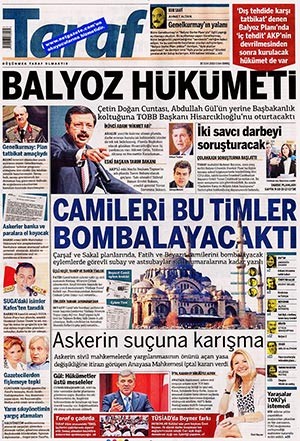
"Taraf" broke the Balyoz conspiracy theory on Jan. 22, 2010.

Turkey's military has long been both the state's most trusted institution and the guarantor of Atatürk's legacy, especially his laicism. Devotion to the founder is not some dry abstraction but a very real and central part of a Turkish officer's life; as journalist Mehmet Ali Birand has documented, cadet-officers hardly go an hour without hearing Atatürk's name invoked.

On four occasions between 1960 and 1997, the military intervened to repair a political process gone awry. On the last of these occasions, it forced the Islamist government of Necmettin Erbakan out of power. Chastened by this experience, some of Erbakan's staff re-organized themselves as the more cautious Justice and Development Party (AKP). In Turkey's decisive election of 2002, they surged ahead of discredited and fragmented centrist parties with a plurality of 34 percent of the popular vote.

Parliamentary rules then transformed that plurality into a 66 percent supermajority of assembly seats and a rare case of single-party rule. Not only did the AKP skillfully take advantage of its opportunity to lay the foundations of an Islamic order but no other party or leader emerged to challenge it. As a result, the AKP increased its portion of the vote in the 2007 elections to a resounding 47 percent, with control over 62 percent of parliamentary seats.

Repeated AKP electoral successes encouraged it to drop its earlier caution and to hasten moving the country toward its dream of an Islamic Republic of Turkey. The party placed partisans in the presidency and the judiciary while seizing increased control of the educational, business, media, and other leading institutions. It even challenged the secularists' hold over what Turks call the "deep state" – the non-elected institutions of the intelligence agencies, security services, and the judiciary. Only the military, ultimate arbiter of the country's direction, remained beyond AKP control.

Several factors then prompted the AKP to confront the military: European Union accession demands for civilian control over the military; a 2008 court case that came close to shutting down the AKP; and the growing assertiveness of its Islamist ally, the Fethullah Gülen Movement. An erosion in AKP popularity (from 47 percent in 2007 to 29 percent now) added a sense of urgency to this confrontation, for it points to the end of one-party AKP rule in the next elections.

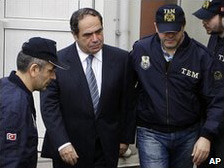
Gen. Ibrahim Firtina, a former head of the air force, was questioned in court about a plot to overthrow the government.

The AKP devised an elaborate conspiracy theory in 2007, dubbed Ergenekon, to arrest about two hundred AKP critics, including military officers, under accusation of plotting to overthrow the elected government. The military responded passively, so the AKP raised the stakes on Jan. 22 by concocting a second conspiracy theory, this one termed Balyoz ("Sledgehammer") and exclusively directed against the military.

The military denied any illegal activities and the chief of general staff, İlker Başbuğ, warned that "Our patience has a limit." Nonetheless, the government proceeded, starting on Feb. 22, to arrest 67 active and retired military officers, including former heads of the air force and navy. So far, 35 officers have been indicted.

Thus has the AKP thrown down the gauntlet, leaving the military leadership basically with two unattractive options: (1) continue selectively to acquiesce to the AKP and hope that fair elections by 2011 will terminate and reverse this process; or (2) stage a coup d'état, risking voter backlash and increased Islamist electoral strength.

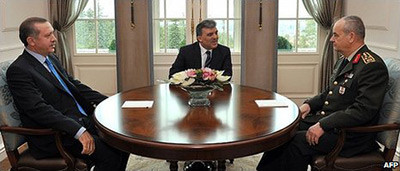
Prime Minister Recep Tayyip Erdoğan, President Abdullah Gul and Armed Forces Chief of Staff Gen. İlker Başbuğ met on February 25.

At stake is whether the Ergenekon/Balyoz offensives will succeed in transforming the military from an Atatürkist to a Gülenist institution; or whether the AKP's blatant deceit and over-reaching will spur secularists to find their voice and their confidence. Ultimately the issue concerns whether Shari'a (Islamic law) rules Turkey or the country returns to secularism.

Turkey's Islamic importance suggests that the outcome of this crisis has consequences for Muslims everywhere. AKP domination of the military means Islamists control the umma's most powerful secular institution, proving that, for the moment, they are unstoppable. But if the military retains its independence, Atatürk's vision will remain alive in Turkey and offer Muslims worldwide an alternative to the Islamist juggernaut.


Translate