 |
| (So sorry we can not cooperate with your attempt to create the demise of Jews by building Muslim homes in a predominently Jewish area, but you said you didn't recognize Jews living here... so just keep on pretending the people living in Judea don't exist) |
Showing posts with label Green line. Show all posts
Showing posts with label Green line. Show all posts
You don't recognize us, We don't recognize you

 Labels:
1967 borders»
Area C territory»
E.U.»
Europe»
Green line»
Judea and Samaria
Labels:
1967 borders»
Area C territory»
E.U.»
Europe»
Green line»
Judea and Samaria
No Jews allowed in Judea says NY Jews, Muslims and Christians only
Labels:
1967 borders»
Apartheid»
Green line»
Jewish Federation»
Judea»
Judea and Samaria»
liberal Jews

Christian Biblical ethicists claim God didn't promise Israel to Jews
Labels:
Anti-Zionism»
Bethel»
Canaanites»
Christians»
Edomites»
Esau»
Euphrates»
fundamentalist»
Genesis»
Green line»
Hagar»
Ham»
Horeb»
Jacob»
Keturah»
Nile»
Semites»
Shem»
Tigris»
Zionism
(EOZ) In September, David P. Gushee and Glen H. Stassen, two Christian ethicists, wrote "An Open Letter to America's Christian Zionists." The main point of this letter was to dispute the biblical idea that God gave Israel to Jews alone:
Not to put too fine a point on it, we wish to claim here that the prevailing version of American Christian Zionism—that is, your belief system—underwrites theft of Palestinian land and oppression of Palestinian people, helps create the conditions for an explosion of violence, and pushes US policy in a destructive direction that violates our nation’s commitment to universal human rights. In all of these, American Christian Zionism as it currently stands is sinful and produces sin. We write as evangelical Christians committed lifelong to Israel's security, and we are seriously worried about your support for policies that violate biblical warnings about injustice and may lead to the outcome you most fear—serious harm to or even destruction of Israel.In a later letter, published November 12, the same two wrote:
We write as evangelicals to you, our fellow evangelicals. On the shared basis of biblical authority, we ask you to reconsider your interpretation of Scripture, for the sake of God, humanity, the United States, and, yes, Israel itself, the Land and People we both love.
We acknowledge that your evangelical-fundamentalist American Christian Zionism (henceforth simply “Christian Zionism”) is a product of a Christian community that loves and reads the Bible. This is on its face a good thing--for there appear to be fewer and fewer American Christians whose love of the Bible and whose devotion to reading it can be taken for granted. We commend your love for the scriptures.
Both now and in the past, whenever Christian Zionism emerges its essential origin is simply Christian reading of the Hebrew Bible, or what Christians call the Old Testament. Our love of the Bible takes Christians into the pages of the Old Testament; there we cannot help but discover the centrality of a Promised Land for the Jewish people. The trajectory of the canonical Old Testament moves inexorably toward and away from the Promised Land—the patriarchal narratives in which a people and land are promised despite humble origins; enslavement in Egypt; the miraculous Exodus and grim wilderness wanderings under Moses; the conquest of the Promised Land; the establishment, split, and eventual conquest of Israel as a political entity; the Babylonian exile and dispersion of the Jewish people; and a partial return to the land, at which point the OT historical narrative ends.
...
We suggest to you that contemporary Christian Zionism is well-intentioned but needs correction at some very important points. This requires some careful biblical and theological work—from within the basic framework of evangelical Christianity. This means that the relevant scriptural texts need to be studied in detail, and that Christian theology needs to do its proper work with those texts.
For example, we suggest that Christian Zionists who move from a generalized love of Israel to a specific claim that the contemporary state of Israel has divine title to the entire Holy Land, need to take more seriously the complexity of what the Bible actually says about God’s promises to Abraham.
Genesis 15:18 reads: “On that day the Lord made a covenant with Abram, saying, ‘To your descendants I give this land, from the river of Egypt to the great river, the river Euphrates.” The next verse goes on to name the various peoples to whom the land belonged at the time.
The territory denoted by the space between these two rivers includes modern-day Lebanon, Syria, Jordan, half of Iraq, half of Egypt, parts of Turkey and Saudi Arabia, the modern state of Israel, as well as the occupied Palestinian territories.
A literal reading of the text that assumes that the descendants of Abram are only the Jewish people faces a problem here. Either God is not very good at keeping his promises, or God’s plan is for contemporary Israel ultimately to conquer all of these other countries and occupy their land. That would result in an Israel ruled by its 90% majority Arabs, or an Israel attempting to subjugate that 90% by force.
But the promise looks very different if we take seriously all of the offspring of Abraham. Genesis 15:4-5 has God taking Abram outside and telling him that his descendants will be as numerous as the stars of the heavens. Genesis 17:4, probably the pivotal text, has God saying to Abraham: “This is my covenant with you: You shall be the ancestor of a multitude of nations.” Many nations, a multitude of nations; many offspring, many kings—read Genesis 17 again and see the plural nouns here.
Close readers of Scripture will know that in fact Abraham did become the father of many nations. With Sarah he became the father of Isaac and the ancestor of all in his line, via Jacob and Esau. With Hagar he became the father of Ishmael and all in his line. And with the long-forgotten Keturah (Gen. 25:1) he became the father of Zimran, Jokshan, Medan, Midian, Ishbak, and Shuah. The Old Testament clearly positions Abraham as the father/ancestor of not only the Jewish people but of a vast number of other peoples, all scattered through the territories promised in Genesis 15. Abraham becomes the father of dozens of peoples, exactly as the Bible says! It is certainly true that the Old Testament primarily tells the story of the line of Isaac and therefore of what became the Jewish people, but that cannot cancel the significance of the promises to Abraham and the many peoples credited to him in Genesis.
...Perhaps you will respond by saying that God promises the land of Canaan specifically to the Jewish people. You might cite here Genesis 17:8: “I will give to you, and to your offspring after you, the land where you are now an alien, all the land of Canaan, for a perpetual holding.” This interpretation would require restricting the “offspring” in question to Abraham’s offspring through Sarah via Isaac and then on to Jacob and excluding Esau. But the promise to possess the land includes the offspring of Isaac, and the offspring of Isaac includes Esau, with his five Edomite sons and their offspring, as Genesis 36 states, and that includes multitudes of Canaanites, not only Jews. It would also require the assumption that we know what Gen. 17 means territorially with the term “Canaan” and that it corresponds with the Zionist’s version of the proper boundaries of the modern state of Israel.
The responses that disagreed did not discuss the biblical passages, but shifted the topic to the politics of the present government of Israel and the West Bank, and Hamas, and whether Israel forced Palestinians out of their homes or not.
These are important topics, but we are hoping for biblical discussion.
What we are asking is whether our readers see Genesis 15 and 17 saying that Abraham is the father of many nations, with descendants as many as the stars of the universe. And whether the territory includes all the land between the Nile and the Euphrates, which of course includes many nations, most all Arab. We believe ours is the plain, literal reading. No one has explained a different reading in response.
I have no idea why no Christian Zionist took it upon themselves to answer this letter within the worldview of Christian theology. Honestly, if it is true, it is a bit disappointing.
So, even though I am not a Christian nor a Jewish Biblical scholar by any means, I would like to make a point.
It seems strange that the authors' arguments that God's promises apply to all of Abraham's descendants do not take into account later declarations by God.
For example, God explicitly told Jacob in Genesis 28:13 that "I am the LORD, the God of Abraham thy father, and the God of Isaac. The land whereon thou liest, to thee will I give it, and to thy seed."
This happened at Bet El (Bethel). One can argue about the size of the land promised by God at that point, but one cannot argue that the promise was made to anyone but the Jewish people. And Bet El is on the "wrong" side of the Green Line. Would the authors admit that, Biblically, this must remain a part of Israel?
More explicitly, in Exodus 23, God tells the Israelites:
But if thou shalt indeed hearken unto his voice, and do all that I speak; then I will be an enemy unto thine enemies, and an adversary unto thine adversaries. For Mine angel shall go before thee, and bring thee in unto the Amorite, and the Hittite, and the Perizzite, and the Canaanite, the Hivite, and the Jebusite; and I will cut them off. ...And I will set thy border from the Red Sea even unto the sea of the Philistines, and from the wilderness unto the River; for I will deliver the inhabitants of the land into your hand; and thou shalt drive them out before thee.
And in Deuteronomy chapter 1:
The LORD our God spoke unto us in Horeb, saying: 'Ye have dwelt long enough in this mountain; turn you, and take your journey, and go to the hill-country of the Amorites and unto all the places nigh thereunto, in the Arabah, in the hill-country, and in the Lowland, and in the South, and by the sea-shore; the land of the Canaanites, and Lebanon, as far as the great river, the river Euphrates. Behold, I have set the land before you: go in and possess the land which the LORD swore unto your fathers, to Abraham, to Isaac, and to Jacob, to give unto them and to their seed after them.'The straight translations of these passages are somewhat contradictory and without further study I imagine it is difficult for Christians to know how to reconcile them. But it is extraordinarily dishonest to interpret only one of God's promises to Abraham and his children in a vacuum without even considering the more explicit promises He made later to Jacob, Moses and the children of Israel. Is it not the same God who made all of these promises? Are not all of them of equal weight? If so, then the issue is not interpreting one of them, but reconciling and interpreting all of them together.
Beyond that, it seems to me that the entire Biblical narrative would be problematic if most of the peoples who were God's covenental partners simply disappeared from the story or played only bit parts. If the children of Israel were not the main intended recipients of God's promises, then why would the Bible spend so much time only dealing with them and all but ignoring the Ishmaelites and the Edomites?
The writers make other arguments about whether today's Jews should still be considered to be within the same covenant, but that is a much bigger topic. And before I spend time on that, I would love to know how they interpret and reconcile the many other Biblical verses tying the Land of Israel with, specifically, the Jews.
(Parenthetically, I think it is not clear at all that you can consider Esau's progeny to be "Canaanites." While Gen. 38 says they lived in Canaan, the Canaanites were presumably the descendants of Canaan, Noah's grandson through Ham. Which means, ironically, that Canaanites are not Semites, but rather "Hamites." So don't accuse me of anti-Semitism :) )
I am afraid that this might turn into a very big theological thread, and I am not really comfortable with that here; Christian theology is not a topic that belongs on this blog. Hopefully it will spark discussion among Christians that will take place elsewhere.

Palestinians may give up on bid for full UN membership to avoid U.S. veto, sources say
Labels:
: 1947 partition plan»
1949 armistice lines»
1967 borders»
242»
Ariel Sharon»
Catherine Ashton»
Green line»
Israel's Unilateral Peace»
Resolution 181»
U.N. Security Council»
UN General Assembly»
Unilateral
Wishing to avoid an American veto at the Security Council, the Palestinian Authority is considering turning directly to the United Nations General Assembly in September in order to gain international recognition of Palestinian statehood.
Palestinian sources and European diplomats say that the Palestinians will give up their effort to be accepted as a full member of the UN - a move that would require approval by the Security Council - and will seek instead recognition by the General Assembly of a Palestinian State within the 1967 borders, which will not be a full member of the organization. via haaretz.com
 | |||
|
there was a whole lot of verbal attacks on the U.S. for this need for Palestine to settle for less. Catherine Ashton who is the foreign policy head of the E.U. and a member of labor in the U.K. tried to put forward a version that was rejected by the Muslim Arabs for 6o years and would of ignored G W Bush's promises of facts on the ground to Ariel Sharon.Following the failed meeting of the Quartet foreign ministers in Washington last week, the Palestinians recognized that the United States will veto any resolution that will be brought before the UN Security Council for unilateral Palestinian statehood. Moreover, the Palestinians have also concluded that turning to the Security Council with a request for full membership in the UN is a more complicated proposition, largely because of time constraints. Palestinian sources and European diplomats said that Palestinian Authority President Mahmoud Abbas and his aides are increasingly leaning toward a direct appeal to the General Assembly of the international organization. Even though the assembly lacks the authority to offer the Palestinians full UN membership, at the General Assembly the United States is unable to use its veto power against resolutions brought before the plenum for a vote. Also, the Palestinians would like the vote to take place during the General Assembly in the last week of September, and for this there is no need for a great deal of preparation. The vote at the General Assembly could be called with as little as 24 hours notice. A vote at the General Assembly is expected to end with a Palestinian victory and a large majority, as some 140 member states are expected to support recognition of a Palestinian state. Even though a General Assembly resolution is "weaker" than one by the Security Council, the Palestinians are comparing such a decision to Resolution 181 of November 29, 1947, in which the General Assembly approved the plan to partition Palestine. Senior Palestinian officials say that without the decision on dividing Palestine in 1947, Israel would not have had the international legitimacy to declare independence in May 1948.Except that Israel could have done whatever it wanted in 1948 because the Arabs (there were no 'Palestinians' in 1948) rejected the partition plan and determined to drive the Jews into the sea. Moreover, Israel was admitted by the Security Council in 1949. more via israelmatzav.blogspot.com
Who does the boycott hurt?
Labels:
Ahmed Tibi»
Barkan»
Green line»
Settlements»
settlers
A while back, one Israeli company decided to move out of the Barkan (Settler) Industrial Park because of the pressure from the Left. As a result, its 90 Arabs employees were fired as they couldn’t work within the “Green Line”, the Jewish employees merely had to commute in the opposite direction. The firing of 90 Arabs means that some 800 Arabs no longer had a provider of income.
The truth is, a successful boycott would in reality hurt the Palestinians far, far more than it would hurt the Jews. But don’t confuse the Leftists with that piece of information, because their calls for boycott are helping improve the Settler economy they hate so much.
Ahmed Tibi
Oh, and here’s a question for you (as asked in Makor Rishon).
If Ahmed Tibi, an Israeli citizen currently living over the Green Line (making him a Settler) were to open a factory, would the Left call for its boycott too? Or are their calls to boycott actually racist and only targeting Jews? more via muqata.blogspot.com

you can not reason with the unreasonable though
2000 Israelis and Arabs march in Jerusalem to support Palestinian independence
Labels:
1967 borders»
Avraham Burg»
Dov Hanin»
Green line»
Hadash»
Meretz»
Michael Ben Yair»
Nelson Mandela»
Zehava Galon

 |
| check out the amusing advertising on Haaretz where the article was found |
the original post said thousands of protesters on the Haaretz
website. The reality in the actual writing was 2000 people. Which
sounds about right.via haaretz.com
Where are the 67 borders?
Labels:
1949 Armistice»
1967 borders»
Abba Eban»
AIPAC»
Auschwitz borders»
Gilad Shalit»
Google»
Google Maps»
Green line»
Six Day War»
Turki al-Faisal»
Wikipedia»
Yahoo»
Yahoo Weather
I have often written about the manipulation of technology to fabricate an ahistorical and counter-factual narrative; for example the replacement geography in Google Earth, and the relocation of East Jerusalem to Palestine in Yahoo Weather. History is a critical part of the Jewish claim to the Land of Israel. Getting it right is important. The current discourse over “67 borders” in the media, blogosphere and social media, presents a narrative so removed from fact that its propagandistic nature can be exposed even by someone with only Google Maps and Wikipedia to guide them. The propaganda has been triggered by discussion over the Palestinian unilateral declaration of statehood. More and more people are speaking about Israel’s borders, and in particular the idea of “returning to the 67 borders.” Those with a knowledge of history would know there is no such thing. For a start, they mean pre-1967, not 1967, and to be fully accurate, they mean boundaries or lines not borders. The loss of the “pre” prefix is the most blatant attempt to wipe clear the historical narrative, see for example the recent Washington Post op-ed by Turki al-Faisal, Saudi Arabia’s Former Ambassador.
Even in Israel there has been a move away from the “green line” to “67 borders,” articles in both Haaretz and Jerusalem Post have used this terminology. This is unsurprising given the use of this terminology by Israeli leaders, the British Prime Minister, and many other. The White House, whatever one thinks of their policy, at least have the terminology right, despite media headlines and reporting to the contrary, at AIPAC, President Obama’s actual words referred to “pre-1967 lines,” a formulation that the White House press office has also used consistently.
The 1949 Armistice Agreement Line shown on Google MapsOn Google Maps the line is clearly and correctly labelled the “1949 Armistice Agreement Line.” In Wikipedia, the article on the Green Line, refers to the boundary as “the demarcation lines set out in the 1949 Armistice Agreements between Israel and its neighbours (Egypt, Jordan, Lebanon and Syria) after the 1948 Arab-Israeli War.” The narrative of ’67 borders is a Palestinian one. It obfuscates the fact that a return to these borders would be a return to the unstable position after the war of independence.
The Wikipedia article itself notes this was never an “international or permanent border,” it also notes the position in international law, expressed by the deputy legal advisor to the US Department of State in the American Journal of International Law (1970). He said “...modifications of the 1949 armistice lines among those States within former Palestinian territory are lawful... whether those modifications are...'insubstantial alterations required for mutual security' or more substantial alterations - such as recognition of Israeli sovereignty over the whole of Jerusalem.” The Palestinian narrative seeks to lock in the minimalist idea of insubstantial changes and make even that look like a serious sacrifice that is almost too much to ask of them.
History is important. Last week was the anniversary of the Six Day war, and the relevance to today was well outlined by David Harris last week. Language and rhetoric are also important. Let’s stop the downwards slide into a Palestinian narrative. Let us begin to speak of the 1949 ceasefire lines, the psychological trauma of insecurity they imposed, the real danger they created in the face of a conventional warfare threat, and why Abba Eban referred to these indefensible borders as Auschwitz borders, meaning they put Jews, at the time many of them Holocaust survivors, again at the mercy of being slaughtered on mass by those who wished them harm. Israel’s recent experience with Hamas in Gaza justifies a continual concern about such dangerous borders. Not only are there the rockets on Sderot, let’s also remember Gilad Shalit kidnapped by terrorists who made the short journey from Gaza almost 5 years ago.
A two state solution is possible, and large parts of the future border may indeed be along the green line, but the negotiation and public discussion must have a basis in history and fact. It cannot be built on the ahistorical changing sands of Palestinian propaganda. In the mean time, all of us, from international leaders and the media to Facebook users, should watch our language and ensure we don’t strengthen a narrative that will lead not to peace but potentially to renewed bloodshed. If, despite all their flaws, Google Maps and Wikipedia can get this right, so can the rest of us.

Danny Ayalon: Israel's Right in the 'Disputed' Territories
Labels:
242»
Ambassador Arthur Goldberg»
Danny Ayalon»
Green line»
Jerusalem»
Judea and Samaria»
Kuznetsov»
Lord Caradon»
Resolution 194»
Resolution 242»
Resolution 338»
Six Day War
 The recent statements by the European Union's new foreign relations chief Catherine Ashton criticizing Israel have once again brought international attention to Jerusalem and the settlements. However, little appears to be truly understood about Israel's rights to what are generally called the "occupied territories" but what really are "disputed territories."
That's because the land now known as the West Bank cannot be considered "occupied" in the legal sense of the word as it had not attained recognized sovereignty before Israel's conquest. Contrary to some beliefs there has never been a Palestinian state, and no other nation has ever established Jerusalem as its capital despite it being under Islamic control for hundreds of years.
The name "West Bank" was first used in 1950 by the Jordanians when they annexed the land to differentiate it from the rest of the country, which is on the east bank of the river Jordan. The boundaries of this territory were set only one year before during the armistice agreement between Israel and Jordan that ended the war that began in 1948 when five Arab armies invaded the nascent Jewish State. It was at Jordan's insistence that the 1949 armistice line became not a recognized international border but only a line separating armies. The Armistice Agreement specifically stated: "No provision of this Agreement shall in any way prejudice the rights, claims, and positions of either Party hereto in the peaceful settlement of the Palestine questions, the provisions of this Agreement being dictated exclusively by military considerations." (Italics added.) This boundary became the famous "Green Line," so named because the military officials during the armistice talks used a green pen to draw the line on the map.
After the Six Day War, when once again Arab armies sought to destroy Israel and the Jewish state subsequently captured the West Bank and other territory, the United Nations sought to create an enduring solution to the conflict. U.N. Security Council Resolution 242 is probably one of the most misunderstood documents in the international arena. While many, especially the Palestinians, push the idea that the document demands that Israel return everything captured over the Green Line, nothing could be further from the truth. The resolution calls for "peace within secure and recognized boundaries," but nowhere does it mention where those boundaries should be.
It is best to understand the intentions of the drafters of the resolution before considering other interpretations. Eugene V. Rostow, U.S. Undersecretary of State for Political Affairs in 1967 and a drafter of the resolution, stated in 1990: "Security Council Resolution 242 and (subsequent U.N. Security Council Resolution) 338... rest on two principles, Israel may administer the territory until its Arab neighbors make peace; and when peace is made, Israel should withdraw to "secure and recognized borders," which need not be the same as the Armistice Demarcation Lines of 194."
Lord Caradon, the British U.N. Ambassador at the time and the resolution's main drafter who introduced it to the Council, said in 1974 unequivocally that, "It would have been wrong to demand that Israel return to its positions of June 4, 1967, because those positions were undesirable and artificial."
The U.S. ambassador to the U.N. at the time, former Supreme Court Justice Arthur Goldberg, made the issue even clearer when he stated in 1973 that, "the resolution speaks of withdrawal from occupied territories without defining the extent of withdrawal." This would encompass "less than a complete withdrawal of Israeli forces from occupied territory, inasmuch as Israel's prior frontiers had proven to be notably insecure."
Even the Soviet delegate to the U.N., Vasily Kuznetsov, who fought against the final text, conceded that the resolution gave Israel the right to "withdraw its forces only to those lines it considers appropriate."
After the war in 1967, when Jews started returning to their historic heartland in the West Bank, or Judea and Samaria, as the territory had been known around the world for 2,000 years until the Jordanians renamed it, the issue of settlements arose. However, Rostow found no legal impediment to Jewish settlement in these territories. He maintained that the original British Mandate of Palestine still applies to the West Bank. He said "the Jewish right of settlement in Palestine west of the Jordan River, that is, in Israel, the West Bank, Jerusalem, was made unassailable. That right has never been terminated and cannot be terminated except by a recognized peace between Israel and its neighbors." There is no internationally binding document pertaining to this territory that has nullified this right of Jewish settlement since.
And yet, there is this perception that Israel is occupying stolen land and that the Palestinians are the only party with national, legal and historic rights to it. Not only is this morally and factually incorrect, but the more this narrative is being accepted, the less likely the Palestinians feel the need to come to the negotiating table. Statements like those of Lady Ashton's are not only incorrect; they push a negotiated solution further away.
Mr. Ayalon is the deputy foreign minister of Israel.
via online.wsj.com
bias in International Herald Tribune - NYTimes owned
Labels:
1949 Armistice»
Gaza Rocket Attacks Again»
Green line»
International Herald Tribune»
media bias»
Muammar al-Gaddafi»
NYTimes
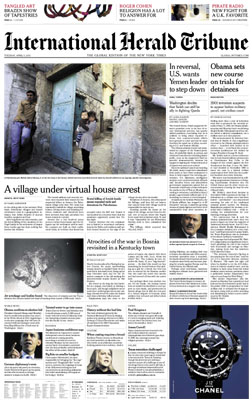
Today's European edition of the International Herald Tribune, published by the New York Times, is a stark display of bias, absolving Palestinians of any role as perpetrators in the conflict while placing Palestinian grievances against Israel under a microscope. The "global edition of the New York Times," today's paper runs two stories about alleged Israeli wrongdoings, including the most prominent front-page story, a lengthy article on Israeli actions in the West Bank village of Awarta, as well as an inside article on Israeli plans for construction beyond the 1949 armistice line (Green Line). At the same time, the Tribune fails to give even passing mention to two major news stories which broke yesterday, both of which involve alleged Palestinian wrongdoing -- the murder of Israeli film director and activist in Jenin and the indictment of a Gaza engineer for his alleged role in rocket development.
more via camera.org
Colonel Muammar Gaddafi and his sons are said to have bankrolled dozens of Arab journalists in return for turning a blind eye to what the Libyan regime was doing to its people. The list of beneficiaries included newspaper editors, reporters and columnists from Egypt, Syria, Jordan, the Gulf and the Palestinian territories.
Senior Arab journalists living in London and Paris also said to have been on the Libyan regime's payroll.
Gaddafi and his sons are not the only ones who have been bribing journalists in the Arab world. The regime of ousted Egyptian President Hosni Mubarak and several oil-rich Gulf countries like Saudi Arabia have for decades offered bribes to Arab journalists.
This explains why many Arab journalists have refrained from reporting anything that reflected negatively on their paymasters.
Instead of reporting on the grievances of Arabs living under dictatorships, these journalists often engaged in heaping praise on Arab regimes and criticizing only one country: Israel.
via hudson-ny.org
INTERNATIONAL LAW REGARDING THE LAND OF ISRAEL AND JERUSALEM
Labels:
British Mandate for Palestine»
Green line»
international law»
Jerusalem»
Jordan»
Judea and Samaria»
San Remo Conference»
Tomb of the Patriarchs and Matriarchs
International law is often cited as a pretext for the policies of Western governments and human rights agencies toward Judea, Samaria, and Gaza in general and Jerusalem in particular. A certain assumption or presumption about the international law status of these areas is the premise for claims that they are "occupied territory," that Israeli construction in formerly Jordanian-ruled parts of Jerusalem is "illegal," etc.
Given the centrality of allegations about international law in the diplomatic and political assaults on Israel made by such bodies as the European Union, the UN General Assembly, and others, there is a need to know, to understand and to expound the true international law concerning the Land of Israel as a matter of sheer political self-defense. What indeed has been the status of Judea, Samaria, and Gaza under the law of nations?
International law has recognized Jewish rights to sovereignty over the Land of Israel and to settlement throughout the land. In April 1920, at the San Remo Conference (part of the post-World War I peace negotiations), the Principal Allied Powers, acting on behalf of the international community, recognized all the land between the Jordan River and the sea, including Jerusalem, as part of the Jewish National Home, based on the Jewish people's historic rights. On the same grounds, the Golan[1] and Transjordan too were within the National Home (albeit the eastern border of the National Home, though clearly east of the Jordan, was not yet fixed).
The San Remo decision meant also the juridical creation of "Palestine" as a political entity as well as the introduction of that name as the official geographic designation for the new entity. During the centuries of Ottoman rule, the country was divided among larger administrative entities with their capitals outside the country, the vilayets of Beirut and Damascus, although in the mid-nineteenth century, as a consequence of increasing influence by Christian powers on the Ottoman Empire and Jerusalem's political sensitivity due to the Christian powers' interest in the city, the Jerusalem area was made into an independent sanjaq (district). It was called "independent" because its governor reported directly to the Ottoman capital, Istanbul (then called Constantinople in the West), not to a provincial (vilayet) governor.
Furthermore, Arab-Muslims traditionally saw the land as an undifferentiated part of Bilad al-Sham, usually translated as Syria or Greater Syria, which comprised the Syria, Lebanon, Israel and Jordan of today, roughly speaking. Before the Crusades, the Arab-Muslim conquerors had designated the southern part of Israel (roughly speaking) as the military district of Filastin, corresponding to the Roman-Byzantine district of Palaestina Prima (one of three parts of Palaestina). The Crusaders ordinarily called the country Holy Land (Terra Sancta). Use of the name Filastin was not resumed by Muslim rulers after the Crusades. Under the Mamluks and Ottomans, Bilad al-Sham underwent several administrative reorganizations, changes of internal borders, etc. But there was never a Muslim governmental unit of any name that corresponded geographically to the Jewish concept of Land of Israel or the Greco-Roman Judea (= IUDAEA, which included Samaria, Galilee, Golan, the coastal plain, the Jordan's eastern bank, etc., in addition to Judea in the narrow sense). Emperor Hadrian had renamed the Province of Judea (= Provincia Iudaea) "Palaestina" (ca. 135 CE) for imperialist reasons.
Hence, the Arab-Muslim geographic concept differed radically from that of Jews and Christians. Further, whereas both Jews and Christians saw the country as a distinct geographic concept, they tended to use different names for it. In Jewish tradition the land was long called the Land of Israel, while Christians, through the nineteenth century, were likely to call it Holy Land (according to their various languages, that is, Terre Sainte, etc.), with Palestine, Judea, Land of the Bible, etc., as alternate names.
The San Remo decision for the Jewish National Home was ratified by the the League of Nations in 1922 and endorsed by a joint resolution of the United States Congress that same year, with a more official US endorsement coming in the Anglo-American Convention on Palestine (proclaimed 1925).
This legal state of affairs was expounded in a legal memorandum drawn up in 1946 [2] by a group of distinguished American-Jewish jurists including Judge Simon Rifkind, Abraham Fortas (later appointed to the Supreme Court), and others.
To measure the extent of American commitment to the National Home at the beginning, we may quote from the terminology of the time: "RES. 52: Expressing satisfaction at the re-creation of Palestine as the national home of the Jewish race" (House Committee on Foreign Affairs). "Resolved by the Senate and House of Representatives of the United States of America in Congress assembled, that the United States of America favors the establishment in Palestine of a national home for the Jewish people..." (1922).
Because the legal issue is once again very much alive, a brief survey of the matter is useful, with particular reference to Jerusalem.[3] By the time the League of Nations was replaced by the UN in 1945, Britain had illegally tried to revoke the Jewish National Home, violating the principles of the League's mandate. This attempt was embodied in the Palestine White Paper of 1939, on the eve of the Holocaust, and in various subsequent ordinances enacted by the British mandatory government, which made it very difficult for Jewish refugees to enter the country and forbidding any Jews to buy real estate in most of the country. Nevertheless, this British attempt to change the country's status was rejected as illegal by the League of Nations Permanent Mandates Commission in June 1939.
When the UN was founded in 1945, it reaffirmed through its Charter the existing territorial rights of peoples as they had been before the war (Article 80). This applied of course to the Jewish National Home. However, many or most people today are either not aware that the whole country constituted the Jewish National Home, or believe that the UN had somehow eliminated this status and, in any case, had fixed legal boundaries for Israel through the 1947 Partition Resolution. Yet the 1947 resolution was passed by the General Assembly. And all General Assembly resolutions on political issues are merely recommendations.
The UN Charter states, defining the powers of the various UN bodies: "The General Assembly may discuss any questions relating to the maintenance of international peace and security... and... may make recommendations with regard to any such question" (Article 11; also see Arts. 10, 12, 13, 14). Only the Security Council can make binding resolutions, according to the Charter.
Now the Partition Plan, in a not uncommon display of political irrealism, recommended two states in the former mandatory Palestine west of the Jordan, one Jewish and one Arab, plus a special status for Jerusalem (The British had separated Transjordan unilaterally from the Jewish National Home in 1922, although not de jure). The Holy City was to be an internationally governed corpus separatum. While the Jewish leadership accepted the Plan, the Arab governments and local Arab leadership universally rejected it. After the war had begun the UN made no effort to prevent the invasion of the country by Arab states, to prevent Arab attacks on Jews within the country or to eliminate the Arab siege of the Jews in Jerusalem, a city where Jews had been the majority at least since 1870. Thus Israel did not feel bound by the Partition recommendation. Professor Eugene Rostow, an authority on international law, has pointed out that the Arab war on Israel of 1947-49, "made the Partition Plan irrelevant."[4]
After the battles of the War of Independence had ended, Israel and four Arab states signed armistice agreements. The accord with Jordan (then called Transjordan) specifically stated that no political border with Israel was being recognized, merely an armistice line (the "green line"). And this at Arab insistence! Arab spokesmen repeated this on later occasions. For instance, the Jordanian delegate to the UN told the Security Council a few days before the Six Day War:
There is an Armistice Agreement. The Agreement did not fix boundaries; it fixed a demarcation line. The Agreement did not pass judgement on rights - political, military, or otherwise. Thus I know of no territory; I know of no boundary. (May 31, 1967)
Obviously, since no political border between Jordan and Israel was recognized, then the prior legal status prevailed - that is, the Jewish National Home recognized and constituted in 1920 at San Remo. Hence, the areas that Jordan called "West Bank," as well as east Jerusalem (which had thousands of Jewish residents before 1948), remained part of the National Home even during Jordanian occupation. The Assembly's repetitions of its Jerusalem recommendation (GA resolutions 194, 303, etc.) could not change this. Nor did the Security Council change the status of Jerusalem by its famous Resolution 242 after the Six Day War.
Although the Council's resolutions are said by the UN Charter to be binding, this resolution did not specify what territories were "occupied." Perhaps the Council was referring to the Sinai Peninsula, occupied by Israel in that just war of self-defense. Furthermore, the Council could not legislate ex post facto, after the fact, to take away the already existing rights of the Jewish people. According to Professor Rostow, "The withdrawal of Great Britain as administrator and trustee did not of course terminate the Mandate as a trust [for the Jewish people]."[5]
Jerusalem of course took a special place in the age-old yearning for a restored Jewish National Home. And in Jerusalem too this yearning ran into opposition not just from Arabs but from Western powers (and others following their lead). They have long refused to recognize any part of Jerusalem as part of Israel, nor do they recognize the Holy City as Israel's capital. Their pretext is the separate status provided for Jerusalem in the Partition Plan. Yet this Plan was merely an Assembly recommendation, whereas the San Remo decision of 1920 was law. Thus, the refusal of the powers to transfer their embassies to Jerusalem, which means refusal to accept the city as Israel's capital, has no foundation in law.
Obviously, the refusal has its reasons. It may stem from the same reasons that induced the British to allow Arab mobs in a series of pogroms (1920, 1929, 1936-38) to drive Jews away from the neighborhood of Jewish holy places, such as the Temple Mount and the Cave of the Patriarchs in Hebron. It may be related to Britain's reasons for appointing Arab mayors for Jerusalem throughout the whole mandatory period, despite the Jewish majority since at least 1870. Now the Ottoman Empire did the same up to 1917, but then the Ottoman Empire was an avowed Muslim state, whereas the British had accepted an international commitment (the Mandate) to foster development of the country as the Jewish National Home.
It is clear that according to the San Remo decision of 1920 and the League of Nations vote of 1922 for the Jewish National Home, Israel's extension of its jurisdiction over all Jerusalem since the Six Day War is legal and proper.
Nevertheless, self-serving interpretations of law are often made by interested parties. In the case of Israel, such interpretations provide pretexts for declarations by governments and groupings of governments - the Arab League, the European Union, the UN General Assembly - that are hostile to Israeli sovereignty in Jerusalem (or indeed anywhere in the country). Such false and hostile interpretations remind us that we dare not place our trust in law or international accords. Yet, the outbursts in the form of declarations and resolutions based on these interpretations have more force and cause more damage than many friends of Israel seem to realize, although they may be less effective than their authors would like). And thus they need to be answered.
FOOTNOTES
1. The Golan was an original part of the Jewish National Home as decided at San Remo and had been populated and ruled by Jews in Second Temple times and afterwards. In 1923, the British authorities transferred the Golan to the French mandate of Syria without approval of the Zionist Organization.
2. Simon Rifkind, Abraham Fortas, et al., Basic Equities of the Palestine Problem: A Memorandum (1946) [reprinted New York: Arno Press, 1977].
3. We shall use the Rifkind-Fortas memorandum, our own study of the UN Charter and subsequent UN acts, writings of Prof. Julius Stone and Prof. Eugene Rostow, and various historical information. We have also benefited from conversations with Attorney Howard Grief of Jerusalem, a former advisor on international law to the Israeli Ministry of Energy, who has done research into the Balfour Declaration, the San Remo Decision, the League of Nations Mandate, etc., up to the series of agreements going by the name of the Oslo Accords. The conclusions are my own.
4. Eugene Rostow, "Resolution 242 at Twenty," Jerusalem: Institute for Advanced Strategic and Political Studies, 1988, p 5.
5. Ibid.
The author is a researcher, writer and translator, living in Jerusalem.
This is a revised version of an article published in Midstream (New York) in February/March, 1999.

Israeli Settlement Areas
Labels:
Freezes»
Green line»
Israeli sovereignty»
Judea»
Judea and Samaria»
Settlements
5.
Founded in 1978
Ariel
Population: 16,716
Of the five largest settlements in the West Bank, Ariel is located the furthest from the Green Line – more than 9 miles. It lies east of Tel Aviv and north of Jerusalem. Though it remains on the Palestinian side of the separation barrier, it is considered a strategic bulwark protecting Israel's narrow middle. It has a university, the Ariel University Center of Samaria, that enrolls 8,500 students, both Jews and Arabs.

A Palestinian and foreign worker ride on a trailer hauling crates of Cabernet Sauvignon grapes during the harvest, August 31, in one of the vineyards of the Israeli Gush Etzion Settlement region in the West Bank. (Newscom)4.
Gush Etzion bloc
First post-1948 settlement was founded in 1967
Population: 20,532 (excluding Betar Illit)
Gush Etzion is the collective name used for a group of Israeli settlements in the vicinity of the West Bank city of Bethlehem. The Foundation for Middle East Peace counts 15 settlements as part of the bloc, including Betar Illit. The settlements lie on both sides of the separation barrier, but entirely on the Palestinian side of the Green Line.
Israelis first attempted to settle the area now part of the Gush Etzion bloc in the 1920s. The first attempt was unsuccessful, and later attempts were destroyed in the 1948 war. Efforts began again in 1967, when Israel took over the West Bank in the Six-Day War.

3.Betar Illit
Founded in 1985
Population: 34,829
Betar Illit is situated about six miles south of Jerusalem and west of Bethlehem, and is located less than a kilometer within the Palestinian side of the Green Line. It is an Orthodox Jewish community with one of the fastest-growing populations in the West Bank. Because much of the population is engaged in religious study, rather than employed in nearby cities, it is relatively self contained. Betar Illit is often considered part of the Gush Etzion settlement bloc.

A Palestinian laborer works on a construction site in the West Bank Jewish settlement of Maale Adumim September 14. (Ronen Zvulun/Reuters)2.
Founded in 1975
Maale Adumim
Population: 33,821
Maale Adumim lies east of Jerusalem, about 2.5 miles from the Green Line. Considered by many Israelis to be a suburb of the city because of its close proximity, it began as a planned community and commuter town for Israelis working in Jerusalem. A mix of religious and secular Jews live there.
Israel values the "strategic depth” Maale Adumim offers against an army coming from the east. But Palestinians and their international supporters have criticized Israel’s efforts to incorporate Maale Adumim, as well as an adjacent area known as E-1, because those plans threaten the territorial contiguity of a future Palestinian state. The Maale Adumim bloc extends far into the West Bank, leaving only a narrow corridor of land in the eastern West Bank to connect the northern and southern regions of the territory.

A Jewish settler walks with children near a construction site in the West Bank Jewish settlement of Modiin Illit, Sept. 14. (Bernat Armangue/AP)
1.
Founded in 1981
Modin Illit
Population: 41,869
Modiin Illit sits about halfway between Tel Aviv and Jerusalem. With more than 42,000 settlers today, Modiin Illit alone has about four times the number of settlers that were in the entire Gaza Strip before the 2005 disengagement. Most of its residents are Orthodox Jews.
Modiin Illit is encompassed by the Israeli separation barrier – designed to protect Israeli citizens from Palestinian militant attacks – even though it lies outside the pre-1967 Israeli border known as the Green Line. Just on the other side of the wall from Modiin Illit is Bilin, where Palestinians have held weekly protests against the wall for several years.
via csmonitor.com
As I have not had great experiences with the credibility of this publication... please let me know if any of this information is false...
As I have not had great experiences with the credibility of this publication... please let me know if any of this information is false...
Facts About Settlements
By Mitchell Bard
(Updated September 24,
2009)
“Settlements”
are actually towns and villages where Jews have gone to live since
the capture of Judea and Samaria — the West
Bank — and Gaza Strip
in the 1967 war . In many
cases, flourishing Jewish communities lived in the same area for thousands
of years.Strategic concerns led both Labor
and Likud governments
to establish settlements. The first were built by Labor governments
from 1968-1977. The objective was to secure a Jewish majority in key
strategic regions of the West Bank, such as the Tel
Aviv-Jerusalem corridor,
the scene of heavy fighting in several Arab-Israeli
wars.The second wave of settlements began with the occupation
of the Park Hotel in Hebron
in 1968, a town with a long, rich Jewish history, that had been interrupted
by an Arab massacre in 1929.
These were the first of the ideological settlers who believed that
Israel's victory in 1967 was an act of God and indicated divine providence
that the historic Land of Israel should be restored to the Jewish
people. Very few such settlements were established until Menachem
Begin assumed power. His government and subsequent Likud governments
provided financial incentives for Jews to move to parts of Judea and
Samaria that did not necessarily have any strategic value. Their purpose
was to solidify Israel's hold on territory that was part of biblical
and historical Palestine/Israel (minus the nearly four-fifths of Palestine
Great Britain severed in 1921 to create Transjordan)
and preempt the creation of a Palestinian state.A third group of Jews who are today considered "settlers,"
moved to the West Bank primarily for economic reasons; that is, the
government provided financial incentives to live there, and the towns
were close to their jobs.Today, roughly 130 settlements
are in the territories, with an estimated population of 276,440.
Critics suggest these figures imply territorial
compromise with the Palestinians is impossible;
however, the distribution of the Jewish
population is such that a solution is
conceivable. When Arab-Israeli peace talks
began in late 1991, more than 80 percent
of the West Bank contained no settlements
or only sparsely populated ones. Today,
roughly 70 percent of Israelis
living in the West Bank, approximately
190,000 people, live in what are in effect
suburbs of major Israeli cities such as Jerusalem and Tel
Aviv. They could be brought within
Israel's borders if Israel were to redraw
them so as to retain an Arab population
(from the West Bank) of less than 50,000.
These include Israelis living in the following
regions of the West Bank: Ariel, the
area surrounding Ariel, Gush
Etzion, Maaleh Adumim, Givat Zeev
and Latrun.
It is inconceivable that Israel would
evacuate large cities such as Ariel,
with a population of approximately 20,000,
even after a peace agreement with the
Palestinians, and even Yasser
Arafat grudgingly accepted at Camp
David the idea that the large settelement
blocs would be part of Israel.It is also important to
understand that most settlements are relatively
small towns. Of 124 of the
West
Bank settlements, the data shows
that only 5 (4%) have populations greater
than 10,000, 45 have populations greater
than 1,000 (45%), and 74 have populations
greater than 500 (60%). Fifty settlements
(40%) have fewer than 500 residents.1 More
than 40% of the Jews live in just six
settlements near the 1967 border. The Arab
city of Nablus alone
is larger than those six Jewish cities
put together. Nearly half the settlements
and 70% of the Jewish population live
within
five miles of the Green Line; three-fourths
of the settlements and 94% of the population
live within 10 miles.The area in dispute
is also very small. According to one organization
critical of settlements, the built-up areas
constitute only 1.7% of the West Bank.
That is less than 40 square miles. Even
if you add the unbuilt areas falling with
the municipal boundaries of the settlements,
the total area is only 152 square miles.Legalities
Another charge is that settlements are “illegal.”
The United States has never adopted this position and legal scholars
have noted that a country acting in self-defense may seize and occupy
territory when necessary to protect itself. Moreover, the occupying
power may require, as a condition for its withdrawal, security measures
designed to ensure its citizens are not menaced again from that territory.
According to Eugene Rostow, a former Undersecretary
of State for Political Affairs in the Johnson Administration, Resolution
242 gives Israel a legal right to be in the West Bank. The resolution
“allows Israel to administer the territories” it won in
1967 “until 'a just and lasting peace in the Middle East' is
achieved,” Rostow wrote in The New Republic (10/21/91).
During the debate on the resolution, he added, “speaker after
speaker made it clear that Israel was not to be forced back to the
'fragile' and 'vulnerable' [1949] Armistice Demarcation Lines.”
Obstacles?
Israel's adversaries, and even some friends, assert
that settlements are an obstacle to peace. The evidence points to
the opposite conclusion. From 1949-67, when Jews were forbidden to
live on the West Bank, the Arabs refused to make peace with Israel.
From 1967-77, the Labor Party established only a few strategic settlements
in the territories, yet the Arabs showed no interest in making peace
with Israel. In 1977, months after a Likud government committed to
greater settlement activity took power, Egyptian President
Anwar Sadat went to Jerusalem. One year later, Israel froze settlements,
hoping the gesture would entice other Arabs to join the Camp
David peace process. But none would. In another Camp
David summit in 2000, Ehud
Barak offered to dismantle most settlements and create a Palestinian
state in exchange for peace, and Yasser Arafat rejected the plan.Israel also proved willing to dismantle settlements
in the interest of peace. During the Camp David negotiations with
Egypt, all of the issues
had been resolved, but one remained, Sadat's insistence that all settlements
in the Sinai be removed. Begin didn't want to remove them, but he
called Ariel Sharon for
advice. Sharon said that in the interest of peace, the settlements
should be dismantled. Israel did just that in 1982, providing compensation
to residents for the loss of their homes, farms and businesses that
ranged from $100,000 to $500,000 (Jerusalem Post, January 8,
2004). Nevertheless, a small group of settlers in the town of Yamit
refused to leave and Sharon had the army literally drag them out of
their homes to comply with the terms of the agreement
with Egypt.In short, the historical record shows that with
the exception of Egypt,
and Jordan, the Arab states
and Palestinians have been intransigent regardless of the scope of
settlement activity. One reason is the conviction that time is on
their side. References are frequently made in Arabic writings to how
long it took to expel the Crusaders
and how it might take a similar length of time to do the same to the
Zionists.Settlement activity may be a stimulus to peace because
it forces Arabs to question this tenet. “The Palestinians now
realize,” said Bethlehem
Mayor Elias Freij, a member of the Palestinian delegation to the Madrid
talks, “that time is now on the side of Israel, which can build
settlements and create facts, and that the only way out of this dilemma
is face-to-face negotiations.” Consequently, the Arabs went to
Madrid and Washington for peace talks despite continued settlement
activity. Similarly, the Palestinians negotiated with Prime Minister
Yitzhak Rabin, even though
he also allowed the number of settlers to grow.Rights Versus Wisdom
The implication of many settlement critics is that
it would be better for peace if the West Bank were Judenrein.
It would certainly be called racist if Jews were barred from living
in New York, Paris or London; barring them from living in the West
Bank, the cradle of Jewish civilization, would be no less objectionable.
On the other hand, though Jews may have the right
to live in the territories, it still might not be to Israel's advantage
for them to do so. Settlements create serious security concerns for
Israel, requiring the deployment of forces to protect Jews living
in communities outside the boundaries of the state and diverting resources
that might otherwise be used to prepare the military for possible
conflicts with enemy armies. The settlements also have had a budgetary
impact as hundreds of millions of dollars are spent each year on infrastructure,
incentives, and other material needs for Jews living in these communities.
Many Israelis believe that the military and economic cost is not justified
and support the removal of some settlements. Those closest to the
1967 border, and especially those surrounding Jerusalem, however,
are generally regarded as justified on a variety of grounds and are
likely to be incorporated within the ultimate boundary of Israel.Israelis also increasingly believe the Palestinians
may be correct about time being on their side. If Israel were to annex
the territories, it would face a dilemma that no official has yet
solved, and that is how Israel could remain both a Jewish and democratic
state. Though some Jews on the right of the political spectrum hold
out hope of a dramatic demographic shift as a result of immigration,
most projections foresee an exponential increase in the population
of Arabs in Israel and the territories. According to Arnon Soffer,
Israel's most prominent demographer, 6,300,000 Jews are expected to
live in Israel, the West Bank, and Gaza combined while the Palestinian
population would be 8,740,000. If these Palestinians all had the right
to vote in a "Greater Israel," Israel could not maintain
its Jewish character, and if they were denied the right to vote, Israel
would no longer be a democracy (Forward, (January 9, 2004).
This is why no Israeli prime minister, even those believed to support
"Greater Israel," was ever prepared to annex the territories,
and why most Israelis, including Prime Minister Sharon, have favored
trading land for peace and security.Peace Agreements
When he presented the Interim
Agreement (“Oslo 2”) before the Knesset
on October 5, 1995, Prime Minister Rabin stated, “I wish to remind
you, we made a commitment...to the Knesset not to uproot any settlement
in the framework of the Interim Agreement, nor to freeze construction
and natural growth.” Neither the
Declaration of Principles of September 13, 1993, nor the
Interim Agreement contains any provisions prohibiting or restricting
the establishment or expansion of Jewish communities in the West Bank
or Gaza Strip. While a clause in the accords prohibits changing the
status of the territories, it was intended to ensure only that neither
side would take unilateral measures to alter the legal status of the
areas (such as annexation or declaration of statehood).According to the road
map for peace, Israel is supposed to freeze settlement activity
and remove illegal outposts. Israel has been removing illegal outposts,
but has not been willing to implement the freeze because the Palestinians
have failed to fulfill their commitments to stop the violence.In August 2005, Israel
evacuated all
the settlements in the Gaza
Strip and four in the West
Bank under the disengagement
plan initiated by Prime
Minister Sharon.
This was
a dramatic shift in policy by a man considered
one of the fathers of the settler movement. Sharon has
also said that Israel will not keep
all the settlements in the West
BankIsrael gave up all the
territory it held in Gaza and
evacuated some West
Bank settlements without any agreement
from the Palestinians, who now have
complete authority over their population
within Gaza.
This offered the Palestinians an opportunity
to prove that if Israel made territorial
concessions, they would be prepared to
coexist with their neighbor and to build
a state of their own. Instead of trading
land for peace, however, Israel exchanged
territory for terror. Hamas came to power
in the Palestinian
Authority and instead
of using the opportunity to build the infrastructure
for statehood, the Gaza
Strip became a
scene of chaos as rival Palestinian factions
vied for power. Terrorism from Gaza
also continued unabated and Israeli towns
have been repeatedly
hit by rockets fired
from the area Israel evacuated.
Source:
Anthony Cordesman, "From
Peace to War: Land for Peace or Settlements
for War," (DC:
Center for Strategic and International
Studies, August 15, 2003), pp. 17-21. B'tselem,
July 11, 2009.
East Jerusalem and the Green Line
Labels:
East Jerusalem»
Green line
Haaretz reports with great distress that there are some 50,000 Jewish housing units in various stages of planning for Jerusalem neighborhoods that, like Ramat Shlomo, are beyond the 'green line.'
Most of the housing units will be built in predominantly Jewish neighborhoods beyond the Green Line, while a smaller number of them will be built in Arab neighborhoods. The plans for some 20,000 of the apartments are already in advanced stages of approval and implementation, while plans for the remainder have yet to be submitted to the planning committees.

There's a severe housing shortage in Jerusalem. To put it in perspective, in my (beyond the 'green line') Jerusalem neighborhood, a storage room made over into a one-bedroom apartment rents for about $600 per month. The other night, I saw a sign for an apartment the size of ours which is renting for NIS 6000 per month (about $1,600 at today's exchange rate). That's way beyond the budget of most families in my neighborhood.
read more about this here israelmatzav.blogspot.com
Subscribe to:
Posts (Atom)


