But I thought that lying was against sharia law! The mullahs would never allow this!
Iran has been systematically providing false information to the International Atomic Energy Agency because it has been infiltrated by intelligence agencies keeping tabs on Iran's nuclear program, Iran's Atomic Energy Vice President Fereydoun Abbasi Davani has admitted.
Abbasi Davani, who heads the Iranian delegation taking part in the 56th session of the agency in Vienna, made the revelation in an interview with the Al-Hayat newspaper.
"The IAEA says it gets its information from the intelligence services belonging to the member states, and we monitor and followed up seven years ago activities of the British foreign intelligence service [MI6], which gathered information for people, which then exposed [Iranian nuclear scientists] to assassination at the hands of Zionist intelligence agents. Some of the information provided by the agency related to these events. For our part, we sometimes gave false information to protect our nuclear sites and our interests. This inevitably misled other intelligence agencies," Davani told Al-Hayat.
Does this mean that the "anti-nuclear fatwa" might be a lie too? Allah forbid!
Showing posts with label IAEA. Show all posts
Showing posts with label IAEA. Show all posts
Iran admits lying to the IAEA about its nuclear program

 Labels:
Bomb Iran»
IAEA
Labels:
Bomb Iran»
IAEA
THE ABANDONMENT: CHARLES KRAUTHAMMER ****
Labels:
Anthony Cordesman»
Charles Krauthammer»
IAEA»
Iran»
James Phillips
http://www.nationalreview.com/articles/316851/abandonment-charles-krauthammer
There are two positions one can take regarding the Iranian nuclear program: (a) it doesn’t matter, we can deter them, or (b) it does matter, we must stop them.
In my view, the first position — that we can contain Iran as we did the Soviet Union — is totally wrong, a product of wishful thinking and misread history. But at least it’s internally coherent.
What is incoherent is President Obama’s position. He declares the Iranian program intolerable — “I do not have a policy of containment; I have a policy to prevent Iran from obtaining a nuclear weapon” — yet stands by as Iran rapidly approaches nuclearization.
A policy so incoherent, so knowingly and obviously contradictory, is a declaration of weakness and passivity. And this, as Anthony Cordesman, James Phillips, and others have argued, can increase the chance of war. It creates, writes Cordesman, “the same conditions that helped trigger World War II — years of negotiations and threats, where the threats failed to be taken seriously until war became all too real.”
This has precipitated the current U.S.-Israeli crisis, sharpened by the president’s rebuff of the Israeli prime minister’s request for a meeting during his upcoming U.S. visit. Ominous new developments; no Obama response. Alarm bells going off everywhere; Obama plays deaf.
The old arguments, old excuses, old pretensions have become ridiculous:
1. Sanctions. The director of national intelligence testified to Congress at the beginning of the year that they had zero effect in slowing the nuclear program. Now the International Atomic Energy Agency (IAEA) reports (August 30) that the Iranian nuclear program, far from slowing, is actually accelerating. Iran has doubled the number of high-speed centrifuges at Fordow, the facility outside Qom built into a mountain to make it impregnable to air attack.
This week, the IAEA reported Iranian advances in calculating the explosive power of an atomic warhead. It noted once again Iran’s refusal to allow inspection of its weapons-testing facility at Parchin, and cited satellite evidence of Iranian attempts to clean up and hide what’s gone on there.
The administration’s ritual response is that it has imposed the toughest sanctions ever. So what? They’re a means, not an end. And they’ve had no effect on the nuclear program.
2. Negotiations. The latest, supposedly last-ditch round of talks in Istanbul, Baghdad, then Moscow has completely collapsed. The West even conceded to Iran the right to enrich — shattering a decade-long consensus and six Security Council resolutions demanding it cease enrichment.
Iran’s response? Contemptuous rejection.
Why not? The mullahs have strung Obama along for more than three years and still see no credible threat emanating from the one country that could disarm them.
3. Diplomatic isolation. The administration boasts that Iran is becoming increasingly isolated. Really? Just two weeks ago, 120 nations showed up in Tehran for a meeting of the Non-Aligned Movement — against U.S. entreaties not to attend. Even the U.N. secretary general attended — after the administration implored him not to.
Which shows you what American entreaties are worth today. And the farcical nature of Iran’s alleged isolation.
The Obama policy is in shambles. Which is why Cordesman argues that the only way to prevent a nuclear Iran without war is to establish a credible military threat to make Iran recalculate and reconsider. That means U.S. red lines: deadlines beyond which Washington will not allow itself to be strung, as well as benchmark actions that would trigger a response, such as the further hardening of Iran’s nuclear facilities to the point of invulnerability and, therefore, irreversibility.
Which made all the more shocking Secretary of State Hillary Clinton’s dismissal last Sunday of the very notion of any U.S. red lines. No deadlines. No bright-line action beyond which Iran must not go. The sleeping giant continues to slumber. And to wait. As the administration likes to put it, “for Iran to live up to its international obligations.”
This is beyond feckless. The Obama policy is a double game: a rhetorical commitment to stopping Iran, yet real-life actions that everyone understands will allow Iran to go nuclear.
Yet at the same time that it does nothing, the administration warns Israel sternly, repeatedly, publicly, even threateningly not to strike the Iranian nuclear program. With zero prospect of his policy’s succeeding, Obama insists on Israeli inaction, even as Iran races to close the window of opportunity for any successful attack.
Not since its birth six decades ago has Israel been so cast adrift by its closest ally.
— Charles Krauthammer is a nationally syndicated columnist. © 2012 the Washington Post Writers Group
Obama Has Israel's Back? Maybe....
Labels:
Bomb Iran»
Bret Stephens»
IAEA»
Martin Dempsey
Or maybe it's time to realize that Israel is on its own...
Bret Stephens..
Wall Street Journal..
03 September '12..
Maybe Martin Dempsey chose his words poorly.
Maybe the chairman of the Joint Chiefs of Staff didn't mean to imply Israel would be committing a crime when he told reporters last week that the U.S. would not be "complicit" with an Israeli attack on Iran. Maybe he hadn't yet read the latest report from the International Atomic Energy Agency, noting that Iran continued to enrich, continued to obstruct, continued to deceive. Maybe Gen. Dempsey wasn't speaking for the president at all, just offering opinions above his pay grade.
Or maybe he was speaking directly for a president who, politics being what they are, can't yet say such things himself.
Maybe it isn't true, as the Israeli newspaper Yediot Ahronot reported yesterday, that the U.S. has told Iran via European channels that it would not back an Israeli strike provided Iran did not retaliate against U.S. assets in the Persian Gulf. Maybe it's a slur to suggest this administration would ever broach, much less cut, a deal with Tehran at the expense of Jerusalem.
Or maybe it would cut that deal in a heartbeat.
Maybe it's no big deal that the U.S. is walking away from a joint U.S.-Israeli military exercise scheduled for October and cited last year by the State Department as evidence of the "new heights" to which Mr. Obama had carried America's "unwavering commitment to Israel's security." Maybe "slashing by more than two-thirds the number of American troops going to Israel and reducing both the number and potency of missile interception systems at the core of the joint exercise," as Time magazine reports, was merely the result of ordinary budgetary pressures.
Or maybe that's another piece of Gen. Dempsey's non-complicity policy.
Maybe the president is serious when he says he will prevent Iran from getting a bomb in the first place, rather than try to contain a nuclear Iran after the fact. Maybe the elaborate antimissile systems the U.S. is racing to set up in the region—so that, according to the New York Times, "even if [Iran] developed a nuclear weapon and mounted it atop its growing fleet of missiles, it could be countered by antimissile systems"—is not about containment at all.
Or maybe the administration thinks containment is a viable option after all, or at least a better one than military strikes, which is why it's now spending its money on it.
Maybe the administration thinks that it can pursue an effective covert strategy against Iran while also telling the media that it is pursuing such a strategy. Maybe someone forgot to tell whoever is leaking the details of this strategy that "covert" is another word for "secret."
Or maybe the Obama administration is happy to brag about its covert accomplishments, even when the bragging betrays Israel's secrets as well.
Maybe the administration knows that diplomacy has run its course with a regime that has rejected one overture after another.
Or maybe the administration really thinks it can still tempt the mullahs with a grand bargain in which they give up their nukes in exchange for a U.S. embassy in Tehran (they loved the last one) along with spare parts for their airplanes.
Maybe President Obama is, as some senior Israeli decision makers claim, a sincere and fabulous friend of Israel.
Or maybe such statements are simply a matter of being polite about an administration that knows it has a problem with disenchanted Jewish voters and distrustful donors.
Maybe Mr. Obama has privately offered Israel realistic assurances that the U.S. is prepared to use force to stop Iran as soon as the election is behind him. Maybe the near-hysteria that has gripped the Israeli government is an ingenious head fake designed to make the Iranians think they can exploit the discord between the two Satans.
Or maybe the only head fake is the president's attempt to woo skeptical voters that he really has Israel's back.
Maybe, dear Western reader, you think the administration is right to stay Israel's hand—because you'd rather have the U.S. do the job cleanly, after exhausting whatever other options remain, rather than risk having Israel do the job messily. Maybe you have a fair and defensible point.
Or maybe you think that the mullahs nuclear ambitions are their own business and they'll leave us alone if only we leave them. Maybe you're Ron Paul.
Maybe, dear Israeli reader, you think it oughtn't be the responsibility of a small power to confront Iran alone, especially when Iran's threat goes well beyond Israel alone. Maybe you, too, have a fair and defensible point.
Or maybe you think that, whatever the merits of that argument, Israel will not find its security on the strength of its debating points. Maybe you think, too, that Israel puts its sovereignty and security at risk when it allows any other nation to seek a veto over its actions.
Maybe the risks of Israeli inaction—not least to its reputation and deterrent power—are greater than the risks of action, real as they surely are. Maybe it's true that those who dare, win. Maybe it's time to stop letting the Iranians do all the daring.
Link: http://online.wsj.com/article/SB10000872396390444301704577629343781718780.html
A version of this article appeared September 4, 2012, on page A17 in the U.S. edition of The Wall Street Journal, with the headline: Maybe Obama Has Israel's Back.

AP gets image of Iranian explosives containment chamber
Labels:
Bomb Iran»
IAEA»
Nuclear Proliferation
...not that this will make a difference to those who hate the Zionist Entity

(Carl) The Associated Press has obtained an image of an explosives containment chamber, used to test nuclear weapons, from Iran. An IAEA inspector has confirmed the image's authenticity.
The image was provided to The Associated Press by an official of a country tracking Iran's nuclear program who said the drawing proves the structure exists, despite Tehran's refusal to acknowledge it.The Iranians had no comment on the image. How much longer are we going to continue to pretend that Iran is not developing nuclear weapons? Read the whole thing.
The official said he could not discuss the drawing's origins beyond that it was based on information from a person who had seen the chamber at the Parchin military site, adding that going into detail would endanger the life of that informant.
His country, a member of the International Atomic Energy Agency, is severely critical of Iran's assertions that its nuclear activities are peaceful and asserts they are a springboard for making atomic arms.
A former senior IAEA official said he believes the drawing is accurate. Olli Heinonen, until last year the UN nuclear agency's deputy director general in charge of the Iran file, said it was "very similar" to a photo he recently saw that he believes to be the pressure chamber the IAEA suspects is at Parchin. He said even the colors of the drawing matched that of the photo.
Updates on Iran's "mysterious blast"
Labels:
Ali Khamenei»
Bushehr»
IAEA»
Izadi»
Mahmoud al Mabhouh»
Moghaddam»
Mossad»
Revolutionary Guards»
Saeed Qasemi»
Shahab-3
From Time:
The list of Iranian "accidents" over the past few years includes:Israeli newspapers on Sunday were thick with innuendo, the front pages of the three largest dailies dominated by variations on the headline "Mysterious Explosion in Iranian Missile Base." Turn the page, and the mystery is answered with a wink. "Who Is Responsible for Attacks on the Iranian Army?" asks Maariv, and the paper lists without further comment a half-dozen other violent setbacks to Iran's nuclear and military nexus. For Israeli readers, the coy implication is that their own government was behind Saturday's massive blast just outside Tehran. It is an assumption a Western intelligence source insists is correct: the Mossad — the Israeli agency charged with covert operations — did it. "Don't believe the Iranians that it was an accident," the official tells TIME, adding that other sabotage is being planned to impede the Iranian ability to develop and deliver a nuclear weapon. "There are more bullets in the magazine," the official says.
AP photo from video of blast
The powerful blast or series of blasts — reports described an initial explosion followed by a much larger one — devastated a missile base in the gritty urban sprawl to the west of the Iranian capital. The base housed Shahab missiles, which, at their longest range, can reach Israel. Last week's report from the International Atomic Energy Agency (IAEA) said Iran had experimented with removing the conventional warhead on the Shahab-3 and replacing it with one that would hold a nuclear device. Iran says the explosion was an accident that came while troops were transferring ammunition out of the depot "toward the appropriate site."
[I]n Sunday's editions, the Hebrew press coyly listed what Yedioth Ahronoth called "Iran's Mysterious Mishaps." The tallies ran from the November 2007 explosion at a missile base south of Tehran to the October 2010 blast at a Shahab facility in southwestern Iran, to the assassinations of three Iranian scientists working in the nuclear program — two last year and one in July.
At the very least, the list burnishes the mystique of the Mossad, Israel's overseas spy agency. Whatever the case-by-case reality, the popular notion that, through the Mossad, Israel knows everything and can reach anywhere is one of the most valuable assets available to a state whose entire doctrine of defense can be summed up in the word deterrence. But it doesn't mean Israel is the only country with a foreign intelligence operation inside Iran. The most recent IAEA report included intelligence from 10 governments on details of the Iranian nuclear effort. And in previous interviews, Western security sources have indicated that U.S. and other Western intelligence agencies have partnered with Israel on covert operations inside Iran. Sometimes the partner brings specific expertise or access. In other cases, Iranian agents on the ground who might harbor misgivings about Israel are allowed to believe they are working only with another government altogether.
Saturday's blast was so powerful it was felt 25 miles away in Tehran, and so loud that one nearby resident with combat experience thought he had just heard the detonation of an aerial bomb. "Frankly it did not sound like an arms depot from where I was because when one of those goes off, it is multiple explosions over minutes, even hours depending on the size of the facility," the resident says. "All I heard was one big boom. I was sure from the quality of the noise that anyone in its immediate vicinity was dead. Something definitely happened, but I would not trust the [Revolutionary] Guards to be absolutely forthcoming as to what it was."
- November 2007 - Explosion in a missile base south of Tehran. Dozens of technicians are killed.
- July 2008 - Explosion in a convoy of trucks carrying missiles probably intended for Hezbollah. 15 deaths.
- August 2009 - a passenger plane crashes after takeoff from Tehran. On board were probably explosives and rockets destined for Hezbollah. 168 dead.
- October 2010 - Explosion of the Revolutionary Guard base in south-western Iran where Shahab missiles are stored. 18 dead.
- June 2011 - aircraft carrying Russian scientists who assisted in building the Bushehr reactor crashes. Dozens killed, including six scientists.
- November 2011 - Explosion at the base of the Revolutionary Guards missile. 17 killed.
And from AP:
A Revolutionary Guard commander killed in an explosion at an ammunition depot west of Tehran was a key figure in Iran's missile program, the elite military force said in a statement Sunday.Mako says that Moghaddam had worked closely with Mahmoud al-Mabhouh, the senior Hamas member assassinated in Dubai nearly two years ago.
Gen. Hasan Moghaddam was killed together with 16 other Guard members Saturday at a military site outside Bidganeh village, 25 miles (40 kilometers) southwest of Tehran.
Saeed Qasemi, a Guard commander, said Iran owes its missile program to Moghaddam.
"A major part of (our) progress in the field of missile capability and artillery was due to round-the-clock efforts by martyr Moghaddam," Qasemi told the conservative news website rajanews.com.
Another Guard commander, Gen. Mostafa Izadi, called Moghaddam a "founder of the Guard's surface-to-surface missile systems."
Qasemi said Moghaddam was one of a few Guard commanders favored by Iran's Supreme Leader Ayatollah Ali Khamenei.
"The exalted leader had a special interest in him," he said.
Defense Minister Ehud Barak, when asked to comment on the explosion, answered with the Hebrew phrase "כן ירבו" which translates roughly to "May there be many more."

Egghead an Iranian agent?
Labels:
IAEA»
Mohamed ElBaradei
 |
(Israel Matzav) Israeli officials are accusing former IAEA Director General Mohamed ElBaradei, an Egyptian diplomat and Nobel Peace Prize winner, of being an Iranian agent all along. (OVER EASY)
IAEA: Iran developing nuclear arms
Labels:
Bomb Iran»
IAEA
(YNET) UN nuclear watchdog says Islamic Republic worked on bomb design, 'carried out activities relevant to development of nuclear explosive device.' Iran: Politically motivated report. Meanwhile, US official says Washington likely to slap Tehran with more sanctions, but not on oil or gas
Iran has worked on developing a nuclear weapon design and other research and testing relevant for such arms, the UN atomic agency said in its most detailed report to date pointing to military dimensions to Tehran's nuclear program.
The International Atomic Energy Agency document, which has been preceded by media speculation of military strikes against Iranian nuclear sites, detailed new evidence suggesting efforts to develop a nuclear arms capability.
The report was distributed to the 35 members of IAEA and to the United Nations Security Council, while parts of it were obtained by news agencies.
"The agency has serious concerns regarding possible military dimensions to Iran's nuclear program," the IAEA said in the report, which included a 13-page annex with key technical descriptions of research.
Citing "credible" information, the Vienna-based agency said the data "indicates that Iran has carried out activities relevant to the development of a nuclear explosive device."
Iranian nuclear facilities (Photo: AFP)
It added: "The information also indicates that prior to the end of 2003, these activities took place under a structured programme, and that some activities may still be ongoing.
The report also stated that Iran has benefited from the help "of a clandestine nuclear network," corresponding to news that a Russian scientist and Pakistani experts have lent a hand to Tehran.
'Repeats Zionists accusations'
Tehran quickly rejected the report: "(It) is unbalanced, unprofessional and politically motivated," said Ali Asghar Soltanieh, Iran's ambassador to the IAEA.
Iran's official news agency IRNA stated that the findings "repeat the Zionist regime's claims," adding that the document, which was supposed to remain confidential, "was given ahead of time to media outlets and American government officials.
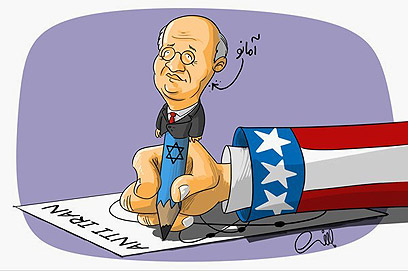
Iranian caricature depicting Yukiya Amano as American and Jewish mouthpiece
"Publishing satellite images of suspicious facilities as damning evidence proves that this report was conducted without proper evidence in order to fit to the American's worldview," the news agency, which is considered the Iranian regime's mouthpiece, stated.
The US State Department on Tuesday said it needed time to the report and declined to make any immediate comment on its contents.
"This was released to member states about an hour ago so we're going to take some time to look at it before commenting," State Department spokeswoman Victoria Nuland told a news briefing.
"We are not prepared to talk about any next steps at this point."
'More sanctions, but not on oil'
However, a US official said on Tuesday that Washington may impose more sanctions on Iran, possibly on commercial banks or front companies, but is unlikely to go after its oil and gas sector or its central bank for now,
"I think you will see bilateral sanctions increasing," the official, speaking on condition of anonymity, said after the report's release.
"From our side, we are really looking to close loopholes wherever they may exist," he added, noting that US sanctions are so comprehensive that "there is not a whole lot out there other than the oil and gas market and you know how sensitive that is."
"I don't think we are there yet," he added, referring to the possibility of the United States seeking via US sanctions to make it harder for Iran to export oil and gas, the mainstay of the Islamic Republic's economy.
The official also played down the chances of sanctioning Iran's central bank, which is the clearinghouse for much of its petroleum trade with the rest of the world and which Washington recently suggested was a possibility.
"That is off the table (for now)," said the US official. "That could change, depending on what other players (think). I don't want to rule that out, but it is not really currently on the table."
Meanwhile, Russia criticized the release of the report on, saying it would reduce hopes for dialogue with Tehran and suggesting it was aimed to scuttle the chances for a diplomatic solution.
"We have serious doubts about the justification for steps to reveal contents of the report to a broad public, primarily because it is precisely now that certain chances for the renewal of dialogue between the 'sextet' of international mediators and Tehran have begun to appear," the Russian Foreign Ministry said in a statement.
It said time was needed to study the report and determine whether it contained new evidence of a military element in Iran's nuclear program or was nothing but "the intentional – and counterproductive – whipping up of emotions".

IAEA worried over Iran plans to triple uranium production. UN nuclear chief Amano to meet Iranian FM Salehi, says "further cooperation is needed to restore confidence of int'l community."
Labels:
Ali Akbar Salehi»
IAEA»
Nuclear»
Nuclear Proliferation»
UN Nuclear Non-Poliferation Treaty»
Yukiya Amano
| Iran announced last month it would shift its production of higher-grade uranium to an underground bunker and triple output capacity in a defiant move that further fueled Western unease about Tehran's intentions. |
|

UN nuclear watchdog refers Syria to Security Council
Labels:
China»
Deir Alzour»
IAEA»
NPT»
Nuclear Proliferation»
Russia»
Syria

...now? you do this now? perhaps this has something to do with the human rights abuses that public relations can not contain. note: this is the BBC. This is not FOX. This is a miracle that these networks would owe up to after condemning Israel for self defense like they did in 1981 against Iraq.
The UN nuclear watchdog has decided to report Syria to the UN Security Council over its alleged covert nuclear programme, diplomats have said.
The board of the International Atomic Energy Agency (IAEA) voted to rebuke the country over claims it had built an undeclared nuclear reactor.The alleged structure, which Syria has maintained was a non-nuclear military site, was destroyed by Israel in 2007.
The IAEA move comes as Syrian troops crack down on weeks of protests.
Desert site
At the IAEA meeting at its headquarters in Vienna, 17 countries voted for and six against, including Russia and China.
Diplomats said that overall 11 countries of the 35-member board of governors abstained and one country was absent from the vote.
The last time the IAEA referred a country to the Security Council was in the case of Iran, in February 2006.
Thursday's motion was proposed by the US and its Western allies who had asked the IAEA's governing body to find Syria in "non-compliance" with its international obligations.
Syria is a signatory to the Nuclear Non-Proliferation Treaty (NPT), which gives it the right to enrich its own fuel for civil nuclear power, under inspection from the IAEA.
But it has also signed a safeguards agreement with the IAEA under which it is obliged to notify the UN's nuclear watchdog of any plans to construct a new nuclear facility.
Israel bombed the desert site of the alleged reactor - near Deir Alzour in the country's remote north-east - in September 2007. via bbc.co.uk
Roubini warns Turkey that they are about to have an economic crises
Labels:
Ali Akbar Salehi»
Azerbaijan»
Bank Mellat»
Davutoğlu»
IAEA»
Iran»
Iran's Sanctions»
Iranian»
NPT»
Turkey
Renowned economist Prof. Dr. Nouriel Roubini said that the Turkish Central Bank should be supported by economic policies. Roubini said that the current account deficit and high domestic demand posed a risk to the Turkish economy. via hudson-ny.org
Turkey will be on it's hands and knees begging for stimulus money when their economy collapses. The unemployment is high and the loans can not be paid. The alarm bells are ringing now. Our terrorist enabling business men in the West are about to get a wake up call.
"The most significant existing relationship between Iran and the Turkish financial system is through the Bank Mellat branches in Turkey," David Cohen, acting undersecretary for Terrorism and Financial Intelligence, told the Hürriyet Daily News & Economic Review on Tuesday. via hudson-ny.org
Turkish Foreign Minister Ahmet Davutoğlu (L)
meets with his Iranian counterpart, Ali Akbar Salehi,
in Urmia. AA photo.
“Our prime minister has set a target of $30 billion in annual trade with Iran. That is why we are opening this border crossing,” Turkish Foreign Minister Ahmet Davutoğlu said Saturday. “We are announcing to the world that Turkey and Iran will be friends for eternity.” via hurriyetdailynews.com
Me wonders how much those biz contacts with Iran are worth when Turkey needs a loan.Hardly a model of Democracy for the region to follow. If you want Democracy the world needs to learn from the good business people who have a healthy economy in Israel

do you think ElBaradei sees stones the way he sees WMDs?:
Labels:
Amr Moussa»
Egypt»
IAEA»
Mohamed ElBaradei»
stoning»
WMD
RT @ElBaradei Went 2 vote w family attacked by organized thugs. Car smashed w rocks. Holding referendum in absence of law & order is an irresponsible act
For @ElBaradei the turnaround happened almost overnight. He was the Brotherhood's front man but...broke with them over the referendum. And now they want to break him.
So is the mass media going to start saying: Hey, we were wrong! These people are strong, organized, and radical? Or, rather, is the Obama Administration going to sink deeper into the al-Qaida bad; all other Islamists good mantra? To put it another way, are they willing to lose face for exaggerating the power of Facebook?

I guess there are some people in Egypt who don't like former IAEA chief Mohamed ElBaradei. On Saturday, he went to vote in a referendum and watch what happened....
Hmmm.
Hmmm.
Posted via email from noahdavidsimon's posterous
At this point--to show how bad the situation is in practice--Amr Moussa, veteran radical Arab nationalist, Israel-baiter, and anti-American is quickly becoming the best one can hope for in terms of the new regime.
The only thing surprising to me is that the Islamists have been emboldened so fast. I thought they would be cautious a while longer in their pretense at being moderate and pro-democracy. But revolutionary Islamists quickly become arrogant when people make concessions to them and they conclude that they are strong and victorious.
via rubinreports.blogspot.com
At this point--to show how bad the situation is in practice--Amr Moussa, veteran radical Arab nationalist, Israel-baiter, and anti-American is quickly becoming the best one can hope for in terms of the new regime.
The only thing surprising to me is that the Islamists have been emboldened so fast. I thought they would be cautious a while longer in their pretense at being moderate and pro-democracy. But revolutionary Islamists quickly become arrogant when people make concessions to them and they conclude that they are strong and victorious.
via rubinreports.blogspot.com
CHECKMATE! Saddam's WMDS found
Labels:
IAEA»
Iraq»
Iraqi weapons inspector»
Syria»
WMDs
... now what argument does the "Left" have?
 Even Chomsky admitted there was satelite activity that he saw.
President George W. Bush was subjected to one of the most vicious smear campaigns in history, based on the false assertion that he lied about Saddam Hussein pursuing weapons of mass destruction as a justification for the Iraq War. WikiLeaks documents released in October once again confirm (AT had the story in December, 2009) that Iraq did indeed possess yellowcake uranium, despite the lies of Joseph Wilson, husband of CIA desk jockey Valerie Palme.
President George W. Bush was subjected to one of the most vicious smear campaigns in history, based on the false assertion that he lied about Saddam Hussein pursuing weapons of mass destruction as a justification for the Iraq War. WikiLeaks documents released in October once again confirm (AT had the story in December, 2009) that Iraq did indeed possess yellowcake uranium, despite the lies of Joseph Wilson, husband of CIA desk jockey Valerie Palme.
Larrey Elder presents a debunking of the "no WMD" media fantasy today on Townhall, and makes the entirely proper point that George W. Bush is owed a huge apology. Strangely, for whatever reason, the ex-president has not defended himself on this point in his current bestselling book, nor did he during his presidency.
So, congratulations Pvt. Manning and Julian A. for confirming what AT readers already knew, but don't expect any kudos from the left or the press.
I'm going to have to ask for apologies from a lot of people
You will recall that there are three sites in Syria, which are associated with the al-Kibar reactor site that was mysteriously destroyed in September 2007, and to which the Syrians have denied the IAEA access. Now, thanks to satellite images, there is more evidence of suspicious activities at the sites in question.read the rest at the link
The Sueddeutsche Zeitung has reported the names of three cities in Syria which are near sites suspected of being functionally related to a destroyed covert reactor construction project. These suspect sites are located near Masyaf, the village of Marj as-Sultan near Damascus, and Iskandariyah (see figure 1).
ISIS has learned that the site seen in Figure 2 is the suspect site located near Masyaf.
This site is located approximately six kilometers northeast of Masyaf city center 1 in Syria (see figures 3 and 4), and appears to be comprised of storage buildings. Aside from what could be a line of berms or trenches (see figure 5), the site does not appear to have many security measures visible in commercial satellite imagery. The entire site, however, is situated in a ravine between two hills and buildings at the site are located along the base of the hills—a common method for providing general protection and isolation. This could indicate that the site is a military depot/storage facility. Hundreds of items can also be seen stored in rows out in the open (see figures 6 and 7). It is unclear what these items are.Read the whole thing. The bottom line is that without access to the sites in question, no one can tell for sure what they are, and the Syrians are refusing to grant the inspectors access to the sites.


South Africa's Nuclear Weapons Program
Labels:
de Klerk»
IAEA»
NPT»
Nuclear»
Nuclear Proliferation»
South Africa
Some folks on Seesmic Video asked for a background on this. This was shared with me by Charles W. Schowalter and is an overview from MIT
South Africa's Nuclear Weapons Program
David Albright, President
Institute for Science and International Security March 14, 2001
Institute for Science and International Security March 14, 2001
South Africa is the only country to voluntarily give up its nuclear weapons. Many other states, such as South Korea, Taiwan, Argentina, and Brazil, abandoned their nuclear programs before they developed a weapon capability. However, South Africa's abandonment of its twenty- to thirty-year-old nuclear weapons program remains unique.
South Africa's first device was completed in 1979. A decade of weapons development followed, leading to plans to mate nuclear warheads with ballistic missiles. In 1990, President F. W. de Klerk terminated the program and in 1991 South Africa signed the Nuclear Non-Proliferation Treaty (NPT). The IAEA then conducted an unprecedented verification of nuclear rollback. Although the IAEA was traditionally concerned only with the accuracy of a nation's declaration, after the agency's failure to detect Iraq's nuclear program the IAEA shifted its focus also to verifying the completeness of a nation's declaration of nuclear activities and facilities.
The official history of South Africa's nuclear weapons program as stated by South African government officials sidesteps some issues and is misleading on others. ISIS has interviewed South African nuclear scientists and government officials and collected material from South Africa and the IAEA to develop a more complete history of this program. The case of South Africa provides the only example of verification of nuclear rollback and highlights the extreme difficulty of verifying nuclear disarmament.
South Africa's nuclear program began during World War II with the discovery of major uranium deposits in the country. South Africa's first large-scale nuclear research and development project was initiated in 1959 under the auspices of the Atomic Energy Board (AEB). Although members of the former apartheid government claim that this project was not weapons-related, the African National Congress (ANC) believes that the ultimate goal of this early project was a nuclear weapon. The heart of the program was an indigenous nuclear power reactor fueled with natural uranium. Research on uranium enrichment was also commenced. A nuclear research center, including a US-provided research reactor, was established at Pelindaba. In 1967, South Africa abandoned the indigenous power reactor program while moving uranium enrichment to the pilot plant stage.
In 1967, South Africa combined its experience gained with the power reactor and uranium enrichment programs to launch a program to build peaceful nuclear explosives (PNEs). In 1970, South Africa announced the construction of a uranium enrichment plant, called the Y-Plant, at Valindaba, next to Pelindaba. Realizing that the large facility could not be hidden from outsiders, South Africa publicly announced the existence of the plant but kept secret the uranium enrichment technology and its plans to produce weapons-grade uranium. South Africa had tremendous problems getting the plant to work properly and the net effect was that output was only half as much as expected. Despite these problems, by the end of the 1980s, the plant had produced roughly 500 kilograms of uranium enriched to at least 80%.
In 1970, a committee within the AEB recommended that the government develop several types of PNEs including those based on gun-type and implosion-type designs (Type A) as well as boosted fission (Type A*) and thermonuclear designs (Type B). In 1971, the Minister of Mines approved development of the Type A devices. In 1973, theoretical work on Type B devices was approved and two years later approval was granted for the construction of facilities to produce the material needed for thermonuclear devices.
The AEB scientists chose to focus on the gun-type design and had completed theoretical work on such a design by 1973. In 1976, the first full scale test of the device, using natural uranium instead of enriched uranium, was conducted successfully. The next year, South Africa completed its first full-scale device (minus the highly enriched uranium). The huge device, 4.5 meters long and 3400 kilograms in weight, was suitable only for a static test. South Africa began its search for a test site in 1973 and by 1977 had completed two shafts in the Kalahari Desert. Preparations for a cold test were detected in August 1977 by the United States and Soviet Union forcing South Africa to halt its test preparation activities. Following this episode, AEB scientists miniaturized the design of the device so that it was only 2 meters long, weighed 750 kilograms and would be ready for testing at short notice.
By 1977, AEB also established nuclear weapon research and development and production facilities at Pelindaba. Around this time, South Africa's security environment had deteriorated with the introduction of Cuban forces into Angola and the imposition of a military embargo by the United Nations. In 1978, P.W. Botha became prime minister of South Africa and a nuclear strategy was developed. While the AEB felt that an underground test would be a sufficient deterrent, the military believed that a fully weaponized nuclear capability was needed to provide a credible deterrent. As a result, responsibility for the weaponization program was transferred to Armscor, South Africa's primary weapon development agency. By 1982, Armscor had built its first device, a relatively simple bomb. Subsequently it made extensive modifications to the AEB weapon design to meet the military's requirements for safety, security and reliability.
In 1985, the government capped the weapons program at seven gun-type devices and limited HEU production at the Y-Plant to that needed to meet this goal. Research on implosion, boosted fission and thermonuclear designs continued but work on plutonium-based weapons was halted. In addition, development of a ballistic missile to replace the aging Buccaneer bombers as a nuclear delivery system was continued. Armscor also received additional funds to build a new weapon production facility called Advena Central Laboratory.
South Africa's nuclear strategy, originally developed in the late 1970s, had three phases. Phase one consisted of perpetuating strategic uncertainty regarding South Africa's nuclear capabilities. If South Africa faced an overwhelming conventional military threat and the West was unwilling to intervene on its behalf, South Africa would implement phase two of the strategy. Under this phase, South Africa would covertly acknowledge the existence of its nuclear weapons to key Western powers in the hope of inducing their intervention. If this approach did not succeed, South Africa would move to phase three, the adoption of an overt deterrent posture, which included several options. South Africa would publicly acknowledge the existence of its nuclear stockpile, conduct an underground nuclear test, or detonate a nuclear explosion on the surface. South Africa calculated that the West's determination to prevent the spread of nuclear weapons would force them to place South Africa under their nuclear umbrella in the event of a crisis. The implementation of South Africa's nuclear strategy never progressed beyond phase one.
By 1989, South Africa had six devices in its arsenal, each containing 55 kilograms of HEU, and enough HEU for a seventh device. South Africa took several precautions to safeguard its weapon stockpile. All the devices were stored unassembled with the front and rear portions of the weapons stored in separate vaults. Four codes, including one held by the president, were required to assemble the two parts into a weapon. In addition, to prevent premature detonation of a device, the weapons would only arm once they reached a certain altitude on board their delivery aircraft. Armscor based its safeguards largely on American practices.
By late 1989, the departure of Cuban forces from Angola, the decline of the Soviet Union and the independence of Namibia, had significantly improved South Africa's security situation. President F.W. de Klerk, elected in September 1989, sought an end to the apartheid regime and South Africa's acceptance back into the international community. The nuclear weapons program was viewed an obstacle to these goals and orders were issued for the termination of the program. By the time South Africa joined the NPT in the summer of 1991 and IAEA inspections began later that year the program had been dismantled and its nuclear weapon manufacturing facilities had been decontaminated. Largely because of domestic and international pressure, de Klerk announced the existence of the former weapons program and began cooperating with IAEA efforts to verify the rollback of the program.
With access to South African records, the IAEA recalculated the Y-Plant's production on a day-to-day basis and arrived at a final estimate within about 5-10 kilograms of South Africa's declaration. The IAEA was able to verify the scope and timing of the South African nuclear weapons program and its subsequent dismantlement.
South Africa's success in developing nuclear weapons can be attributed to five elements. First, South Africa mastered the highly enriched uranium production process. Second, the nation had a defense industry which could produce nuclear delivery systems. Third, the program had good scientists and technicians. Fourth, the program had a good foreign procurement network. Fifth, the weapons' design was kept simple and low in cost. The international sanctions placed on South Africa in the 1970s slowed but did not stop its nuclear weapon program. In fact, the imposition of the sanctions in the 1970s may have hardened South Africa's determination to build nuclear weapons.
Rapporteur: Gregory Koblentz
back to seminar schedule, spring 2001
via web.mit.edu
Subscribe to:
Posts (Atom)


