...denied correlative: the repressive and brutal totalitarian crackdown on the people of Qatar(Maan) GAZA CITY – Influential Egyptian Muslim theologian Yususf al-Qaradawi on Friday stressed the necessity that the Rafah crossing between Egypt and the Gaza Strip should be open completely.
During a meeting with the premier of the Hamas-run government in the Gaza Strip Ismail Haniyeh in Qatar, al-Qaradawi said, “It is unusual that closure of the Rafah crossing continues barring movement of people and goods.”
He added that the Gaza Strip expected support from the Arab and Islamic nations. Al-Qaradaqwi applauded the emir of Qatar, Hamad Bin Khalifa Al Thani, for his support to Palestine and to Gaza.
“In light of what the triumphant revolutions in the Arab world achieved, I can assert that Palestine will achieve victory because Palestine is rightness and rightness always wins, while occupation is falseness and falseness will eventually vanish.”
For his part, Haniyeh applauded Qatar and Sheikh Al Thani for the support to Palestine and the Palestinian cause. He highlighted that the emir of Qatar responded positively to calls for reconstructing the war-torn Gaza Strip.
Showing posts with label King Hamad bin Isa al-Khalifa. Show all posts
Showing posts with label King Hamad bin Isa al-Khalifa. Show all posts
Maan News Agency: Haniyeh meets renowned Egypt sheikh in Qatar

 Labels:
Hamad Bin Khalifa Al Thani»
Ismail Haniyeh»
King Hamad bin Isa al-Khalifa»
Qatar»
Sheikh Khalid bin Hamad Al-Khalifa»
Yousef al Qaradhawi»
Yusuf al-Qaradawi
Labels:
Hamad Bin Khalifa Al Thani»
Ismail Haniyeh»
King Hamad bin Isa al-Khalifa»
Qatar»
Sheikh Khalid bin Hamad Al-Khalifa»
Yousef al Qaradhawi»
Yusuf al-Qaradawi
Bahraini King's Son Weds Saudi King's Daughter
Labels:
Arab Spring»
Bahrain»
King Hamad bin Isa al-Khalifa»
Sahab bint Abdallah bin Abd Al-Aziz»
Saudi King Abdullah»
Saudis»
Sheikh Khalid bin Hamad Al-Khalifa

The Bahraini news agency BNA reported that Sheikh Khalid bin Hamad Al-Khalifa, the son of Bahrain's king, married Sahab bint Abdallah bin Abd Al-Aziz, the daughter of the Saudi king, on June 16.
The report added that this marriage strengthens Saudi-Bahraini relations even more, following the Saudi assistance in quelling the unrest in Bahrain in March, 2011.
via thememriblog.org
Syrian soldiers shot for refusing to fire on protesters?
Labels:
Al Arabiya»
Al Jazeera»
al-Jazeera»
Arab Spring»
Asharq al-Awsat»
Assad»
King Hamad bin Isa al-Khalifa»
media bias»
NYTimes»
Qatar»
Rafik Hariri»
Riyadh»
Saudis»
social media»
Syria»
Washington Post

 |
Some sober analysis of the "Arab Spring" |
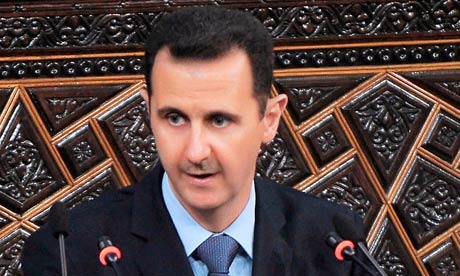
 Syrian soldiers have been shot by security forces after refusing to fire on protesters, witnesses said, as a crackdown on anti-government demonstrations intensified:...The Arab Spring can never bloom if the people can not be heard because of Saudi fears.
  | ||
|
The Arab media has largely been silent about what's been going on in Syria. And the Western media have followed their lead. Lee Smith explains why.
What’s peculiar is that given the size of the uprising—people are in the streets of every major Syrian city except Aleppo—and the bravery of the demonstrators, there’s been little attention paid to it. After all, these are not Egyptian security forces under the command of a U.S. ally like former president Hosni Mubarak. Any Syrian who steps out into the street understands that if security forces have a clear shot, they’ll take it, and no one is going to stop them, certainly not the regime, and not fear of repercussions from the international press either. The same Western and Arab media that covered the Egyptian uprising as it unfolded is all but absent from Syria.But the lack of coverage cannot be entirely blamed on al-Jazeera.
The New York Times’s reporting is coming out of Cairo and New York; the Washington Post’s coverage is based in Beirut; Reuters has people in Damascus, but the regime keeps detaining them and throwing them out. That is to say, the Assad regime has done an excellent job of keeping the curtains closed on events, so that the main source of news coming directly out of Syria is almost exclusively from the Internet, YouTube, Facebook, and Twitter. The social media galvanized Egyptian and Tunisian protestors, but for the Syrian opposition it is the main source of media they have to show the world what’s happening.
As Washington, D.C.-based Arab journalist Hussain Abdul Hussain notes:
Arab satellite channels dedicated more air time to Syria than in the previous weekdays. The first 30-minutes of Al-Jazeera's news coverage were dedicated to clashes in Syria. However, Al-Jazeera, which has been exceptionally silent on Syria, perhaps because of the good alliance between Assad and Al-Jazeera's owner the Sheikh of Qatar Hamad Bin Khalifa Al Thani, cherry-picked its coverage of Syrian rallies.
Young also faults Al Arabiya, the majority-Saudi-owned network, founded in 2003 for no other purpose than to deter its Qatari rival, Al Jazeera, which came to prominence through its attacks on Riyadh and other Arab rivals, including Cairo.And Western media is just following the Arab lead rather than doing their job. What could go wrong?
To toss Al-Jazeera and Al-Arabiya into the same basket is entirely justified here, because both Saudi Arabia and Qatar share a desire to avert a breakdown in Syria, fearing that chaos might ensue. Their views are echoed by a majority of Gulf states, whose leaders have called Assad lately to express their backing.It’s true that the Saudis, who have been at loggerheads with Syria ever since they suspected Syrian involvement in the murder of former Lebanese prime minister Rafiq Hariri, don’t want to see Assad fall. They fear that the wave of Arab uprisings is likely to reach them next, and this is a good place to block a domino. However, other Saudi-owned media, like the pan-Arab London-based newspaper Asharq al-Awsat, has been unsparing in its criticism of Damascus.
Perhaps that’s because the Saudis recognize that in a region with soaring illiteracy rates, video is a much more powerful medium than the printed press. Of course, it’s also possible to overstate the influence of Al Jazeera, especially compared to one of the region’s oldest and most powerful media, the sermon at Friday noon prayers. Last week in Beirut I heard rumors that the Saudis had instructed Sunni sheikhs and imams throughout Syria to calm things down and keep people out of the street. Apparently, the Saudis’ wishes were scattered by the winds of the Syrian uprising.
Wikileaks: Bahrain secretly in contact with the Mossad
Labels:
Abbas»
Abu Mazen»
Arab Spring»
Arabs»
Haaretz»
Hadasah»
Iran»
King Hamad bin Isa al-Khalifa»
Mossad»
Oman»
Qatar»
Shi'i»
UAE»
WikiLeaks»
Yedioth Ahronoth
There will be another "Arab Spring" in Bahrain, Qatar, Oman and the UAE. These revolutions are not about Democracy. These revolutions are a revolution against Democracy and the Western countries that spawned it.
He may have greeted Abu Bluff for the sake of form, but a cable released by Wikileaks reported that Bahrainian King Hamad bin Isa al-Khalifa told then US ambassador William Monroe in 2005 that he was in touch with the Mossad.
“[The king] revealed that Bahrain already has contacts with Israel at the intelligence/security level (ie with Mossad) and indicated that Bahrain will be willing to move forward in other areas,” the cable said.Heh.
The king also told the ambassador that he had ordered his public information minister to stop calling Israel the “enemy” or the “Zionist entity” in official statements of the kingdom, said the cable, which was released by the anti-secrecy website WikiLeaks.
The Israeli newspapers Haaretz and Yedioth Ahronoth recently published reports based on the cable.
The cable’s revelation comes at a delicate time for Bahrain’s Sunni royal family, which invited troops from Saudi Arabia and other Gulf states last month to help quell an uprising by the country’s Shiite majority.
“In the Arab world, they hate this sort of thing and in Bahrain I’m sure it will be yet another sin [for the opposition] to beat the government with,” said Simon Henderson, a Gulf anaylst for the Washington Institute for Near East Policy.
“It will also not be particularly welcomed by supporters of the government, even though they might half understand that to counter Iran, the government needs to deal with a whole variety of people,” he said.
Bahraini officials could not be reached for comment.
A leading pro-government lawmaker insisted that the information about contacts with Mossad “cannot be true” because Bahraini intelligence officers “still consider [Israel] an enemy.”
Israel has also had contact with Qatar, Oman and the UAE. Read the whole thing.

But according to cables previously released by WikiLeaks, Israel has maintained covert ties with several Arab states — particularly those in the Persian Gulf, like Bahrain, that fear Iran’s spreading influence.
For example, a March 2009 cable from the U.S. Embassy in Tel Aviv quotes Yaacov Hadas, a senior Israeli foreign ministry official, describing Israel’s growing engagement with the Gulf states.
“Hadas said the Gulf Arabs believe in Israel’s role because of their perception of Israel’s close relationship with the U.S. but also due to their sense that they can count on Israel against Iran. ‘They believe Israel can work magic,’ Hadas commented,” the cable says.
That cable described Israel’s ties with Qatar, Oman and the United Arab Emirates, but not Bahrain.
I'm sure Obama will feel empathy for the citizens of these Arab countries when they overthrow their government because they were too friendly with Jews.
Crown Prince of Bahrain expected to invite Saudi support following anti-government demonstrations in capital
Labels:
Bahrain»
Gulf Co-operation Council»
King Hamad bin Isa al-Khalifa»
Saudi Arabia»
Saudis
The United States condemned the violence. "We urge the government of Bahrain to pursue a peaceful and meaningful dialogue with the opposition rather than resorting to the use of force," said White House spokesman Jay Carney. via google.com


 Saudi forces are preparing to intervene in neighboring Bahrain, after a day of clashes between police and protesters who mounted the most serious challenge to the island's royal family since demonstrations began a month ago.
The Crown Prince of Bahrain is expected to formally invite security forces from Saudi Arabia into his country today, as part of a request for support from other members of the six-member Gulf Co-operation Council.Thousands of demonstrators on Sunday cut off Bahrain's financial centre and drove back police trying to eject them from the capital's central square, while protesters also clashed with government supporters on the campus of the main university.
Amid the revolt Bahrain also faces a potential sectarian conflict between the ruling minority of Sunnis Muslims and a majority of Shia Muslims, around 70% of the kingdom's 525,000 residents.
The crown prince, Salman bin Hamad al-Khalifa, said in a televised statement that Bahrain had "witnessed tragic events" during a month of unprecedented political unrest.
Warning that "the right to security and safety is above all else", he added: "Any legitimate claims must not be made at the expanse of security and stability."
The crown prince has also promised that national dialogue would look at increasing the power of Bahrain's parliament, and that any deal could be put to nationwide referendum.
However, some protesters have pressed their demands further to call for the toppling of the Sunni dynasty. images via travel-images.ws via librabunda.blogspot.com

WikiLeaks: US embassy cables: Bahrain king says Iranian nuclear programme must be stopped
Labels:
Bahrain»
Bomb Iran»
Iran»
King Hamad bin Isa al-Khalifa»
Petraeus»
WikiLeaks

King Hamad bin Isa al-Khalifa tells head of US central command, General David Petraeus, that Arab states need to do more to engage Iraq, and urges American action to stop Iran's nuclear programme.
via guardian.co.uk
Subscribe to:
Posts (Atom)


