(Sultan Knish)Liberal Jews have become the eunuchs in the modern Byzantiums, trusted to administer the system because they have no interests of their own. When Jewish groups are asked to define Jewish interests they inevitably reel off a series of liberal platitudes about immigration, abortion, tolerance and gay rights. It's not that Jewish interests don't exists, it's that they have been steadily excluded from the dialogue space and liberal policies have been treated as their equivalent. Israel is the last stand. It's the last Jewish interest that is specifically ethnic and religious, rather than some vague nostrum about Tikkun Olam and what Jewish values have to say about importing HIV positive Peruvians. And it's no wonder that it's so fiercely under attack.I usually like to do a cartoon when I see a great Sultan Knish post... I don't think you want to see me drawing this.... so I'm posting the whole thing. Ouch!
The eunuchs can be trusted because they have no families and no children. They have no future and so they have no outside interests. They are contemptible for those reasons, but also useful for those reasons. You can trust a eunuch to see to things without worrying that he will selfishly help his own, because he has no 'own', he is an isolate, a dead end, a withered branch. The liberal Jew has the same role and for the same reason. His identity is a transitory thing on the path to integration. He has a future, but not a Jewish future. Like the eunuch, he is a dead branch of the tree.
Everyone knows Jews are clannish. It's one of the stereotypes, right up there with cheap. But the Jewish eunuch can't be clannish, not really, because the eunuch has no clan except his own kind and they aren't much of a worry because eunuchs don't reproduce. They may form their own groups and chatter on about whatever it is eunuchs care about, but everyone knows they have no future. Wait a few generations and they'll be gone.
And that is the trouble with Israel, it is much too alive. It is a Jewish country swarming with Jews. It actually calls on ethnic and religious allegiances. It is the last Jewish interest there is. It is the dream muddying the waters of the eunuch's loyalties. And it has to be destroyed for the liberals eunuchs to keep their place in the bureaucracy of the postmodern borderless state. (MORE)
Showing posts with label Tariq Ramadan. Show all posts
Showing posts with label Tariq Ramadan. Show all posts
The Liberal Jewish Eunuch

 Labels:
eunuchs»
liberal Jews»
Mohammed Merah»
Multiculturalism»
Sarkozy»
Tariq Ramadan»
Tolouse
Labels:
eunuchs»
liberal Jews»
Mohammed Merah»
Multiculturalism»
Sarkozy»
Tariq Ramadan»
Tolouse

Tariq Ramadan Proves Switzerland is NOT Neutral
Labels:
Goldstone»
Switzerland»
Tariq Ramadan
NOR WERE the Swiss EVER Neutral! Not during the Holocaust... not NOW!
Tariq Tricks: Favorite Islamist Spin
In response to a question about how "the weaker" such as "Palestinians, Muslims and blacks" should resist "oppression," Ramadan recounted how, as he put it, "when Israel was killing innocent people in Gaza," Switzerland chose to break its neutrality and take the side of the Palestinians; not to do so would have been to implicitly support the "oppressor." The implication was that if even neutral Switzerland decided to support the Palestinians, everyone should. He did not bring up Hamas's use of human shields or its deliberate choice to store weapons in hospitals and near U.N. buildings, nor did he mention Richard Goldstone's recent recantation on the entire official narrative of the Gaza War.
Christiane Amanpour could not get
Tariq Ramadan to condemn stoning of women
for whatever reason
Tariq Tricks: Favorite Islamist Spin
Labels:
Tariq Ramadan

The Islamic Ummah['s]...rightful position which was intended by Allah, [is] the most exalted nation among men, as the leaders of humanity....Jihad [is] not only for the purpose of fending-off assaults and attacks of Allah's enemies from Muslims, but are also for the purpose of realizing the great task of establishing an Islamic state and strengthening the religion and spreading it around the world..."
Mustafa Mashhur, Jihad Is The Way, (Egyptian Muslim Brotherhood leader, 1996-2002)
By Barry Rubin
The op-ed in the New York Times international edition by Tariq Ramadan is full of lies. Yet virtually no Western reader, no matter how suspicious of the Muslim Brotherhood, will notice any of the specific ways he distorts history.
Ramadan is supposedly the most sophisticated Islamic intellectual in the world as well as being a professor at major universities. The article carries an Oxford dateline. Yet it is typical of the polemical misinformation regularly put out by Islamists and swallowed whole by the Western media.
Let's go through the article:
"The Islamist presence has for decades justified the West’s acceptance of the worst dictatorships in the Arab world. And it was these very regimes that demonized their Islamist opponents...."
Well, let's see. Which were the worst dictatorships in the Arab world that demonized their Islamist opponents? Gamal Abdel Nasser's Egypt; Algeria's military junta; Syria and Iraqi Ba'thist regimes? None of them were Western-backed.
What countries were Western-backed? Saudi Arabia, which gave refuge to Islamists including many members of the Egyptian Muslim Brotherhood; Jordan, whose government often worked with Islamists; Lebanon, where Islamists could operate freely. The United States supported Anwar al-Sadat's Egypt and Sadat had ended the Nasser-era oppression. The Gulf sheikdoms? Never repressed non-terrorist Islamists.
Every Western reader of his op-ed probably thought he was being accurate but, other than Tunisia, it is hard to make any case for what he wrote as being true, except for Mubarak's Egypt. As for that latter country, (the American-sponsored) Mubarak repressed Islamists much less after some of them murdered his predecessor, Sadat, than (the anti-American) Nasser after their attempted assassination of him.
What Ramadan also doesn’t say is that the Islamists want to establish new dictatorships that will certainly not be backed by America because they will be sinking their claws into America’s back, so to speak. Hamas in the Gaza Strip and Hizballah in Lebanon are the first two. There may well be more.
While Ramadan says the “worst dictatorships” demonized Islamism, they also—and to a greater extent—demonized the United States, the West, and Israel. Ramadan wants to create new “worst dictatorships” that also demonize the United States, the West, and Israel.
Those "dumb" Americans actually thought that an Islamist regime in Iran would be bad for them? Ha-ha! How silly!
So was the Islamist “threat” such a fantasy? In Iran, the Islamist regime has compiled a record of repression and mismanagement. In Afghanistan, it was even worse. In the Gaza Strip, Hamas has repressed its nationalist rivals, expelled Christians, and is steadily tightening the noose. In Sudan, Islamist governments were also extremely repressive.
So has the fear of radical Islamism proven to be such an illusion?
Ramadan continues that Egypt’s Muslim Brotherhood:
“Historically represents that country’s first well-organized mass movement with the political influence to match. For more than 60 years, the Brotherhood has been illegal but tolerated. It has demonstrated a powerful capacity to mobilize the people in each relatively democratic election — for trade unions, professional associations, municipalities, parliament and so on — where it has been a participant….”
There is an interesting little misstatement here—designed to leave out Sadat’s tolerance of the Brotherhood’s return to operation—by claiming that nothing has changed in 60 years. To admit the man who made peace with Israel also made peace with the Brotherhood is unacceptable for the Brotherhood’s own distorted history.
He also assumes, correctly no doubt, that his readers have no idea what the Brotherhood members actually do in parliament when they get there. They propose precisely the kind of legislation you'd expect, expressing the goals that Ramadan pretends don't exist.
Yet there is also an element of truth in this passage. At a time when the theme is to downplay the Brotherhood’s strength, Ramadan can’t help but brag by how powerful it is. He continues,
“Islamism [is] a mosaic of widely differing trends and factions, but its many different facets have emerged over time and in response to historical shifts.”
In other words, Islamism is too complex to understand. Now of course, there are many Islamist groups and these use different strategies and tactics. But all of them, as Ramadan knows perfectly well, have the same goal: the seizure of state power and the revolutionary transformation of their societies into countries ruled only by Islamists and exclusively by their interpretation of Sharia law.
Despite their many differences, the Brotherhood has this in common with al-Qaida, the Taliban, the Iranian regime, and many other such groups.
“The Muslim Brothers began in the 1930s as a legalist, anti-colonialist and nonviolent movement that claimed legitimacy for armed resistance in Palestine against Zionist expansionism during the period before World War II. The writings from between 1930 and 1945 of Hassan al-Banna, founder of the Brotherhood, show that he opposed colonialism and strongly criticized the fascist governments in Germany and Italy. He rejected use of violence in Egypt, even though he considered it legitimate in Palestine, in resistance to the Zionist Stern and Irgun terror gangs. He believed that the British parliamentary model represented the kind closest to Islamic principles.”
This is a lie so shameless that Ramadan knew he was fabricating just to fool the Western audience. The Brotherhood was founded by his grandfather in 1928. It was not only anti-colonialist but, as noted above, intent on gaining power for itself and suppressing the other anti-colonialist movements, be they liberal, leftist, or nationalist. The idea that his grandfather was a believer in the British parliamentary system is such a huge fabrication that it sounds like a joke.
But “nonviolent”! What about the famous Muslim Brotherhood terrorist unit which assassinated political rivals? His own grandfather was killed in revenge after his men murdered the Egyptian prime minister! To say, “He was assassinated in 1949 by the Egyptian government on the orders of the British occupier,” is of course a typical fabrication, to play on the theme that only imperialists and their stooges opposed the Brotherhood.
What he writes about Zionism is also a lie. The Brotherhood’s attitude toward Jews is full of basic anti-Semitism expressed in virtually every document of the organization. And, of course, the Brotherhood was fighting against any Jewish state long before either the Sternists or Irgun did anything. When his father went off to fight the Jews, he was almost certainly carrying a German rifle supplied to the Muslim Brotherhood by Hitler in 1942.
Among the most profound lies is to claim that the Brotherhood was anti-fascist. In a forthcoming book, Germany, the Nazis, and the Making of the Modern Middle East, Wolfgang Schwanitz and I will show how the Brotherhood was in fact subsidized by the Nazi government in the 1930s through Amin al-Husaini, the mufti, and became a wartime ally of Germany. In 1942, the Brotherhood received German weapons to stage an uprising once the German army entered into Egypt. It also was incorporated in plans to massacre all of the Jews of the Middle East. Ramadan’s grandfather was a Nazi collaborator.
“Following Gamal Abdel Nasser’s revolution in 1952, the movement was subjected to violent repression.”
Might the newspaper’s readers wonder why Nasser violently repressed the Brotherhood? No mass market newspaper has mentioned the little fact that this “nonviolent” organization tried to assassinate Nasser but missed. Naturally, this made him a bit petulant.
Ramadan then invents a fantasy history in which most of the Brotherhood “remained committed to the group’s original position of gradual reform.” What actually happened is that the Brotherhood devised a two-stage revolutionary strategy. Given its weakness and the likelihood of repression, it would stay away from violence and focus on “da’wa,” long-term recruitment and base-building. One day, leaders promised, it would return to its revolutionary ways.
That day, from my reading, came last October when the Brotherhood’s leader, Muhammad Badi, declared that the time had come for jihad.
True, the current revolution is the product of high food prices, the rise of a middle-class youth group wanting democratic freedom, and the Tunisian upheavals. But a fourth factor is the Brotherhood’s strategic shift, believing that the Mubarak regime was on its last legs and that there was strong popular opposition to the transfer of power to the weak, out-of-touch son, Gamal Mubarak. To what extent the Brotherhood prepared and planned for an uprising we will only know in the future. It didn’t have to be the whole or main reason for the revolution but it might be far more significant than we have known.
Ramadan continues that many members were forced into exile, but then he tells another lie to set up his own role: “Still others settled in the West, where they came into direct contact with the European tradition of democratic freedom.”
That, of course, was him. But is this the story of his background? Not at all. His father’s whole early career was based on being an assistant to the Mufti, who had backed the Nazis, excoriated the Jews, and advocated genocide. After Hitler's defeat, the Mufti had returned to his leadership of the Palestinian Arabs. In 1947 rejected the partition plan and thus the creation of a Palestinian Arab state. He then began the war that would lead to hundreds of thousands of Arabs becoming refugees and setting off the Arab-Israeli conflict.
So if any one man was responsible for the failure to create a Palestinian Arab state and the creation of the Palestinian refugee problem, it was his father's boss.
His father later arrived in Switzerland because he fled an anti-American (not U.S.-backed) dictatorship in Egypt that had extended its rule into Syria. His job was to set up a base for a European-based Islamism; to create an anti-democratic society, not to imbibe the benefits of Western democracy. Vladimir Lenin lived in exile in Switzerland, too, but that did not make him into a democrat.
Ramadan then returns to his original themes: the Brotherhood is diverse and largely moderate; the United States and Israel want to stop Egyptian democracy. He is setting up the long-standing, temporarily underground, but soon to return virulent hatreds that the Brotherhood speeches.
“By deciding to line up behind Mohamed ElBaradei, who has emerged as the chief figure among the anti-Mubarak protesters, the Muslim Brotherhood’s leadership has signaled that now is not the time to expose itself by making political demands that might frighten the West, not to mention the Egyptian people. Caution is the watchword. “
This is also a lie. The fable here is that the Brotherhood saw that ElBaradei was the “chief figure” and so in good democratic fashion supported him. In fact, ElBaradei has been largely a creature of the Brotherhood, which supplies most of his base, activists, support, and maybe funding. The young pro-democracy anti-Mubarak protesters are not at all supporting ElBaradei who has been out of Egypt for 30 years. The Brotherhood is definitely “behind” ElBaradei but in quite a different way than Ramadan implied.
The more the Brotherhood lies, the more suspicious I become. If it came clean about its past, that might mean it was indeed willing to change. If it openly expressed its goals of a Sharia state, it might show itself willing to take a place as one party trying to exert influence on the direction of society (something like this has happened in Iraq). Yet to pretend that the Brotherhood is about peace, love, and democracy is like watching a wolf dressed up as a sheep: you know it’s up to no good.
But then, for the grandson of an antisemitic Nazi collaborator, and son of top aide to another Nazi collaborator, and who himself advocates a totalitarian state, Ramadan has done very well to be hailed as a man of peace by applauding Western intellectuals.
Ramadan is indeed accurate when he says that the Brotherhood’s leadership “has signaled” that now is the time to act in a moderate fashion so as not to “frighten” the West or the Egyptian people. That's precisely what he's doing. Later, when the Brotherhood has a big share of power, it can reveal its true nature and aims. By then it will be too late.
Barry Rubin is director of the Global Research in International Affairs (GLORIA) Center and editor of the Middle East Review of International Affairs (MERIA) Journal. His latest books are The Israel-Arab Reader (seventh edition), The Long War for Freedom: The Arab Struggle for Democracy in the Middle East (Wiley), and The Truth About Syria (Palgrave-Macmillan). The GLORIA Center's site is http://www.gloria-center.org and of his blog, Rubin Reports, http://www.rubinreports.blogspot.com.
Christiane Amanpour could not get Tariq Ramadan to condemn stoning of women for whatever reason
Labels:
Christiane Amanpour»
Cooper Union»
Tariq Ramadan

Ramadan arrived in the U.S. last week and has been speaking in public forums and private fundraisers throughout the country. He was preparing to take a faculty position at Notre Dame University in 2004, when his visa was revoked. U.S. officials cited contributions he had made to an organization that supported the terrorist organization Hamas, a Brotherhood-affiliated group.
Secretary of State http://xrl.us/HitleryClinton A.K.A Hillary Clinton dropped the ban on Ramadan's entry in January following a court order that would have required that the government prove he knew the charity had Hamas ties when he made his contributions. Allies in the American Civil Liberties Union and in academic circles eagerly awaited the visit that would result.
Garden-variety European leftism," wrote the New Yorker's George Packer. On CNN, Christiane Amanpour could not get him to "condemn out of hand stoning of women for whatever reason
The feedback seems to strengthen the hand of Ramadan's critics, who say the Oxford University professor of Islamic studies is polished, but that his claims of moderation are a façade hiding a radical agenda.
"He's been this poster boy for Islamists," Hudson Institute scholar Zeyno Baran told the Investigative Project on Terrorism. Yet "his word choices are so clever that it's difficult to see where he is coming from."
Ramadan "engages in double speak," said Salim Mansur, a professor at the University of Western Ontario and newspaper columnist who has emerged as one of Ramadan's sharpest Muslim critics.
When Ramadan talks to liberal intellectuals, he "quotes Voltaire and says he shouldn't be equated with his grandfather [Al-Banna]," says Mansur. "When he goes to Muslims, he mentions that he is the grandson of Al-Banna and that he is working with Sheik [Yusuf]al- Qaradawi, and any differences between them are 'stylistic.'"Al-Qaradawi is an influential spiritual guide for the Muslim Brotherhood.Ramadan has called for "suspending" stoning (the penalty for adultery in many Muslim states) rather than abolishing it. "What does a 'suspension' mean? What about 'moratorium?'" Baran asked. "Why not just end stoning in the 21st century?"
To do so would require Ramadan to go against Sharia law, she said. He isn't willing to do that, so he opts for talk of suspending such practices and achieving a Muslim "consensus" before changing the law.
Judging from some of his initial appearances in the United States, this approach may be catching up with Ramadan. In a speech at Cooper Union in New York City, he seemed poorly prepared and provided analysis that prompted Packer's "garden-variety European leftism" critique. Packer, a journalist who had written sympathetically of Ramadan and regarded him as a moderate, shared the panel with Ramadan and tried to question him.
On CNN, Ramadan sounded evasive as Amanpour peppered him with questions about the mistreatment of women in Islamic states and questioned his claim to be a Muslim reformer.
"Many people, describe you as 'an Islamist in sheep's clothing,'" she told Ramadan, because he fails to take absolute positions against things like the stoning of women.
Amanpour asked about a 2003 debate with then-French Interior Minister Nicolas Sarkozy, in which Ramadan called for a stoning moratorium while Islamic scholars tried to reach a consensus on the issue.
"And Mr. Sarkozy was furious. He said, 'What do you mean a moratorium? Don't you condemn it out of hand? What are you saying - that we just stop it a little bit, discuss it, and then continue it?' "
Why not condemn out of hand stoning of women for any reason? Amanpour asked.
Ramadan accused Amanpour of incorrectly translating his remarks. He then confirmed the substance of her question, saying it was pointless to condemn such practices while the American and French governments are dealing with Muslim "petro-monarchies" like Saudi Arabia.
Ramadan said his position is "let us first go for a moratorium, to stop it right now and then to have a discussion. What is wrong with this?"
He was defensive when asked about his failure to condemn a cleric who had rationalized the use of female suicide bombers, suggesting that he opposed suicide bombings while embracing the goals of the organizations that use them: "My position on this is, the Palestinian resistance or the Iraqi resistance is legitimate. The means should be ethical. You cannot target innocent people. You cannot target civilians. I was always clear."
Amanpour asked Ramadan about his grandfather, Muslim Brotherhood founder al-Banna, and his association with "extremism" and a very strict version of Sharia. Conditions had changed since the 1930s and 1940s, Ramadan said, and he wants to be judged on the basis of his own work - not the actions of his ancestor.
Ramadan has denied any connection with the Muslim Brotherhood. In an interview with New York magazine last week, Ramadan tried to distance himself from the Brotherhood, saying it split in 1949 and "became something completely different. I disagree with what it has become."
Ramadan's efforts are complicated, however, by his U.S. itinerary, which includes numerous speeches before organizations linked to the Muslim Brotherhood.
On Saturday, Ramadan was keynote speaker at a Council on American-Islamic Relations (CAIR) banquet in Chicago. Exhibits in the terror-support prosecution of the Holy Land Foundation for Relief and Development show CAIR was an extension of a Hamas-support network in the U.S. CAIR's Hamas ties appear to be the subject of a federal grand jury investigation.
On Monday, he addressed the Prince Alwaleed Bin-Talal Center on Muslim-Christian Understanding at Georgetown University in Washington, a Saudi-backed charity headed by John Esposito, a longstanding apologist for CAIR and other Islamist groups.Later on Monday, Ramadan was hosted at a Capitol Hill reception by MAS Freedom, an organization affiliated with the Muslim American Society, another Brotherhood-affiliated group. MAS Freedom Executive Director Mahdi Bray invited Ramadan to be keynote speaker at MAS Freedom's "Standing for Justice" banquet in Boston May 16.
Lawyerly evasions, Whitewashing Muslim Brotherhood's Pro-Nazi StanceDuring his Cooper Union appearance - where he spoke before an overwhelmingly supportive audience - Ramadan was on a panel with Dalia Mogahed of the Gallup Center for Muslim Studies, Joan Wallach Scott of Princeton's Institute for Advanced Study, and George Packer of the New Yorker. The moderator was Jacob Weisberg of Slate magazine.
Ramadan opened by congratulating the United States for letting him in, criticizing American foreign policy and urging Muslims to stop worrying about integrating in the West and focus instead on contributing to their new homes.Packer wrote:"Ramadan seemed wrong-footed in those opening remarks. He didn't have a sense of where he was, of his American audience. It was as if he were speaking to disaffected young second-generation immigrants in a working-class mosque...which is how he spends much of his time. Multiple identities, the value of diversity - not exactly news in this city, in this country. Many of his sentences amounted to buzz words strung together, without reaching a point. It seemed a missed opportunity; his first address in America since becoming an international figure, and he hadn't prepared, hadn't thought it through."Ramadan appeared "much sharper" when the panel and the audience joined the discussion, Packer wrote. Listening to Ramadan for an hour and a half, Packer concluded that Ramadan "is not a philosopher, or an original thinker. He has been cast in that role by recent historical crises and his own ambition - the role of someone whom large numbers of people turn to for insight on a vast range of issues." But what Ramadan has to say about most subjects is "garden variety European leftism."
Packer expressed surprise that none of the speakers who proceeded him at an event sponsored by groups such as the American Civil Liberties Union had said anything about the threats to freedom of speech and expression "in countries where Muslims constitute the majority, or where some Muslims who are in the minority refuse to accept it."
So, the New Yorker correspondent asked Ramadan two questions. One, drawing from a chapter in Paul Berman's forthcoming book, The Flight of the Intellectuals, described the relationship between Ramadan's grandfather, MB founder Al-Banna, and Haj Amin al-Husseini, the Mufti of Jerusalem who was "a Nazi ally who made a series of genocidal broadcasts on an Arab radio program transmitted from wartime Berlin, urging Arabs to rise up and kill Jews."Packer's question included quotations from Al-Banna expressing pro-Nazi and anti-Semitic views. The question also cited Qaradawi, a follower of Al-Banna, expressing similar opinions and asked Ramadan why he never condemned those things.
Ramadan flatly denied his grandfather had ever supported Hitler and said it was necessary to understand the "context" in which the Muslim Brotherhood boss collaborated with the Mufti. According to Ramadan, Al-Banna joined the Mufti because of shared opposition to the creation of Israel, and not because of support for Nazism.
Packer's second question dealt with whether Ramadan believed that rights are inherent in human beings or must be granted by the authority of religious texts. "By the end of the evening, I knew the answer. Ramadan is building a worthy bridge on a rotten foundation," Packer wrote.
Salim Mansur questioned Cooper Union's decision to play host to Ramadan. He noted that in February 1860, Abraham Lincoln delivered an historic address there outlining the case against expanding slavery to America's Western territories. Inviting a pro-Muslim Brotherhood ideologue like Ramadan to speak, Mansur said, is analogous to bringing in the descendant of a slave owner or an avowed segregationist "to speak about freedom."
The Investigative Project on Terrorism (IPT) is a non-profit research group founded by Steven Emerson in 1995. It is recognized as the world's most comprehensive data center on radical Islamic terrorist groups. For more than a decade, the IPT has investigated the operations, funding, activities and front groups of Islamic terrorist and extremist groups in the United States and around the world. It has become a principal source of critical evidence to a wide variety of government offices and law enforcement agencies, as well as the U.S. Congress and numerous public policy forums. Research carried out by the IPT team has formed the basis for thousands of articles and television specials on the subject of radical Islamic involvement in terrorism, and has even led to successful government action against terrorists and financiers based in the United States.
Muslim radicals given platform for hate
Labels:
Cooper Union»
Kurt Westergaard»
Tariq Ramadan
The Grenaa City Hall decided to remove a painting down from their Easter exhibition after complaints from visitors.The painting's motif is a veiled woman and a pig looking at a picture of Kurt Westergaard with a bomb in his turban - exactly like in his own controversial caricature of Muhammed.
 so called INTELLECTUALS WELCOME TARIQ RAMADAN TO COOPER UNION
On Thursday evening, April 8th, the vaunted hero of the American left and the denizens of the "politically correct" intellectual enclaves made his return appearance at Cooper Union in New York City. In a panel discussion entitled, "Secularism, Islam and Democracy: Muslims in Europe and the West", Tariq Ramadan, the formerly "exiled" professor of Islamic Studies at Oxford University took center stage at the forum sponsored by the American Civil Liberties Union, the American Association of University Professors, PEN American Center, the American Academy of Religion and Slate Magazine. The audience of approximately 600 people consisted of those who call him “slippery,” “double-faced,” “dangerous,” but his left-wing apologists refer to him as “brilliant,” a “bridge-builder,” and a “Muslim Martin Luther.”
Controversy has swirled around Ramadan, for the better part of his adult life. He is the grandson of Hassan al Banna, who in 1928 founded the Muslim Brotherhood in Egypt and is the son of Said Ramadan who is credited with bringing the Muslim Brotherhood to Germany where it eventually spread throughout Europe.Born in Switzerland, when his father was exiled from Egypt by Gamal Abdul Nasser, Ramadan studied philosophy, literature and social sciences at the University of Geneva and pursued a Master's degree in philosophy and French literature. He received his PhD in Arabic and Islamic studies. He is best known for his dangerously duplicitous positions on Islamic radicalism. His passive and ostensibly reasoned posture while speaking to Western audiences betrays his bellicose commitment to the furtherance of Sharia law that he reserves exclusively for Muslim only gatherings.
The web site of the American Islamic Forum for Democracy says of Ramadan:
"Ramadan is a self proclaimed Salafi-reformist whose version of reform appears to basically be a modernization of the political system prevalent at the time of the Prophet Mohammed rather than advocacy for individual liberty and the separation of mosque and state. A 'rock star' among the many European Muslims, namely Islamists, Ramadan is considered the most cited individual on Islam in Europe. Ramadan eloquently uses language that supports the precepts of non-violence and involvement in western society, yet he does not distance himself in any way or nearly adequately from the supremacy of political Islam and the concept of the Islamic State. His excuse is that he is speaking "from within Muslims". But this prevents a real understanding of his ideas on political Islam, the Islamic state and Sharia versus constitutional republics and the establishment clause. It prevents a real understanding of his position on the Muslim Brotherhood and thus becomes actual tacit support of the agenda of the Muslim Brotherhood.
Ramadan has been unacceptably deceptive on issues related to Sharia such as laws against apostasy, proscribed punishments under Islamic law, the continued viability of the Islamic state and the Ummah, one law versus Sharia law, and real equality for women in all settings to name a few. His positions remain essentially in line with the Muslim Brotherhood-which remains against the best interests of Muslims. His access to media portrays a homogeneity to Muslim opinions which is outright false and denies the real diversity in Muslim communities and ideologies."
Ramadan accepted the tenured position of Henry R. Luce Professor of Religion, Conflict and Peacebuilding at the Joan B. Kroc Institute for International Peace Studies at Notre Dame University in February 2004, but that August, U.S. Customs officials denied Ramadan entry into the country under the "ideological exclusion provision" of the Patriot Act. The university filed a petition on Ramadan's behalf but hearing nothing from the government, he resigned from the post in December 2004. Ramadan was later denied other attempts to get visas so he could honor speaking engagements with the ACLU, the American Association of University Professors and the PEN American Center being among the groups wanting to host him and arguing on his behalf in the ensuing legal wars. After a federal judge ordered the government to make a decision on Ramadan's pending visa request, his application was denied in September 2006, with a U.S. consular officer concluding the academic's actions "constituted providing material support to a terrorist organization."The government's evidence was $940 Ramadan gave to two charity groups that the U.S. Treasury Department linked to Hamas in August 2003 On January 20, 2010, the American State Department had decided, in a document signed by Secretary of State Hillary Clinton, to lift the ban that prohibited Ramadan (as well as Professor Adam Habib from South Africa) from entering the United States. And now, Ramadan has triumphantly returned to the US for what some call the "Tariq Ramadan American Islamist Victory Tour 2010".
Ramadan was introduced by Jameel Jaffer, director of the ACLU's National Security Project, which litigates cases concerning dissent, discrimination, detention, surveillance and due process. He was counsel to the plaintiffs in American Academy of Religion v Chertoff, the lawsuit that ended the ban on Ramadan. Hailing him as the sacrificial lamb of the Bush administration's anti-Islamic agenda, Jaffer said this evening was dedicated "to creating a safe political space for the exchange of ideas".
The panel was moderated by Jacob Weisberg, the Chairman and Editor-in-Chief of The Slate Group, which publishes Slate Magazine and other web sites. Weisberg introduced the other members of the panel, but noted that the evening would focus on the philosophies of Tariq Ramadan and that he'd be asking some hard hitting questions. The other panel members included Dalia Mogahed, a Senior Analyst and Executive Director of the Gallup Center for Muslim Studies and the co-author of a book entitled, "Who Speaks for Islam?: What a Billion Muslims Really Think", George Packer, a staff writer for The New Yorker and the author of "The Assassins' Gate: America in Iraq", Joan Wallach Scott, professor of Social Science at the Institute for Advance Study and the author of the "Politics of the Veil". She is known internationally for writings that theorize gender as an analytic category.
Ramadan took the lectern and thanked the sponsoring groups for championing his free speech rights and then went on to say that while he is sharply critical of American policy vis-a vis Iraq and Afghanistan, he is not anti-Western and feels that Muslims in Europe can maintain a pro-Western lifestyle while closely adhering to their Islamic beliefs. He said that Islamic women were now taking their place in the forefront of those who frame the debate on the dual role of Muslims in a secular European culture and those who remain faithful to Koranic principles.
"Islam is really a Western religion and Muslims in Europe can and should be loyal citizens of the countries in which they live. Many people are scared of the Muslim presence in Europe but we know that we can integrate diversity through secularism, humility, respect and consistency. Muslim women are informing the process and if you look at them you think they're oppressed but when you hear the way they think and speak, they're clearly a driving force in Islam", said Ramadan.
Concerning his thoughts on the Bush administration, Ramadan intoned, "Bush implied that all Muslims were 'others', they were different and somehow dangerous. While I am a vocal opponent of US policy in the Middle East, all I am saying is that I am against the murder of Iraqi civilians and I am waiting for the new administration to be an honest broker in the Israeli-Palestinian conflict. I am still waiting because I don't see it as of yet in the Obama administration"
Ramadan's detractors view his rhetoric quite differently. "Tariq Ramadan's entry into America needs to be met with open dialogue from the Muslim Community, non-Muslim organizations and the media on the real threat of Political Islam," says M. Zuhdi Jasser, the president of the American Islamic Forum for Democracy (AIFD). "It is incumbent on all Americans, especially American Muslims, to engage Ramadan at any opportunity to demonstrate that the US Constitution trumps the construct of the Islamic State." He went on to say, "To give Ramadan an unfettered platform for his dissimulation while also perpetuating his message of victimization is to give him and his clerical colleagues a status which will forever retard real reform within Muslim thought. Real reform comes from those Muslim leaders with the personal strength of character to call for an end to the Islamic state and the separation of mosque and state. Ramadan has not. Rather he is a soft tongued global instrument of political Islam against the bulwark of real freedom and liberty as we know it in the United States."
Pajamas Media columnist and prolific author, Phyllis Chesler stated in a March 25, 2010 article entitled, "Bin Laden Threatens America, NYC Welcomes Tariq Ramadan", "Ramadan is not my problem, I know him for the snake he is. Rather, it would be the sight of so many Americans who’ve glamorized him, who are fooled by him, who have come to worship Death at his feet."
Panelist George Packer of The New Yorker magazine asked Ramadan why he never roundly condemned his grandfather, Hassan al Banna, for his unyielding support and succor of the Grand Mufti of Jerusalem who spent years in Nazi Germany and advocated the mass extermination of the Jews. Ramadan danced around the question saying that his grandfather was misquoted and that he never advocated a totalitarian or fascist regime but only supported the Mufti in terms of his fierce opposition to the creation of the State of Israel. Packer pressed Ramadan on this point and asked how his grandfather could flagrantly align himself with someone who extolled such a pernicious philosophy of classical anti-Semitism. Ramadan refused to admit that the Grand Mufti of Jerusalem was anti-Semitic but rather claimed that he was righteous in his position that Palestine should not be colonized by the Jews of Europe or the West.
Charges of anti-Semitism have dogged Ramadan since he penned an article in 2003 entitled, “Critique of the (New) Communalist Intellectuals.” Ramadan’s main argument was that “French Jewish intellectuals” — like Bernard-Henri Lévy, Alain Finkielkraut, Bernard Kouchner, André Glucksmann and Pierre-André Taguieff (in fact not Jewish at all) — who used to be “considered universalist intellectuals” had become knee-jerk defenders of Israel and thus “had relativized the defense of universal principles of equality and justice.” Ramadan was trying to turn the tables on those who accuse Muslims of obsessing about their victimhood by accusing “Jewish intellectuals” of doing precisely that, thinking of just their own tribal concerns, while Ramadan’s pursuit of justice for Palestinians was supposedly part of a universalist project.
On the question of the rampant oppression of women in the Muslim world, panelist Joan Wallach Scott, a Ramadan supporter, asserted that the issue of gender equality "has been used as a veil" to divert attention from the "social inequality" of Muslims in the Western hemisphere. Citing purported discriminatory practices against Muslims in such countries as France, Scott said that "unemployment is higher for Muslims in France than it is for French nationals" and that Muslims are viewed as "inferior" in the West. From a historical perspective she described Muslims as a "colonized people", subject to prejudice in its most banal form.
Refusing to address such pervasive misogynistic practices in the Islamic world as forced marriages, stonings, beatings, immolations and honor murders of women, Scott pointed to what she perceived as the sheer hypocrisy of the Western patriarchy who she claims are trying to interfere with the reproductive rights of American women, but are "suddenly concerned and overly involved in the oppression of Muslim women," She concluded by saying that Muslim women wear head scarves, veils, burqas and hijab on their own volition and not because they are coerced by the religious dictums of Islamic culture. She called gender equality a "political tool" that has nothing to do with protecting the rights of Muslim women.
Ramadan also heaped criticism on Dutch intellectual, feminist activist, writer, and politician Ayaan Hirsi Ali, who also happens to be a prominent critic of Islam. "Ali believes that Islam is problematic and that one cannot be a Muslim and open to democracy at the same time. She believes that the only way to be a Muslim is to become an ex-Muslim", Ramadan exclaimed. He remained silent on the issue of the religious dogma of Islam that opposes any government that is not ruled by Sharia law or the practice of religious apartheid that is practiced in many Muslim countries.
When questioned about his statements pertaining to homosexuals being anathema in Islamic law and how the Muslim world is being forced to accept homosexuality in order to appear politically correct and more Westernized, Ramadan deftly skirted the question by figuratively tipping his hat to "political correctness" by saying "this is how Muslims perceive the world is viewing them, not how they perceive themselves. You can disagree with someone being gay but we should respect that person and not tell him or her that they are not a Muslim because of this."
The evening concluded with the reading of several pithy questions from audience members that were read aloud by the moderator. It was not at all difficult to see that Ramadan had not fooled everyone as challenging questions were presented to him by the audience and several people commented that in order to understand the real Tariq Ramadan, they should read the books entitled "The Islamist, The Journalist, and the Defense of Liberalism: Who's Afraid of Tariq Ramadan?" by Paul Berman and "Brother Tariq: The Doublespeak of Tariq Ramadan" by Caroline Fourest.Ramadan continues his charade in the next few weeks in such cities as Chicago, Detroit, Washington and Garden Grove, California. May the forces of truth have the temerity to boldly confront this purveyor of mendacity.
The breach remains: Replying to reporters' questions aboard Air Force One on their way back from Prague, Friday afternoon, April 9, Barak Obama's National Security Adviser James Jones said the administration was discussing how to jump-start the Middle East peace process but "doesn't have a new US plan to offer." These are ongoing discussions, he said, adding "we don't intend to surprise anybody at any time."
Friday, too, President Obama said he is working with allies to develop new sanctions on Iran, but can't yet say what they are and whether they might be effective in dissuading Iran from pursuing nuclear weapons. In an interview with ABC's George Stephanopolous, Obama said: "Do we have a guarantee as to the sanctions we are able to institute at this stage are automatically going to change Iranian behavior? Of course we don't."This episode alone illustrates the depth of discord and mistrust clouding relations between the two governments, originating on Israel's side from disappointment over the Obama administration's failure to make good on his high-sounding pledges of tangible steps to abort Iran's nuclear arms program.But he did not deny the intention to impose a future plan.
The reporters' questions were prompted by DEBKA-Net-Weekly's exclusive disclosures this week on Obama's "borders first" plan for an Israeli-Palestinian accord and by debkafile's earlier report this Friday on the reasons for the Israeli prime minister Binyamin Netanyahu's last-minute decision to cancel his attendance at the US-sponsored summit on nuclear terror, opening in Washington Monday, April 11.The White House is furious over the withdrawal, coming as it did shortly after the US and Russian presidents signed a 30 percent warhead reduction treaty in Prague.
Intelligence-atomic energy minister Dan Meridor will represent the prime minister.
Relations have gone from bad to worse since the flare-up between US president Barack Obama and the Israeli prime minister at their White House meeting on March 23. They have since dropped another notch over a new falling-out between the two governments, focusing this time on the absence of security borders in the new US Middle East plan, our sources reported.
Washington took his withdrawal from the nuclear summit as a message that Netanyahu would no longer cooperate with the US on security matters so long as the Obama administration pursued a policy Israel regarded as detrimental to its security interests.
debkafile's Jerusalem sources say the prime minister acted out of two motives:
1. Israeli government circles were advised to read two reports leaked to US newspapers ( Washington Post: Obama weighs new peace plan for the Middle East and the New York Times: Should US design Mideast peace plan?) which appeared to herald the White House's intention to impose a peace settlement on Israel.Our sources in Washington and Jerusalem named National Security Adviser James Jones as the source of the leaks.
One senior source said the leaked reports were serious because "President Obama has his mind set on getting the borders of Israel and the future Palestinian state negotiated and settled in four months. This process leaves no room for any discussion on the security frontiers promised Israel for decades, yet the US president expects the Netanyahu government to accept Washington's borders-cum-Palestinian state package without demur. His planners have shaped a Palestinian state within borders that make no provision for Israeli security. That is something the Netanyahu government will never accept."
2. At the end of their stormy conversation in the White House, Obama handed Netanyahu a list of 11 issues on which he asked Jerusalem to respond. The prime minister continues to withhold his replies having been convinced from close study of the issues/queries that they were clever formulations designed to trick him into endorsing the new American plan for the Middle East.
Without answers to Obama's eleven puzzles, Netanyahu does not feel his trip to Washington is necessary, especially when the only promises he expects to be kept are those of Egyptian, Turkish and other Muslim rulers to slam Israel for its presumed atomic arsenal.
Equally unnecessary is the US Middle East envoy George Mitchell's umpteenth shuttle between Jerusalem and Ramallah. His next trip scheduled for April 11 was also called off.This was the first time the US president admitted that his Iran policy was at least just as likely to fail as to succeed.
via debka.com
Israel Wins Competition Demonstrating Its Superior Knowledge Of International Humanitarian Law
Maybe that is because for the rest of the world, these laws are theoretical--and claims about war crimes are really nothing more than a means for human rights groups to achieve their own agendas.The laws of war – Israelis know them bestWhile the tendency of human rights groups these days seems to be to do whatever possible to remove war as an option on the global arena, the fact remains that in the real world, war and self-defense are still a necessity--as is knowing what international humanitarian law is really all about:An Israeli team from the Interdisciplinary Center, Herzliya, recently beat out 44 universities to take first place in the 2010 edition of the Jean-Pictet Competition on international humanitarian law.
The week-long international competition, held between March 20-27 in Quebec, Canada, matched up teams from universities around the world to test their knowledge in the field of international humanitarian law (IHL) – commonly referred to as the laws of war.
“For an Israeli team to win a competition in the field in which Israel is so often criticized is significant,” said the team’s academic supervisor, Daphné Richemond-Barak. “The Jean-Pictet is the most prestigious competition in the field worldwide.”
In the competition, teams role-played as representatives from foreign affairs, military advocates or the Red Cross. They were questioned by judges and judged by jury. Among the “judges” for the event was Philippe Kirsch, first president of the International Criminal Court in The Hague.In a nutshell, said [coach Ido] Rosenzweig, IHL might be summarized as, “Do the most damage to the enemy [while] minimizing harm to civilians.”Too bad the Goldstone Commission could not be similarly tested.He explained the four core principles of IHL as follows: distinction of soldiers from civilians; military necessity as a rule in evaluating targets; proportionality; and humanity to the enemy.
Technorati Tag: Israel and International Law.
Hillary Clinton Lifts Visa Ban on Islamic Terrorist Scholars
Labels:
ACLU»
Adam Habib»
Habib»
Hillary Clinton»
Tariq Ramadan

ACLU says the guy is against Terrorism and we believe them because he is a feminist that supports Hamas. If you claim you are a feminist then you couldn't be violent... nah! Let's ask Code Pink.
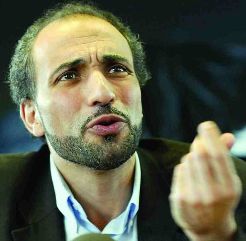
 ...................It’s bad enough that the State Department issued a two-year visa to Northewst Flight 253 terrorist Umar Farouk Abdulmutallab, and then Hillary Clinton failed to revoke it when his father told officials in her (and our) embassy in Nigeria that his son was a terrorist. Hillary got away with that. And Barack Obama took little, if any, blame. via debbieschlussel.com
Now, Barack Hussein Obama and Hillary Clinton have decided to let him in. via israelmatzav.blogspot.com
Government lawyers have said Ramadan was barred because he gave money to a Swiss-based charity, the Association de Secours Palestinien (ASP), between 1998 and 2002. Washington listed ASP as a banned group in 2003, saying it supported terrorism and had contributed funds to the Palestinian Islamic movement Hamas. via swissinfo.ch
here is the ACLU take on the man who they claim is a feminist...
Professor Ramadan has been a consistent critic of terrorism and those who use it. In October 2001, Professor Ramadan publicly deplored the September 11 attacks, saying to fellow Muslims, “Now more than ever we need to criticize some of our brothers . . . You are unjustified if you use the Koran to justify murder.” Professor Ramadan publicly condemned the kidnapping of two French journalists in Iraq in August 2004; the attacks on Jewish synagogues in Istanbul in November 2003; and the terrorist bombing in London in July 2005. via aclu.org
if this guy is a "a consistent critic of terrorism" then why is he supporting Hamas?
For four years, the Bush administration refused to allow Muslim 'scholar' Tariq Ramadan to enter the United States. via israelmatzav.blogspot.com
Hillary Admits Muslim Brotherhood Grandson, Tariq Ramadan
Now he and Hillary are lifting the ban on extremist Muslim “scholars” who openly support and endorse Islamic terrorism, including Tariq Ramadan, whose grandfather, Hassan El-Banna, founded the Muslim Brotherhood (the mother organization to HAMAS, Yasser Arafat, Al-Qaeda, and Al-Qaeda mastermind Ayman Al-Zawahiri). This is the group that masterminded the assassination of Anwar Sadat and the shooting murders of tourists in the massacre at the Temples at Luxor. Ramadan is an open supporter of HAMAS–to which he donated $1,336–and other Islamic terrorist groups. Plus, Ramadan worked for Iran! via debbieschlussel.com
The State Department has cleared the way for two prominent but controversial scholars to return to the United States.
State Department spokesman Darby Holladay said Wednesday that Secretary of State Hillary Rodham Clinton has signed orders enabling the scholars' entry if they obtain visas.
The professors are Tariq Ramadan of Oxford University and Adam Habib of the University of Johannesburg.
Holladay said Clinton decided to use her exemption authority for the benefit of the professors.
The American Civil Liberties Union said it expects the scholars will now get visas within weeks of requesting them.In an ACLU statement, Habib called it a personal victory and also a victory "for democracy around the world." via abclocal.go.com
Subscribe to:
Posts (Atom)


