A Palestinian family of four was killed in a NATO airstrike Monday on the Libyan capital of Tripoli, according to the Palestinian Authority’s Ministry of Foreign Affairs. The ministry explained in a statement published Tuesday on the government news agency Wafa, that the International Red Crescent Association had relayed the news. The family, according to Wafa’s report, had lived in the Yarmouk refugee camp in Damascus, before moving to Tripoli. Palestinian ambassador to Libya Atif Udah told Ma'an radio the family was in a three-story building targeted by a NATO air attack. He identified the victims as Abdullah Muhammad Ash-Shihab, his wife Karima and his 6-month-old twins Khalid and Jumanah. - Ma'an
Showing posts with label Tripoli. Show all posts
Showing posts with label Tripoli. Show all posts
Palestinian Arab family killed - by NATO. Where are the condemnations?

 Labels:
Atif Udah»
Civilian Casualties»
Libya»
Ma'an»
Muammar Gaddafi»
NATO»
Red Crescent»
Red Cross»
refugees»
Tripoli»
Wafa»
Yarmouk
Labels:
Atif Udah»
Civilian Casualties»
Libya»
Ma'an»
Muammar Gaddafi»
NATO»
Red Crescent»
Red Cross»
refugees»
Tripoli»
Wafa»
Yarmouk

U.S. and Allies Seek a Refuge for Qaddafi
Labels:
Africa»
Franco Frattini»
International Criminal Court in The Hague»
Misurata»
Muammar al-Gaddafi»
Pan Am Flight 103»
Qaddafi»
Rome Statute»
Tripoli»
U.N. Security Council»
UN Security Council

...wait.... if the U.K. freed the terrorist who blew up Pan Am Flight 103... it would seem that we also need to arrest some U.K. citizens. Are we going to really hold third world dictators accountable? How about Mubarak for the crimes he did against Israel in the war before the PIECE Agreement? Why the double standard?
The Obama administration has begun seeking a country, most likely in Africa, that might be willing to provide shelter to Col. Muammar el-Qaddafi if he were forced out of Libya, even as a new wave of intelligence reports suggest that no rebel leader has emerged as a credible successor to the Libyan dictator.
The intense search for a country to accept Colonel Qaddafi has been conducted quietly by the United States and its allies, even though the Libyan leader has shown defiance in recent days, declaring that he has no intention of yielding to demands that he leave his country, and intensifying his bombardment of the rebel city of Misurata.About half of the countries in Africa have not signed or ratified the Rome Statute, which requires nations to abide by commands from the international court. (The United States has also not ratified the statute, because of concerns about the potential indictment of its soldiers or intelligence agents.) Italy’s foreign minister, Franco Frattini, suggested late last month that several African countries could offer Colonel Qaddafi a haven, but he did not identify them.
The effort is complicated by the likelihood that he would be indicted by the International Criminal Court in The Hague for the bombing of Pan Am Flight 103 over Scotland in 1988, and atrocities inside Libya.
One possibility, according to three administration officials, is to find a country that is not a signatory to the treaty that requires countries to turn over anyone under indictment for trial by the court, perhaps giving Colonel Qaddafi an incentive to abandon his stronghold in Tripoli.
The move by the United States to find a haven for Colonel Qaddafi may help explain how the White House is trying to enforce President Obama’s declaration that the Libyan leader must leave the country but without violating Mr. Obama’s refusal to put troops on the ground.
The United Nations Security Council has authorized military strikes to protect the Libyan population, but not to oust the leadership. But Mr. Obama and the leaders of Britain and France, among others, have declared that to be their goals, apart from the military campaign.
“We learned some lessons from Iraq, and one of the biggest is that Libyans have to be responsible for regime change, not us,” one senior administration official said on Saturday. “What we’re simply trying to do is find some peaceful way to organize an exit, if the opportunity arises.”
Chavez Defends Gaddafi, Tries to Save Assad
Labels:
Assad»
Benghazi»
Caracas»
Chavez»
Damascus»
Libya»
Muammar al-Gaddafi»
Syria»
Tripoli»
Venezuela
 Venezuelan President Hugo Chavez can be counted on always to stand on the side of radicals and dictatorships. After defending the Libyan regime, Chavez is now trying to save Syrian President Bashar Al-Assad. The Venezuelan leadership is openly supporting the Syrian regime, accusing Western countries of using a "new imperialist format" to topple his friend, Assad. According to Chavez, it is the West that foments revolts in the Arab world to loot Arab resources. "The attack on Syria has begun, there have been some supposedly peaceful protests and some deaths (...) and they are accusing the president [Assad] of killing his people (…) And then the Yankees come in to bomb the people in order to save them. What cynicism on the empire's part," the Venezuelan President said.
Chavez depicted Assad as a "socialist Arab leader, a humanist and a brother," "with a great human sensibility," and who is "in no way an extremist." Chavez made also a comparison between what is happening in Syria and the situation in Libya: "It's the same format … They generate violent conflicts, bloodshed in a country, and subsequently they under take military intervention, in order to take possession of its natural resources and convert it into a colony."
In a recent press release by the Venezuelan press agency (AVN), Chavez said he is convinced that the US wants to generate a revolt in Venezuela similar to those that are taking place in Arab world. In that case, Chavez said, the Venezuelan regime will not keep "its arms crossed;" it will use -- as Assad and Gaddafi are doing -- military weapons, to repress any threat against the Venezuelan regime.
From the press:
March 28, 2011
- Chavez: "Old, mad imperialism, your days are numbered!"
- Chavez :The US is plotting to topple Assad to loot the resources of the Arab state
- Chavez calls Assad a "humanist"
- Venezuelan FM: Colonial powers have only one objective and it is to take ownership of the oil
Chavez: "Old, mad imperialism, your days are numbered!"
Venezuelan President Hugo Chavez said [...] that the colonialist invasion of NATO and the United States against Libya "will turn back against them. I've said this even before the madness of the bombing began." Chavez stated that imperialism's attitude is cynical, since [the Western countries] say that the bombing against the Libyan people does not mean intervention. "How cynical can they be? How much disrespect for the world! They believe they are the Almighty. The world will turn back against them. Note it down." [...]
According to Chavez, NATO maintains a plan to bomb Venezuela, but - the Venezuelan President says - imperialism won't have nor time neither the circumstances to carry out a military attack against Venezuela. [...] "Old, mad imperialism, your days are numbered!" said President Chavez, adding that when this century ends, Imperialism will disappear and the sovereign will of the people will prevail. AVN (Venezuela)
March 27, 2011
Chavez :The US is plotting to topple Assad to loot the resources of the Arab state
Syria has been hit with a fresh wave of anti-government protests during the past week that left scores of people dead. "The attack on Syria has begun; there have been some supposed peaceful protests and some deaths (...), and they are accusing the president [Assad] of killing his people," AFP quoted Chavez as saying on Saturday at a political event. "And then the Yankees come in to bomb the people in order to save them. What cynicism on the empire's part," he noted. […]
Comparing the Syrian situation to the crisis in Libya, Chavez said, "It's the same model." A NATO-led coalition is enforcing a UN-approved no-fly zone over troubled Libya by striking forces loyal to Libyan ruler Muammar Gaddafi. "Generate internal conflicts, bloodshed, in a country in order to then step in, seize its natural resources and make it a colony. It is a new model they have come up with," Chavez said. The Venezuelan president also said that he had spoken with Assad by phone. […] Press TV (Iran)
March 27, 2011
Chavez calls Assad a "humanist"
[…] Venezuelan President Hugo Chavez said the United States and other nations are seeking to intervene militarily in Syria using the same strategy as in Libya. "The supposedly peaceful movements have already begun, and then there will be some deaths and they'll be accusing the Syrian president of killing his people. Later, the Yankees come and want to bomb the people in order to save them, imagine that," said President Chavez.
"What shameless cynicism! It's a new strategy they've invented, to generate violent armed conflicts and spill blood in a country in order to then bomb it and intervene and take ownership of its natural resources and convert it into a colony," Chavez said. […] Chavez also defended Syrian President Bashar Al-Assad, calling him a "humanist" and pointing out that he is "a doctor educated in London; he is no extremist." […]
Venezuelan FM: Colonial powers have only one objective and it is to take ownership of the oil
Meanwhile, Venezuela continues to denounce the international military operation in Libya, which has now been taken over by NATO commanders. "These colonial powers have only one objective and it is to take ownership of the oil and riches of our brotherly people of Libya," Venezuelan Foreign Minister Nicolas Maduro told a state-owned radio program.
Venezuela supports the African Union's proposal for a plan for peaceful mediation, Maduro said. "The empire desperately bombs the Libyan people every night. They want to destroy Libya before arriving at a peace accord," he said.
"All the world is seeing lessons we are learning about the way the former colonial power act desperately when presented with an opportunity. They speak of democracy and human rights, but until yesterday they flattered Gaddafi, they were really courting the oil," Maduro said.
Before the military intervention in Libya began, Chavez proposed a multi-national commission to mediate the conflict between Gaddafi and the rebels and forge a peaceful solution. The Chavez administration has forged unprecedented diplomatic and economic ties with Middle East and African countries to form what Chavez calls a "multi-polar world," not subject to domination by any superpower. Venezuelan Analysis
via hudson-ny.org
by Anna Mahjar-Barducci image via hurryupharry.org
Human Rights Watch and the selling of Gaddafi
Labels:
Amnesty International»
Anne Herzberg»
Faraj Alghoul»
Fathi Eljahmi»
HRW»
Libya»
Muammar al-Gaddafi»
Nadim Houry»
Prof. Gerald Steinberg»
Saif al-Islam»
Sarah Leah Whitson»
Tripoli»
UNHRC»
UNHRW

Gerald Steinberg and Anne Herzberg March 10, 2011 Jerusalem Post
To read the original article, click here.
In 2009, Sarah Leah Whitson, director of the Middle East and North Africa division at Human Rights Watch (HRW), visited Libya, where she claimed to have discovered a “Tripoli spring,” led by Muammar Gaddafi’s son Saif al-Islam. In two articles, she praised him for creating an “expanded space for discussion and debate.”
As a top official of a prominent human rights watchdog, Whitson’s endorsement gave credibility to this fictitious reform movement. Two years later, and weeks after the rebellion began and the Gaddafi regime had killed hundreds, if not thousands, Whitson belatedly reversed course, and in a February 24 Los Angeles Times op-ed acknowledged the façade of Saif’s human rights “reforms.”
In contrast to her earlier praise, Whitson wrote that “most Libyans we spoke with never had much faith that Muammar Gaddafi would learn new tricks, or that the announced reforms were anything more than an endless loop of promises made and broken.”
Clearly, this reversal came far too late to help the Libyans, and reflects the wider moral failure of HRW in the Middle East. In her wildly misnamed “Tripoli Spring,” (Foreign Policy, May 27, 2009), Whitson extolled Saif – who has since vowed to “fight until the last man, the last woman, the last bullet” against the Libyan protesters – as “the real impetus for transformation” via his Gaddafi Foundation and two semi-private papers.
Her embrace continued after a second visit in December 2009, when she referred to Gaddafi’s heir-apparent as one of the “forces of reform,” comparing his foundation to HRW (“Postcard from... Tripoli,” Foreign Policy in Focus, February, 11, 2010). Although HRW officials were placed under constant surveillance, and its press conference was cut short by government agents and ended in “pandemonium,” Whitson still spun her trip in a positive light.
In January 2010, when the regime imposed censorship on the Internet and blocked access to YouTube, Whitson was silent. At the same time, the government established a body to monitor journalists, and closed the two semi-private papers lauded by Whitson in “Tripoli Spring.”
But no correction was issued by HRW.
Whitson’s blindness was further reflected in the case of Fathi Eljahmi, Libya’s most prominent dissident, imprisoned, tortured and killed in 2009. His brother condemned both Amnesty International and HRW for hesitating “to advocate publicly for Fathi’s case” for fear they would “antagonize Gaddafi.”
He reserved special condemnation for Whitson’s reference to Saif ’s charity as a “spring,” observing that the foundation “is actively menacing my brother’s family. Some family members continue to endure interrogation, denial of citizenship papers and passports, round-the- clock surveillance and threats of rape and physical liquidation.”
But Whitson and HRW chose to remain silent.
In contrast to Whitson’s promotion of the “reformer” façade, others were not taken in. Journalist Michael Totten, who also visited Libya, compared the country to North Korea and Turkmenistan, pointedly noting that Saif “is ideologically committed to preserving his father’s prison state system... Gullible diplomats and journalists may sincerely believe he’s a reformer, but a close look at his own statements proves that he’s lying when he passes himself off as moderate.”
Whitson’s endorsement of Gaddafi’s son is not the only example of her cozying up to repressive regimes. In May 2009, Whitson led a fund-raising trip to Saudi Arabia where she marketed HRW’s work combating pro- Israel “pressure groups” to solicit funds from “prominent members of Saudi society” including the ruling Shura Council (the religious police).
In May 2010, Whitson had a meeting with Hamas Minister of Justice Faraj Alghoul. As in the Libyan and Saudi cases, Whitson took the soft approach to massive human-rights violations. Instead, she assured Alghoul that she was visiting Gaza “to listen to all parties directly so she will prepare more objective and impartial reports,” and promised that HRW’s next report would allege Israeli violations of international law.
Beirut was next on Whitson’s itinerary, and during a November 2010 trip she praised “the Lebanese sophistication for human rights.”
In contrast, HRW Lebanon director Nadim Houry condemned the lack of effectual and accountable state institutions, and the absence of political will to implement change. Two months after Whitson’s proclamation of support, Hezbollah took control of the government to block cooperation with the UN tribunal investigating the murder of prime minister Rafik Hariri in 2006.
In each of these cases – Libya, Saudi Arabia, Gaza and Lebanon – Whitson has displayed behavior completely lacking in moral leadership required for any organization claiming to support human rights. In addition, copying the strategy of the Arab dictatorships, year after year HRW has maintained an obsessive focus on allegations directed at Israel. Its website includes only 10 pages on Libya, but more than 40 on Israel.
As HRW founder Robert Bernstein stressed, the “plight of 350 million people” ruled by the most “brutal, closed and autocratic” regimes, “who would most benefit from the kind of attention a large and well-financed international human-rights organization can provide is being ignored as Human Rights Watch’s Middle East division prepares report after report on Israel.”
As long as ideologues like Whitson are responsible for HRW’s agenda in the Middle East, the spin will continue, at the expense of universal human rights.
Gerald Steinberg is on the faculty of Bar-Ilan University and president of NGO Monitor, the Jerusalem-based research organization. Anne Herzberg is NGO Monitor’s legal adviser.

via ngo-monitor.org
EXPOSED: Sarah Leah Whitson, the head of 'Human Rights Watch
Labels:
Anne Herzberg»
Hamas»
HRW»
Lebanon»
Libya»
MENA»
Muammar al-Gaddafi»
NGO»
Prof. Gerald Steinberg»
Qaddafi»
Sarah Leah Whitson»
Saudi Arabia»
Seif al-Islam»
Tripoli
Another Feminist BITES THE DUST!NGO Monitor has called on Sarah Leah Whitson, the head of 'Human Rights Watch's Mideast and North Africa division, to resign, on the grounds that she misled the public regarding the nature of the Gadhafi regime in Libya and the intentions of Gadhafi's son, Seif al-Islam.
Following Human Rights Watch's (HRW) neglect of brutal human rights violations in Libya and false claims and cover-ups about prospects for reforms there, NGO Monitor today called for the immediate resignation of Sarah Leah Whitson, HRW's director of its Middle East and North Africa (MENA) division. HRW's MENA division failed to devote the necessary resources to speaking out against human rights violations by oppressive Middle East regimes, including Saudi Arabia, Hamas, Lebanon, and most notably, Libya. Recent statements by Whitson regarding Seif Islam, a son of Moammar Qaddafi, demonstrate that she consistently whitewashed the reality in Libya and further embarrassed her organization.Maybe Whitson was just trying to raise money from the Libyans. She's really good at that.
"Human Rights Watch, and specifically MENA director Sarah Leah Whitson, has soft-peddled Qaddafi's oppressive acts and offered no help to the Libyan people," says Anne Herzberg, legal advisor for NGO Monitor, a research institution that tracks NGOs. "Whitson was well aware of the atrocities committed by the Qaddafi regime, but she chose to present the façade that Qaddafi's son was prepared to implement 'reforms.' The events in Libya over the past weeks reveal Whitson's gross incompetence. She has failed to retract her previously misleading statements. She cannot continue to head the MENA division, and we call for her immediate resignation."
NGO Monitor notes that Whitson held a press conference last year in Libya that was abruptly halted and ended in "pandemonium." Yet, Whitson spun her trip and the event in a positive light in her 2010 "Postcard from Tripoli," in which she said that Libya had a "moment of opportunity." Even more egregious is Whitson's enthusiastic marketing of the Qaddafi regime from 2009's Tripoli Spring (published in Foreign Policy):
For the first time in memory, change is in the air in Libya. The brittle atmosphere of repression has started to fracture, giving way to expanded space for discussion and debate, proposals for legislative reform, and even financial compensation for families of the hundreds of men killed in a prison riot a decade ago.These assessments differ sharply from the Libya Whitson now admits she saw, as part of her attempts to rewrite the record. In contrast to the earlier fiction, she recently wrote "most Libyans we spoke with never had much faith that Moammar Qaddafi would learn new tricks, or that the announced reforms were anything more than an endless loop of promises made and broken."
Many Libyans say the changes were unavoidable in the face of the open satellite and Internet access of the past decade.
"What Sarah Leah Whitson admits she knew about the Qaddafi family's fraudulent reform agenda completely contradicts statements during her Tripoli trip," says Prof. Gerald Steinberg, president of NGO Monitor. "Reform was never on the horizon and Seif Islam was simply seeking to validate the eventual transfer of power to his hands, using allies like Whitson. Her attempts to give a facelift to MENA's treatment of Libya is indicative of the division's approach to many of the repressive regimes in the region, including Saudi Arabia, Syria, Hamas, and others."
Read the whole thing.

Posted via email from noahdavidsimon's posterous
 |
| Out of Context... but that is the point. EXPOSED in a good way. NOT in a stinky globalist way image via Daniel Ortega Muñoz |
#Islam #Muslim #Jihad #IslamoPhobia #ThomasJefferson
Labels:
Islam»
Keith Ellison»
Thomas Jefferson»
Tripoli
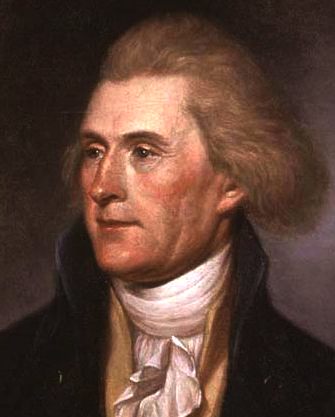 What Thomas Jefferson learned from the Muslim book of Jihad
Ted Sampley
U.S. Veteran Dispatch
January 2007(first post)
Democrat Keith Ellison is now officially the first Muslim United States congressman. True to his pledge, he placed his hand on the Quran, the Muslim book of jihad and pledged his allegiance to the United States during his ceremonial swearing-in.
Capitol Hill staff said Ellison's swearing-in photo opportunity drew more media than they had ever seen in the history of the U.S. House. Ellison represents the 5th
Congressional District of Minnesota.
The Quran Ellison used was no ordinary book. It once belonged to Thomas Jefferson, third president of the United States and one of America's founding fathers. Ellison borrowed it from the Rare Book Section of the Library of Congress. It was one of the 6,500 Jefferson books archived in the library.
Thomas Jefferson's report after meeting with Tripoli's envoy to London in 1786
 |
| https://www.facebook.com/photo.php?fbid=10153780265294131&set=pb.817739130.-2207520000.1455666542.&type=3&theater pic.twitter.com/10nqFKRNqd |
Ellison, who was born in Detroit and converted to Islam while in college, said he chose to use Jefferson's Quran because it showed that "a visionary like Jefferson" believed that wisdom could be gleaned from many sources.
There is no doubt Ellison was right about Jefferson believing wisdom could be "gleaned" from the Muslim Quran. At the time Jefferson owned the book, he needed to know everything possible about Muslims because he was about to advocate war against the Islamic "Barbary" states of Morocco, Algeria, Tunisia and Tripoli.
Ellison's use of Jefferson's Quran as a prop illuminates a subject once well-known in the history of the United States, but, which today, is mostly forgotten - the Muslim pirate slavers who over many centuries enslaved millions of Africans and tens of thousands of Christian Europeans and Americans in the Islamic "Barbary" states.
Over the course of 10 centuries, Muslim pirates cruised the African and Mediterranean coastline, pillaging villages and seizing slaves.
The taking of slaves in pre-dawn raids on unsuspecting coastal villages had a high casualty rate. It was typical of Muslim raiders to kill off as many of the "non-Muslim" older men and women as possible so the preferred "booty" of only young women and children could be collected.
Young non-Muslim women were targeted because of their value as concubines in Islamic markets. Islamic law provides for the sexual interests of Muslim men by allowing them to take as many as four wives at one time and to have as many concubines as their fortunes allow.
Boys, as young as 9 or 10 years old, were often mutilated to create eunuchs who would bring higher prices in the slave markets of the Middle East. Muslim slave traders created "eunuch stations" along major African slave routes so the necessary surgery could be performed. It was estimated that only a small number of the boys subjected to the mutilation survived after the surgery.
When American colonists rebelled against British rule in 1776, American merchant ships lost Royal Navy protection. With no American Navy for protection, American ships were attacked and their Christian crews enslaved by Muslim pirates operating under the control of the "Dey of Algiers"--an Islamist warlord ruling Algeria.
Because American commerce in the Mediterranean was being destroyed by the pirates, the Continental Congress agreed in 1784 to negotiate treaties with the four Barbary States. Congress appointed a special commission consisting of John Adams, Thomas Jefferson, and Benjamin Franklin, to oversee the negotiations.
Lacking the ability to protect its merchant ships in the Mediterranean, the new America government tried to appease the Muslim slavers by agreeing to pay tribute and ransoms in order to retrieve seized American ships and buy the freedom of enslaved sailors.
Adams argued in favor of paying tribute as the cheapest way to get American commerce in the Mediterranean moving again. Jefferson was opposed. He believed there would be no end to the demands for tribute and wanted matters settled "through the medium of war." He proposed a league of trading nations to force an end to Muslim piracy.
In 1786, Jefferson, then the American ambassador to France, and Adams, then the American ambassador to Britain, met in London with Sidi Haji Abdul Rahman Adja, the "Dey of Algiers" ambassador to Britain.
The Americans wanted to negotiate a peace treaty based on Congress' vote to appease.
During the meeting Jefferson and Adams asked the Dey's ambassador why Muslims held so much hostility towards America, a nation with which they had no previous contacts.
In a later meeting with the American Congress, the two future presidents reported that Ambassador Sidi Haji Abdul Rahman Adja had answered that Islam "was founded on the Laws of their Prophet, that it was written in their Quran, that all nations who should not have acknowledged their authority were sinners, that it was their right and duty to make war upon them wherever they could be found, and to make slaves of all they could take as Prisoners, and that every Musselman (Muslim) who should be slain in Battle was sure to go to Paradise."
For the following 15 years, the American government paid the Muslims millions of dollars for the safe passage of American ships or the return of American hostages. The payments in ransom and tribute amounted to 20 percent of United States government annual revenues in 1800.
Not long after Jefferson's inauguration as president in 1801, he dispatched a group of frigates to defend American interests in the Mediterranean, and informed Congress.
Declaring that America was going to spend "millions for defense but not one cent for tribute," Jefferson pressed the issue by deploying American Marines and many of America's best warships to the Muslim Barbary Coast.
The USS Constitution, USS Constellation, USS Philadelphia, USS Chesapeake, USS Argus, USS Syren and USS Intrepid all saw action.
In 1805, American Marines marched across the dessert from Egypt into Tripolitania, forcing the surrender of Tripoli and the freeing of all American slaves.
During the Jefferson administration, the Muslim Barbary States, crumbling as a result of intense American naval bombardment and on shore raids by Marines, finally officially agreed to abandon slavery and piracy.
Jefferson's victory over the Muslims lives on today in the Marine Hymn, with the line, "From the halls of Montezuma to the shores of Tripoli, we will fight our country's battles on the land as on the sea."
It wasn't until 1815 that the problem was fully settled by the total defeat of all the Muslim slave trading pirates.
Jefferson had been right. The "medium of war" was the only way to put an end to the Muslim problem. Mr. Ellison was right about Jefferson. He was a "visionary" wise enough to read and learn about the enemy from their own Muslim book of jihad.
Posted via web from noahdavidsimon's posterous
American Commissioners to John Jay
Grosr. Square March 28th. 1786
Sir
Soon after the arrival of Mr. J. in London, we had a conference with the Ambassador of Tripoli, at his House.
The amount of all the information we can obtain from him was that a perpetual peace was in all respects the most advisable, because a temporary treaty would leave room for increasing demands upon every renewal of it, and a stipulation for annual payments would be liable to failures of performance which would renew the war, repeat the negotiations and continually augment the claims of his nation and the difference of expence would by no means be adequate to the inconvenience, since 12,500 Guineas to his Constituents with 10 pr. Cent upon that sum for himself, must be paid if the treaty was made for only one year.
That 30,000 Guineas for his Employers and £3,000 for himself were the lowest terms upon which a perpetual peace could be made and that this must be paid in Cash on the delivery of the treaty signed by his sovereign, that no kind of Merchandizes could be accepted.
That Tunis would treat upon the same terms, but he could not answer for Algiers or Morocco.
We took the liberty to make some inquiries concerning the Grounds of their pretentions to make war upon Nations who had done them no Injury, and observed that we considered all mankind as our friends who had done us no wrong, nor had given us any provocation.
The Ambassador answered us that it was founded on the Laws of their Prophet,1 that it was written in their Koran, that all nations who should not have acknowledged their authority were sinners, that it was their right and duty to make war upon them wherever they could be found, and to make slaves of all they could take as Prisoners, and that every Musselman who should be slain in battle was sure to go to Paradise.
That it was a law that the first who boarded an Enemy’s Vessell should have one slave, more than his share with the rest, which operated as an incentive to the most desperate Valour and Enterprise, that it was the Practice of their Corsairs to bear down upon a ship, for each sailor to take a dagger in each hand and another in his mouth, and leap on board, which so terrified their Enemies that very few ever stood against them, that he verily believed the Devil assisted his Countrymen, for they were almost always successful. We took time to consider and promised an answer, but we can give him no other, than that the demands exceed our Expectations, and that of Congress, so much that we can proceed no further without fresh instructions.
There is but one possible way that we know of to procure the money, if Congress should authorize us to go to the necessary expence, and that is to borrow it in Holland. We are not certain it can be had there. But if Congress should order us to make the best terms we can with Tunis, Tripoli, Algiers and Morocco, and to procure this money wherever we can find it, upon terms like those of the last loan in Holland, our best endeavours shall be used to remove this formidable obstacle out of the way of the prosperity of the United States.
Inclosed is a Copy of a Letter from P. R. Randall Esqr. at Barcelona, the last from Mr. Barclay was dated Bayonne. It is hoped we shall soon have news from Algiers and Morocco, and we wish it may not be made more disagreable than this from Tunis and Tripoli. We are &c.
J.A.
T.J.
Tr (DLC); in Smith’s hand; endorsed: “March 28. 1786. Copy from J.A.…T.J. to Jno. Jay.” Tr (DNA: PCC, No. 86); at foot of text: “The aforegoing Letter was taken from a Copy furnished by Mr. Jefferson for the purpose, the original having been communicated to Congress and referred by them to a Committee, which never reported on nor returned it. H. Remsen junr.” Not in SJL. According to Jay’s letter of transmittal to Congress, 23 May 1786, the enclosures were missing (DNA: PCC, No. 80, ii; , xxx, 307, note); see Randall to Commissioners, 17 Feb. 1786.
The present letter was read in Congress on 25 May and referred to Jay for a report thereon; Jay’s report, dated 29 May 1786, is in Dipl. Corr., 1783–1789, i, 606–8. Jay expressed confidence in the ministers, suggested that the terms of the treaty with Barbary powers be left to them, and advised against borrowing money for that purpose.
Subscribe to:
Posts (Atom)


